
Lakeland Financial’s Record Quarter: Can Profit Momentum Withstand Sector Headwinds?
Lakeland Financial Corp posted record Q3 2026 net income and sustained revenue growth, drawing market attention to its operational execution and liquidity. The question now is whether these headline results signal durable core profitability or simply reflect a favorable phase in the financial cycle.
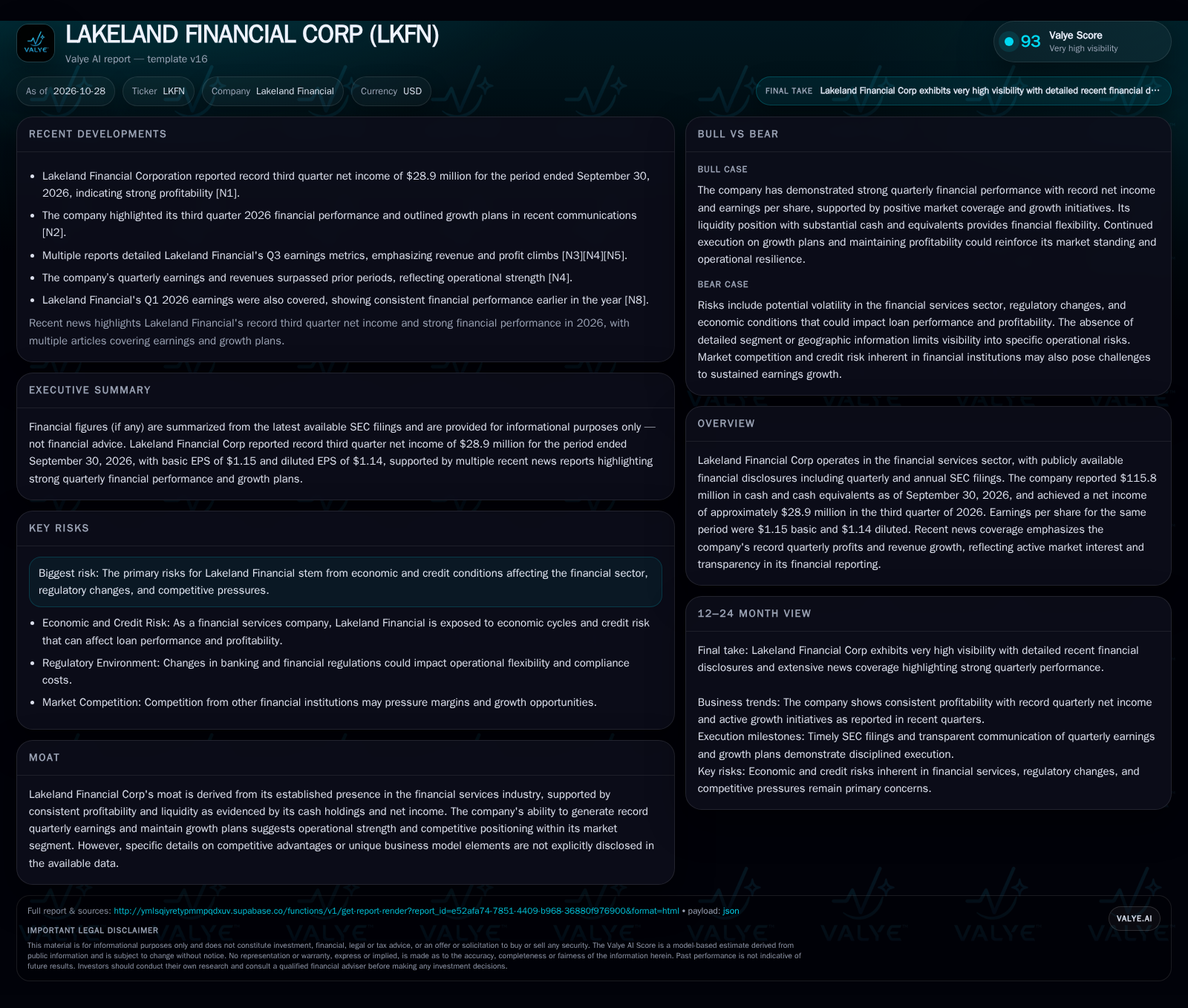
Lakeland Financial Corp delivered record third-quarter net income of $28.9 million and reported $115.8 million in cash and cash equivalents as of September 30, 2026. Earnings per share for Q3 reached $1.15 basic and $1.14 diluted, with revenues and profits exceeding prior periods. Recent news and filings emphasize growth plans and transparent reporting, but industry risks—such as credit quality, regulatory shifts, and competition—remain relevant considerations. The sustainability of this momentum will depend on loan performance, margin management, and the effectiveness of further growth initiatives. [S2] [N1] [N2] [N4] [N5]
Lakeland Financial Corp has captured investor attention with its record-setting third-quarter 2026 net income and a reported liquidity position. These results, coupled with visible growth plans and consistent earnings, position the company as a standout among regional financial institutions this reporting season. However, the durability of this outperformance will hinge on how Lakeland manages credit risk, navigates regulatory changes, and sustains its profitability against a backdrop of sector-wide uncertainty.
Record Net Income and Growing Revenues Define Q3 2026 Performance
Lakeland Financial Corp reported net income of $28.857 million for Q3 2026, its highest quarterly result to date, with basic earnings per share of $1.15 and diluted EPS of $1.14. Cash and cash equivalents were $115.768 million as of September 30, 2026. These results were accompanied by revenues and profits that exceeded prior periods, as noted in both SEC filings and news coverage. This operational momentum has increased visibility and market interest, setting a high bar for future quarters. [S2] [N1] [N4] [N5]
While the headline figures underscore strong financial execution, the underlying drivers—such as loan portfolio growth, margin expansion, or cost controls—are not fully detailed in the available disclosures. The next phase for the company will require translating these record results into sustained core profitability amid changing market conditions.
To further understand the sustainability of Lakeland Financial’s record quarter, it is important to analyze the composition of its revenue streams and the quality of its loan portfolio. If the revenue growth is primarily driven by transient factors such as temporary loan demand spikes or one-time fee income, the durability of profits may be limited. Conversely, a steady increase in core lending activities combined with fee income diversification would indicate a more resilient earnings base. Additionally, monitoring the evolution of non-interest income sources, such as wealth management or treasury services, could provide insight into the company’s ability to mitigate interest rate volatility and competitive pressures.
Profit Drivers and the Economics of Regional Banking
Lakeland Financial’s earnings model is anchored in traditional regional banking economics: net interest income from lending, fee-based services, and disciplined expense management. The record net income suggests effective deployment of interest-earning assets and possibly favorable funding costs during the quarter. Revenue outperformance may be attributed to higher loan volumes, improved asset yields, or a mix shift toward more profitable lending categories, though specific segment data is not disclosed.
Operating leverage can play a significant role in translating incremental revenue growth into outsized profit gains, especially if fixed costs are well-managed. However, as with most banks, profitability is sensitive to net interest margin compression, loan loss provisions, and non-interest expense trends. The company reported cash and liquidity metrics for the period; these figures do not by themselves establish operating runway, investment capacity, financial flexibility, or financing capacity.
The economics of Lakeland Financial’s business model are also influenced by its funding structure and capital allocation decisions. If the company maintains a low-cost deposit base, it can support net interest margin expansion even in a rising rate environment. However, reliance on more expensive wholesale funding or time deposits could compress margins if competitive pressures intensify. The cited source reports dividend-related activity; that disclosure alone does not establish dividend-policy continuity, management confidence, or a material constraint on capital flexibility. A balanced approach that preserves capital adequacy while funding growth initiatives is critical, especially given the cyclical nature of regional banking.
Balancing Local Market Strength Against Sector Competition
Regional banks like Lakeland Financial compete primarily on local relationships, service quality, and tailored product offerings. The company’s consistent profitability and transparent reporting suggest a well-established market position, possibly benefiting from long-standing customer relationships and a stable deposit base.
However, the competitive landscape remains intense. Larger national banks can leverage scale for lower funding costs and broader technology investments, while fintech entrants may pressure fee income and customer acquisition. In the absence of disclosed proprietary technology or unique product advantages, Lakeland’s moat likely rests on operational execution, local brand strength, and prudent risk management. Any erosion in these areas could expose the company to margin pressure or customer attrition.
Lakeland Financial’s competitive positioning may also be shaped by its adaptability to technological advancements and evolving customer preferences. While local relationships remain a key differentiator, the increasing digitization of banking services requires continuous investment in digital platforms and cybersecurity. If Lakeland can leverage technology to enhance customer experience and operational efficiency without significantly increasing costs, it could strengthen its competitive moat. Conversely, lagging in technology adoption or failing to meet changing consumer expectations could erode market share to more agile fintech competitors or larger banks with deeper technology budgets.
Sustained Loan Growth and Margin Expansion Could Drive Outperformance
If Lakeland Financial can continue to grow its loan book while maintaining or expanding net interest margins, the company could deliver further record earnings and potentially accelerate capital return to shareholders. This favorable scenario would likely be supported by a stable or improving credit environment, effective cost discipline, and successful execution of its articulated growth plans.
Confirmation would come from subsequent quarters showing ongoing increases in net income, stable or improving asset quality metrics (if disclosed), and evidence of loan/deposit growth outpacing peers. Additionally, positive commentary on loan pipeline, margin trends, or new market entries would strengthen the case for sustainable outperformance.
Profitability Plateaus as Growth Normalizes Amid Sector Volatility
The most plausible trajectory is that Lakeland Financial maintains solid profitability, but earnings growth moderates as competitive and macroeconomic headwinds reassert themselves. Net interest margins may stabilize or compress if funding costs rise, while loan demand could plateau in a less robust economic environment. Cost discipline and asset quality would become increasingly important in defending returns.
This scenario would be confirmed by future filings showing relatively stable, but not accelerating, net income and EPS, with little evidence of major deterioration in credit metrics or expense ratios. Any signs of shrinking margins or rising loan loss provisions would suggest the company is entering a more mature phase of the cycle.
Credit Deterioration or Margin Compression Could Reverse Momentum
A reversal in Lakeland’s profit momentum could occur if credit quality weakens materially—through rising non-performing loans or higher loan loss provisions—or if net interest margins compress significantly due to adverse rate movements or competitive deposit pricing. Regulatory changes or unexpected compliance costs could further pressure returns.
This scenario would be validated by future quarters showing declining net income, a spike in credit costs relative to historical norms, or commentary around loan delinquencies and risk management challenges. A contraction in the loan portfolio or sustained increase in non-interest expenses would also be warning signs.
What Will Determine Whether Lakeland’s Profit Surge Is Sustainable?
Quarterly net interest margin trends—if disclosed in future reports—would help clarify whether recent earnings are being driven by sustainable core spread improvement.
Loan growth rates versus regional peers would shed light on Lakeland’s ability to capture market share and expand its balance sheet without sacrificing credit quality.
Asset quality indicators, such as non-performing loan ratios or charge-offs (if disclosed), are critical for assessing downside risk and the durability of earnings.
Expense control, as evidenced by efficiency ratio trends, could reveal whether operating leverage can be maintained in a more challenging environment.
Deposit growth and composition (core vs. time deposits), if detailed, would signal competitive positioning in funding markets.
Management commentary on strategic growth initiatives and risk appetite would provide qualitative insight into future earnings potential.
Any regulatory or compliance developments disclosed in filings or earnings calls could signal incremental costs or operational constraints.
Market share data within Lakeland’s core geographies (if available) would test the thesis of local dominance and competitive resilience.
Disclaimer: This is research-only, informational analysis and not investment advice. It may include AI-generated interpretation and general industry context. Always verify important details using primary sources.

Comments