
Parsons Corp: Contract-Driven Growth, Legal Crosswinds, and the Realities of Government Services Economics
Parsons’ momentum in federal and infrastructure contracting underscores its established positioning, but legal disputes and the intricacies of government compliance remain persistent wildcards.
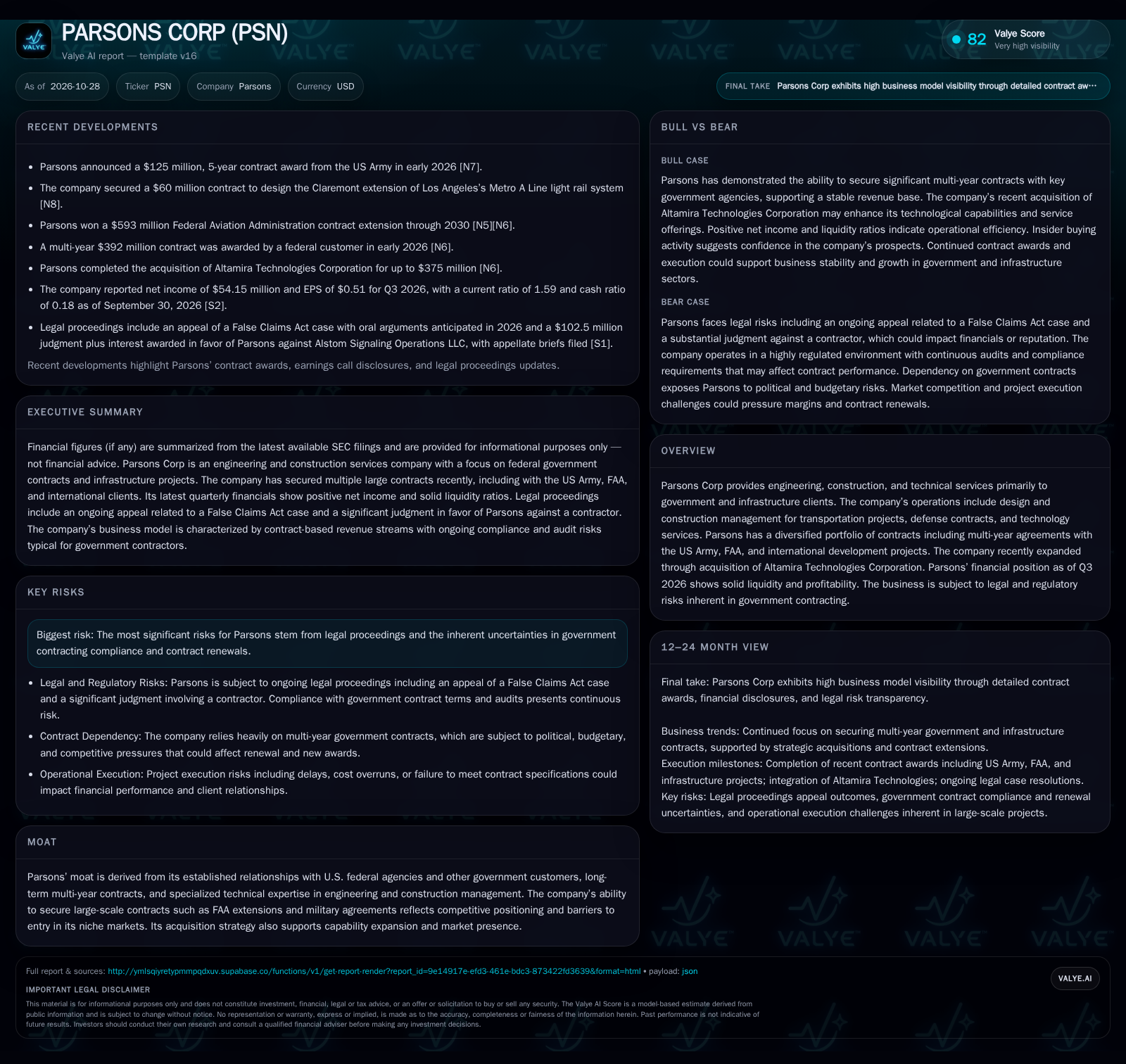
Parsons Corp’s recent $125 million Army contract and $60 million Los Angeles Metro project award highlight its ongoing success in securing large, multi-year government and infrastructure deals. The ability to convert awarded contracts into profitable, timely delivery while managing regulatory and legal headwinds will shape its economic trajectory over the next 12-24 months. [S2] [N7] [N8]
Parsons Corp stands at a familiar crossroads for government services and infrastructure contractors: recent major contract wins with the US Army and LA Metro reinforce its status as a trusted partner for public-sector megaprojects, while a solid Q3 profit and liquidity snapshot reflect near-term financial health. Yet, the company’s exposure to ongoing legal disputes and the structural uncertainties of government contracting—where compliance, audits, and political priorities can rapidly reshape the landscape—underscore that headline wins alone do not guarantee durable value creation. The next phase for Parsons will be defined by its ability to translate contract backlog into profitable execution while navigating regulatory, reputational, and competitive pressures.
Recent Contract Awards and Legal Developments Define Parsons’ 2026 Outlook
In early 2026, Parsons secured a $125 million, five-year contract with the US Army and a $60 million project to design the Claremont extension of Los Angeles’s Metro A Line light rail system, expanding its visibility in both defense and infrastructure verticals. For the quarter ending September 30, 2026, Parsons reported net income of $54.15 million and maintained $296.95 million in cash, with a current ratio of 1.59. These figures reflect an ability to convert contract wins into near-term profitability and operational liquidity. However, legal risk remains prominent: Parsons is both appealing a False Claims Act case and awaiting the resolution of a $102.5 million judgment (plus $34 million in interest) awarded in its favor against Alstom Signaling Operations LLC, with oral arguments anticipated later in 2026. The intersection of these contract wins and legal proceedings will likely shape investor and customer confidence in the near to medium term. [S2] [N7] [N8] [S1]
How Parsons’ Contract Model Drives Revenue and Operating Leverage
Parsons’ economics are defined by a portfolio of multi-year, fixed-price and cost-plus contracts, primarily with U.S. federal agencies and public-sector infrastructure clients. Revenue visibility is typically high during the life of active contracts, but margins are heavily influenced by project execution, change orders, and risk-sharing terms. Cost structure is largely variable, with labor, subcontractor, and material expenses tied to project scope, although fixed overhead from technical staff and corporate infrastructure creates some operating leverage as contract volume grows.
Cash conversion cycles can be lumpy, depending on billing milestones and government payment schedules. The company reported cash and liquidity metrics for the period; these figures do not by themselves establish operating runway, investment capacity, financial flexibility, or financing capacity. Capital intensity is moderate by engineering-services standards, as Parsons typically does not own major physical assets for most projects, but working capital swings can be significant during ramp-up or wind-down phases.
The company’s ability to generate positive net income in Q3 2026 demonstrates effective project execution and cost control, but margin volatility remains a structural feature of government contracting—especially when performance-based incentives or penalties are embedded in contract terms. Long-term value creation will depend on Parsons’ ability to consistently convert backlog into profitable revenue and to manage the risk of cost overruns or legal disputes.
Barriers to Entry, Customer Stickiness, and the Role of Compliance in Differentiation
Parsons competes in an industry where relationships, reputation, and compliance track records are as critical as technical expertise. Its multi-decade history with agencies like the US Army and FAA, combined with its ability to secure large, multi-year contracts, suggests a moderate barrier to entry for new competitors—especially those lacking the requisite security clearances, audit histories, or bonding capacity. However, the competitive set includes both large diversified engineering firms and specialized defense contractors, many of whom are aggressively pursuing similar contract opportunities.
Switching costs for government clients are typically moderate: while systems integration and project continuity create some stickiness, government procurement rules are designed to foster competition at contract renewal. Pricing pressure can intensify during rebids or when budget constraints force agencies to seek lower-cost alternatives. Compliance and audit performance are key differentiators; a strong record can lead to preferred-vendor status, while adverse findings or legal disputes can materially impair competitive position.
Technology substitution—such as increased use of automation, digital twin modeling, or AI-driven project management—may alter the competitive landscape over time, favoring firms that can invest in and deploy advanced solutions at scale. For Parsons, continued investment in technical innovation and compliance infrastructure may be necessary to maintain and extend its market position.
Sustained Contract Wins and Favorable Legal Outcomes Could Catalyze Margin Expansion
If Parsons successfully executes its recently awarded US Army and LA Metro contracts, delivering on time and within budget, it could demonstrate both operational discipline and client trust—potentially leading to follow-on awards or expanded scopes. A favorable resolution to the False Claims Act appeal and successful collection of the Alstom judgment (plus interest) would not only provide a one-time financial boost but also mitigate reputational risk, strengthening its standing with government clients.
Upside would be further supported if Parsons can leverage its existing customer relationships to win additional multi-year contracts, especially in high-growth infrastructure modernization or defense technology domains. Evidence supporting this scenario would include a rising backlog, improving project margins, renewed or expanded contract awards from existing clients, and positive legal developments (such as final recovery of the Alstom judgment).
Confirmation of improved operating leverage—reflected in higher incremental margins as contract volume increases—would further validate this trajectory. Conversely, delays in project execution, margin compression on new awards, or adverse legal outcomes would challenge the upside thesis.
Contract Backlog Converts to Steady Earnings, But Legal and Compliance Risks Remain
The most plausible medium-term scenario is that Parsons continues to convert its awarded contract backlog into stable, if sometimes lumpy, revenue and earnings. Project execution remains generally sound, with modest margin volatility reflecting the usual ebb and flow of government contracting. Legal proceedings, including the False Claims Act appeal and the Alstom judgment, resolve gradually without major surprises—either through settlements or protracted appeals, with limited near-term financial impact.
New contract wins offset natural churn and completion of existing projects, keeping total backlog roughly stable or growing modestly. Compliance and audit findings remain manageable, preserving Parsons’ eligibility for future awards but not conferring a decisive competitive edge.
Evidence confirming this scenario would include steady quarterly revenues, a stable or modestly growing backlog, ongoing contract announcements of similar size and scope to recent wins, and limited impact from legal or regulatory developments. Material negative audit findings, a sudden drop in contract wins, or a major legal loss would challenge the base case.
Legal Setbacks or Project Execution Failures Erode Competitive Position and Profitability
A material downside scenario would be triggered by an adverse outcome in the False Claims Act appeal—such as a significant financial penalty or reputational damage that impairs Parsons’ ability to secure or renew government contracts. Simultaneously, if the company fails to collect the Alstom judgment or faces new legal disputes, cash flow could be stressed and management distracted from core operations.
On the operational front, project execution failures—such as cost overruns, delays, or failure to meet contract specifications—could lead to margin erosion, loss of preferred-vendor status, or even contract terminations. In a sector where compliance lapses can lead to debarment or exclusion from future bidding, any significant audit or regulatory finding could have an outsized impact.
Evidence supporting this scenario would include legal losses with financial penalties, a sharp drop in new contract awards or renewals, negative audit findings, or a material deterioration in cash and liquidity metrics. Conversely, successful resolution of legal matters and continued contract momentum would challenge the downside thesis.
Operational and Legal Developments That Will Shape Parsons’ Value Creation
Resolution and financial impact of the False Claims Act appeal—any adverse ruling or penalty could affect both financials and future contract eligibility.
Timing and success of collecting the $102.5 million judgment (plus interest) from Alstom Signaling Operations LLC, and whether those funds contribute to one-time or recurring profitability.
Execution milestones and margin trends on the newly awarded US Army and LA Metro contracts—any delays, overruns, or customer disputes would test operational discipline.
Backlog growth or contraction—tracking net new awards, contract renewals, and project completions as signals of underlying demand and competitive position.
Audit and compliance findings—monitoring for any material negative outcomes that could affect eligibility or pricing on future government contracts.
Cash flow generation and working capital changes, especially as large projects ramp up or wind down; a useful metric would be free cash flow if disclosed.
Insider transaction activity was reported in the cited source; this activity does not by itself establish insider confidence.
Disclaimer: This is research-only, informational analysis and not investment advice. It may include AI-generated interpretation and general industry context. Always verify important details using primary sources.

Comments