
Urban Edge Properties: Redevelopment Leverage and Urban Retail Realities
Urban Edge Properties is doubling down on value-add retail real estate along the Washington, D.C. to Boston corridor, with a redevelopment pipeline targeting high unleveraged returns. The company’s focus on proactive management, disciplined capital deployment, and sustainability is central to its strategy—but execution risks, market concentration, and evolving retail dynamics shape its outlook.
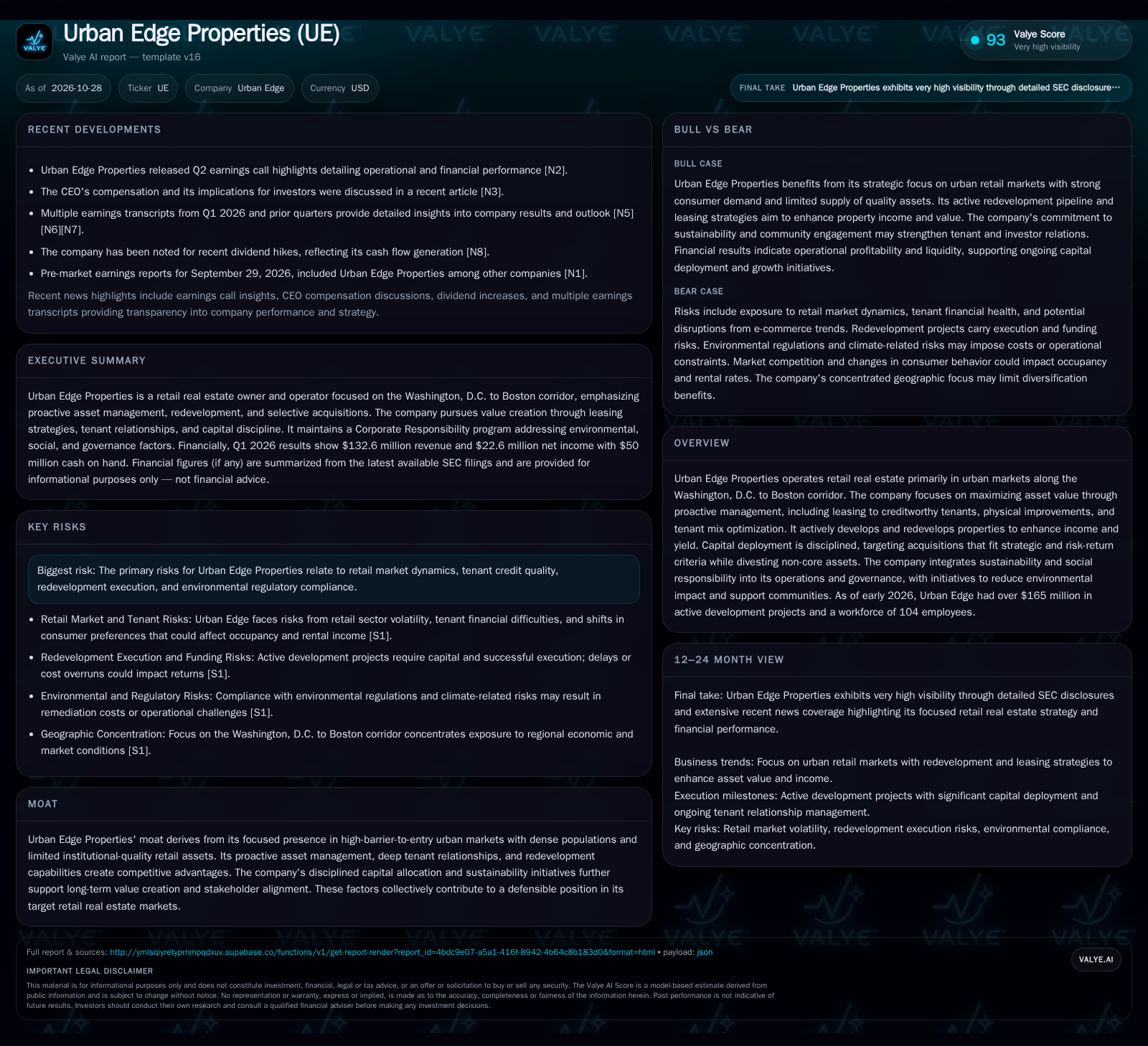
Urban Edge Properties operates in high-density urban retail corridors, driving value through redevelopment, targeted leasing, and capital discipline. With $165.5 million in active projects targeting a 14% yield and Q1 2026 revenue of $132.6 million, the company’s fortunes hinge on execution, tenant health, and the resilience of brick-and-mortar retail in a changing consumer landscape. Geographic concentration and redevelopment risks temper the upside.
Urban Edge Properties stands out in the competitive retail real estate landscape by targeting high-density urban markets where supply of institutional-quality assets is constrained. The company’s disciplined approach—emphasizing redevelopment, tenant relationships, and operational upgrades—aims to extract value from underperforming assets and capitalize on demographic trends in the Washington, D.C. to Boston corridor. However, with $165.5 million in active projects and a significant portion of capital yet to be deployed, execution risks, regional exposure, and the broader challenges facing brick-and-mortar retail remain key variables for investors and stakeholders.
Redevelopment Ambitions, Urban Concentration, and Financial Foundations
Urban Edge Properties is executing a strategy centered on maximizing the value of urban retail assets. As of December 31, 2025, the company had $165.5 million in active development and redevelopment projects, with $85.6 million of that capital still to be funded. These projects target an unleveraged yield of approximately 14%, reflecting a focus on value-added returns in supply-constrained markets [S1].
The company’s Q1 2026 financials reported revenue of $132.6 million, net income of $22.6 million, and a cash balance just under $50 million [S2]. This financial position provides the company with some flexibility but underscores the importance of prudent capital allocation as significant development commitments remain.
Urban Edge’s portfolio is heavily concentrated in the Washington, D.C. to Boston corridor, a region characterized by high population density and strong consumer demand, but also by exposure to localized economic cycles and policy risks [S1].
How Urban Edge Seeks to Extract Value from Urban Retail Assets
Urban Edge’s core economic model revolves around acquiring, redeveloping, and proactively managing retail properties in urban corridors where institutional-quality supply is limited and consumer demand is robust. The company’s revenue is primarily derived from leasing space to tenants, with a focus on optimizing rent levels through contractual increases, lease renewals, and recapturing below-market leases [S1].
Redevelopment and development projects are a key lever: by investing in upgrades, re-tenanting, and repositioning properties, Urban Edge aims to command higher rents and improve occupancy. The targeted 14% unleveraged yield on active projects, if achieved, would represent significant value creation above typical stabilized cap rates for high-quality retail assets. However, these returns depend on both cost discipline and successful tenanting post-redevelopment.
Operating leverage is a central dynamic: incremental revenue from new leases or rent escalations can flow through at high margins once fixed costs are covered, but the model is also vulnerable to vacancy spikes, tenant bankruptcies, or unanticipated capital expenditures. The company’s disciplined capital deployment—selling non-core assets and acquiring only those that meet risk-adjusted return criteria—reflects an awareness of these risks.
Funding needs are material, with $85.6 million in remaining development spend as of year-end 2025 [S1]. While the company generates internal cash flow and has access to unsecured credit lines and potential secured debt, the timing and cost of capital will affect both project returns and balance sheet flexibility.
Urban Edge’s Moat: Urban Focus, Asset Repositioning, and Tenant Relationships
Urban Edge’s main competitive advantage lies in its focused presence in densely populated, supply-constrained urban corridors. These markets create natural barriers to entry for new retail development due to high land costs, regulatory hurdles, and scarcity of large, contiguous sites. By targeting older, undermanaged assets, Urban Edge can unlock value through redevelopment and repositioning that many institutional investors or local owners may not pursue as aggressively [S1].
Proactive management—ranging from targeted leasing to physical improvements and tenant mix optimization—enables the company to tailor assets to evolving consumer and retailer needs. Deep relationships with both national and unique local tenants are a stated priority, potentially leading to higher retention and access to desirable tenants during lease-up periods.
However, counterforces are significant. Urban retail is increasingly challenged by e-commerce substitution, shifts in consumer behavior, and tenant consolidation. Competing landlords, including major REITs and private owners, also vie for creditworthy tenants and may escalate capital spending to keep assets competitive. The question is whether Urban Edge’s scale, local knowledge, and active management can consistently translate to above-market returns in this environment.
What It Would Take for Urban Edge to Outperform: Redevelopment Execution and Retail Resilience
The most favorable scenario for Urban Edge involves the company delivering on its redevelopment pipeline—achieving or exceeding the targeted 14% unleveraged yield on $165.5 million in projects—and successfully backfilling or upgrading tenant rosters with strong, omni-channel retailers. This would drive meaningful rent growth, increased occupancy, and asset value appreciation.
Such an outcome would likely require a stable or improving macro environment in the D.C. to Boston corridor, continued consumer demand for brick-and-mortar shopping, and limited new competitive supply. Tenant health—especially among anchor and junior anchor tenants—would need to remain robust, with minimal bankruptcies or store closures.
Concrete evidence confirming this scenario would include: rising same-property net operating income (NOI), successful lease-up of redeveloped assets at above-underwritten rents, minimal cost overruns or delays, and sustained high occupancy rates. Announcements of new anchor tenant signings or expansions, as well as positive re-leasing spreads, would further validate the thesis.
Urban Edge’s Most Probable Trajectory: Incremental Value Creation Amid Mixed Retail Backdrop
The most plausible outcome is a moderate pace of value creation anchored by steady leasing activity, selective redevelopment success, and some ongoing friction from retail sector headwinds. Urban Edge is likely to realize a portion of its targeted redevelopment yields, but some projects may face delays, cost inflation, or slower-than-expected lease-up as retail tenants remain cautious.
Rental income may grow through contractual increases and recapturing below-market leases, but overall top-line growth could be tempered by persistent e-commerce pressure and potential tenant churn. Asset sales and acquisitions will likely be opportunistic, with capital recycling focused on maintaining portfolio quality rather than rapid expansion.
Confirmation of this scenario would be evidenced by stable or gradually rising occupancy, modest NOI growth, and continued discipline in capital spending. If disclosed, details on leasing spreads, tenant retention rates, and realized yields on completed projects would help assess whether incremental value creation is occurring in line with management’s strategy.
How Execution Stumbles or Retail Weakness Could Derail Value
A more adverse scenario would see Urban Edge grappling with redevelopment cost overruns, project delays, or inability to attract quality tenants at anticipated rents. This could erode targeted returns, strain cash flows, and force the company to defer or scale back future projects. If tenant bankruptcies or store closures accelerate—particularly among anchors—occupancy could decline, lease-up periods could lengthen, and rent growth could stall or reverse.
The company’s geographic concentration amplifies risk: a localized economic downturn or policy shock in the D.C. to Boston corridor could disproportionately impact the entire portfolio. Environmental or regulatory costs could rise, especially if new compliance requirements emerge.
Signs confirming this scenario would include: downward revisions to redevelopment yield or timeline guidance, rising vacancy rates, negative leasing spreads, or an uptick in tenant-related receivables and write-offs. A notable drawdown in cash or increased reliance on external financing to fund ongoing projects would be a warning sign of stress.
What Will Prove Urban Edge’s Redevelopment and Urban Retail Thesis Right or Wrong?
Actual yields realized on redevelopment and development projects, compared to the 14% unleveraged target, if disclosed.
Same-property NOI growth rates, especially in relation to lease-up of redeveloped assets.
Changes in occupancy rates across the portfolio, with a focus on anchor tenant stability.
Leasing spreads on new and renewed leases versus expiring rents, if disclosed.
Tenant concentration and financial health, particularly exposure to vulnerable retailers.
Timing and proceeds of asset sales and acquisitions, as indicators of capital discipline and portfolio upgrading.
Material environmental compliance costs or regulatory developments affecting redevelopment economics.
Disclaimer: This is research-only, informational analysis and not investment advice. It may include AI-generated interpretation and general industry context. Always verify important details using primary sources.

Comments