
Garmin’s Next Chapter: Digital Fitness Expansion, Category Resilience, and the Economics of Multi-Market Navigation
Garmin’s recent digital fitness acquisitions and robust Q3 2026 financials highlight a company at the intersection of hardware innovation and recurring software revenue ambitions. With a diversified presence across fitness, outdoor, aviation, marine, and auto OEM markets, Garmin’s future will hinge on its ability to deepen platform engagement, manage integration risks, and defend its GPS-centric moat against intensifying competition and shifting technology trends.
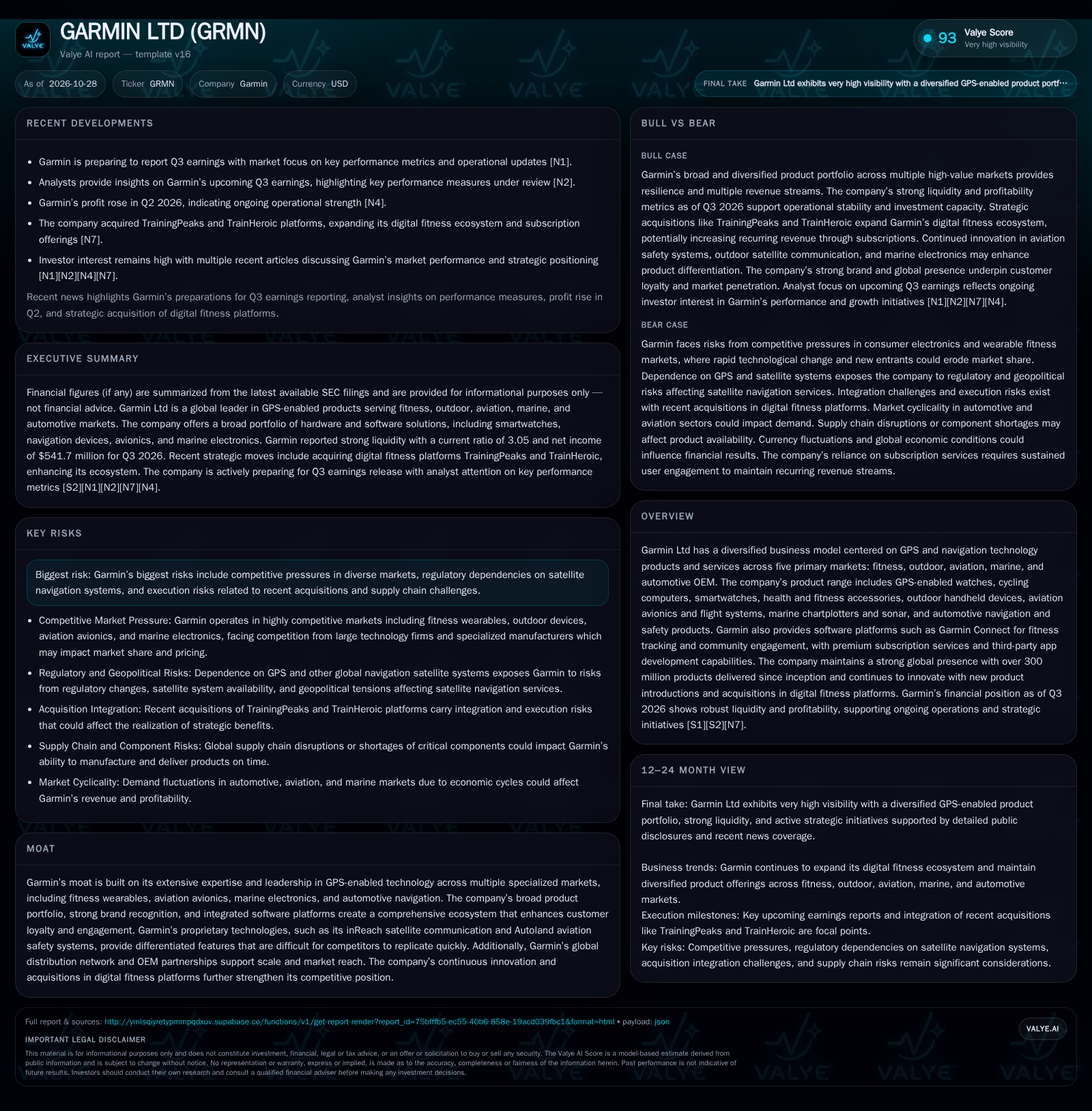
Garmin’s Q3 2026 results underscore strong profitability and liquidity, supporting a strategic push into digital fitness platforms. The company’s expansion into software subscriptions via TrainingPeaks and TrainHeroic aims to grow recurring revenue, but success will depend on user engagement and seamless integration. As competition in wearables intensifies and hardware margins face pressure, Garmin’s ability to leverage its specialized ecosystems and proprietary technologies will be decisive for long-term value creation. [S2] [N7]
Garmin’s Q3 2026 snapshot paints the picture of a company balancing the legacy of hardware leadership with a forward-looking strategy centered on digital platforms and recurring revenue. With over 300 million products delivered to date, Garmin’s next wave of value creation will depend on both expanding its ecosystem and defending its position against new entrants and substitutes. [S2] [N7]
Q3 2026: Financial Strength and Strategic Digital Moves Set the Stage
The company reported cash and liquidity metrics for the period; these figures do not by themselves establish operating runway, investment capacity, financial flexibility, or financing capacity. [S2] These resources underpin the company’s capacity to invest in innovation and absorb integration costs as it scales its digital fitness ambitions.
The acquisitions of TrainingPeaks and TrainHeroic in 2026 mark a strategic pivot toward expanding Garmin’s digital fitness ecosystem, layering subscription-based software and training analytics onto its established hardware base. [N7] This move signals an intent to capture higher-margin, recurring revenue and deepen user engagement beyond device sales.
Recent news and analyst coverage have focused on Garmin’s Q3 2026 performance, highlighting both the company’s ability to deliver consistent profits in Q2 and the expectation of further operational updates as digital initiatives ramp. [N1] [N2] [N4]
How Garmin’s Revenue Mix and Margin Structure Could Evolve
Garmin’s business economics have historically relied on the sale of GPS-enabled hardware—watches, marine electronics, avionics, and navigation devices—across five end markets. Hardware sales tend to be high-ticket and margin-accretive in specialized verticals like aviation and marine, but face more commoditization and pricing pressure in consumer fitness and auto navigation.
The company’s recent acquisition of TrainingPeaks and TrainHeroic introduces a potential shift toward a blended model that combines upfront device sales with recurring software and subscription revenue. If Garmin can successfully cross-sell digital services to its large installed base, average revenue per user (ARPU) could rise and revenue cyclicality could diminish. However, the effectiveness of this strategy depends on sustained user engagement, seamless integration between hardware and software, and the ability to defend premium pricing against rivals.
Operating leverage is a function of both production scale (spreading R&D and manufacturing costs over high volumes) and platform economics (growing subscription revenue with relatively low incremental cost). While the fitness and outdoor segments offer volume-driven leverage, the aviation and marine segments deliver higher margins due to regulatory complexity and mission-critical needs—though these markets are more cyclical and capital-intensive.
Defending the GPS Moat: Specialized Ecosystems Versus Broader Tech Competition
Garmin’s moat is built on decades of GPS, sensor, and navigation expertise, as well as deep integration with OEMs in aviation, marine, and auto. Its proprietary technologies—such as inReach satellite communication and aviation Autoland—create differentiation in specialized, regulation-heavy verticals that are less vulnerable to commoditization.
However, in the consumer fitness and wearable market, Garmin faces intense competition from large technology firms and focused device makers. Rivals can leverage broader ecosystems, aggressive hardware pricing, and deep software integration (e.g., health tracking, AI features) to win market share. The risk is that hardware differentiation erodes over time, pushing Garmin to compete more on software, services, and ecosystem stickiness.
The company’s recent digital fitness acquisitions could bolster its competitive position by offering unique training analytics and performance insights, but success will depend on rapid integration, user adoption, and the ability to fend off substitutes from both device competitors and pure-play digital fitness platforms.
Switching frictions are moderate to high in aviation and marine (due to regulatory, certification, and installed-base factors), but lower in consumer fitness, where brand, app ecosystem, and user experience drive retention.
If Garmin Turns Hardware Users into Digital Subscribers: What a Recurring Revenue Flywheel Would Look Like
A favorable scenario would see Garmin successfully integrating TrainingPeaks and TrainHeroic into its Connect ecosystem, driving a significant portion of its large installed base to adopt paid subscriptions for advanced analytics, training plans, and community features. This would increase ARPU and improve revenue predictability, as recurring software income cushions the volatility of hardware cycles.
Confirmation would come from disclosed growth in digital subscription revenue, rising paid user counts, and expanding gross margins in the fitness and outdoor segments. Evidence of higher user engagement, cross-platform integration, and minimal churn would further support the case.
In this scenario, Garmin could also leverage its deep data assets and device footprint to introduce new value-added services (e.g., personalized coaching, health insights), reinforcing its ecosystem and defending share against tech giants. If successful, this could push valuation multiples higher as the company transitions from a hardware-centric to a blended hardware-software model.
Most Plausible Trajectory: Resilient Multi-Market Operator with Selective Digital Gains
The most plausible outlook is that Garmin maintains its leadership in specialized verticals (aviation, marine, outdoor adventure) while incrementally expanding digital fitness revenue. Hardware remains the dominant revenue driver, but the mix gradually shifts as software subscriptions are adopted by a subset of fitness and outdoor users.
Integration of TrainingPeaks and TrainHeroic is moderately successful—Garmin leverages its installed base for cross-selling, but meaningful recurring revenue growth is gradual. Competitive intensity in wearables and navigation keeps hardware margins in check, but niche markets and proprietary features preserve above-average profitability.
This scenario would be confirmed by steady, if unspectacular, growth in digital revenue, continued profitability in core segments, and stable or rising user engagement metrics. Failure to accelerate digital adoption or evidence of integration friction would challenge the bull case but would not derail Garmin’s core business.
What Could Go Wrong: Integration Stumbles, Margin Compression, and Eroding Differentiation
A negative scenario emerges if Garmin struggles to integrate its digital fitness acquisitions, resulting in fragmented user experiences, limited cross-sell, and low conversion to paid subscriptions. In this case, the company’s efforts to grow recurring revenue stall, and the cost of acquisition and integration weighs on margins.
Simultaneously, if larger tech firms accelerate innovation in wearables, or if price competition intensifies, Garmin could face margin compression in its most visible segments. Loss of share in fitness or outdoor could be compounded by regulatory setbacks or cyclical downturns in aviation or marine.
Confirmation of this scenario would include stagnant or declining digital subscription revenue, rising churn, weak engagement metrics, and evidence of hardware margin erosion. Any material supply chain disruption or inability to innovate in core product lines would further exacerbate downside risks.
Testing the Garmin Thesis: Adoption, Integration, and Category Health
Growth in digital subscription revenue and paid user counts for TrainingPeaks, TrainHeroic, and Garmin Connect+ would help test the effectiveness of the digital ecosystem strategy.
User engagement metrics on Garmin’s platforms (daily active users, retention rates, cross-device usage) would demonstrate ecosystem stickiness if disclosed.
Gross margin trends in fitness and outdoor segments would indicate whether higher-margin software revenue is offsetting hardware pricing pressure.
Evidence of successful integration—such as unified app experiences, new cross-platform features, or bundled subscription/device offerings—would confirm execution on the digital pivot.
Market share data in fitness wearables and outdoor devices would reveal whether Garmin is defending its position against tech giants and new entrants.
Updates on the regulatory environment for GPS and satellite navigation would signal potential external risks to core product functionality.
Quarterly cash flow from operations and capital allocation disclosures would clarify Garmin’s ability to fund R&D, acquisitions, and shareholder returns.
Disclaimer: This is research-only, informational analysis and not investment advice. It may include AI-generated interpretation and general industry context. Always verify important details using primary sources.

Comments