
Replimune’s Next Phase: Commercialization Stakes and the Realities of Single-Asset Oncology Launch
With FDA accelerated approval of TUDRIQEV and a substantial reported cash balance, Replimune faces a critical inflection: the challenge is no longer scientific validation, but whether a rebuilt commercial organization can drive adoption, secure reimbursement, and deliver confirmatory trial success before regulatory or financial pressure intensifies.
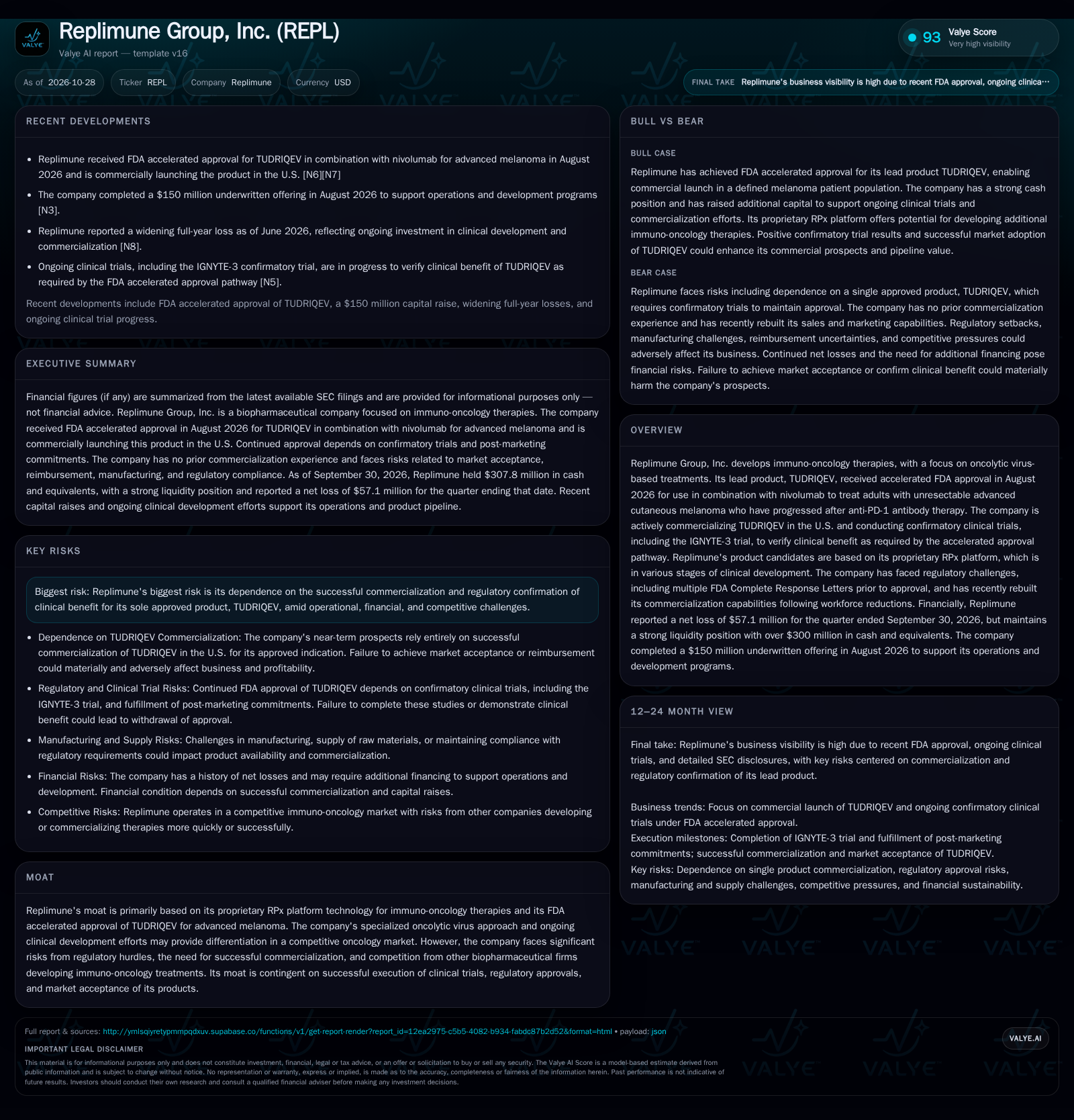
Replimune is transitioning from a clinical-stage to a commercial-stage biotech following FDA accelerated approval of TUDRIQEV for advanced melanoma. The company’s future now depends on execution: market uptake, successful confirmatory trials, and prudent use of its $307.8 million cash reserve. While its proprietary RPx platform offers longer-term optionality, near-term risk is concentrated in the outcome of TUDRIQEV’s launch and regulatory follow-through.
Replimune’s transition from a development-stage biotech to a commercial oncology company is underway after the FDA granted accelerated approval for TUDRIQEV in advanced melanoma. This pivotal event brings both opportunity and risk: the company must now prove it can translate scientific innovation into commercial traction and sustained regulatory success. With over $300 million in cash and a single approved product, the next 12–24 months will test whether Replimune can achieve market adoption, execute confirmatory trials, and build a foundation for its RPx platform—or whether operational and regulatory hurdles will undermine its ambitions.
FDA Nod, Commercial Debut, and a War Chest: Replimune’s New Starting Line
Replimune received FDA accelerated approval for TUDRIQEV in combination with nivolumab in August 2026 for adults with unresectable advanced cutaneous melanoma who have progressed after anti-PD-1 antibody therapy. This is the company’s first and only approved product and is being commercially launched in the U.S. [N6] [N7]
The approval is contingent: ongoing confirmatory trials, notably IGNYTE-3, must demonstrate clinical benefit for continued market access. Failure to do so could result in withdrawal of approval. [S2]
Financially, Replimune reported $307.8 million in cash and equivalents as of September 30, 2026, supported by a $150 million underwritten offering completed in August 2026. The company reported a net loss of $57.1 million for the quarter. [S2] [N3]
Operationally, Replimune has recently rebuilt its sales and marketing organization after prior workforce reductions, highlighting both a refreshed commercial push and a lack of prior launch experience. [S2]
Single-Asset Launch Economics: High Stakes, High Burn, and the Pricing Power Question
Replimune’s revenue prospects hinge entirely on TUDRIQEV’s adoption in a narrowly defined melanoma population, at least in the near term. Commercialization in oncology typically involves premium pricing, but volume is limited by the eligible patient pool and, critically, by the company’s ability to secure broad reimbursement. If TUDRIQEV is priced in line with other novel immuno-oncology agents, per-patient revenue could be significant—but payer resistance is plausible absent clear differentiation.
The company’s cost structure reflects high fixed R&D and SG&A expenses, which are unlikely to scale down quickly given ongoing clinical trials and the need to establish a commercial footprint from scratch. While manufacturing costs for oncolytic virus-based therapies can be substantial, gross margins may trend higher if scale is achieved, but initial margins are likely thin due to low volume and launch investments.
Operating leverage is theoretically strong if TUDRIQEV gains traction and if the company can layer in future indications or products from its RPx platform. However, until additional approvals materialize or TUDRIQEV’s commercial trajectory is proven, fixed costs and continued R&D investment will sustain losses. The recent capital raise provides a buffer, but ongoing burn rates suggest eventual need for further financing if revenues do not ramp rapidly. [S2] [N3]
Immuno-Oncology Battlefield: Differentiation, Substitution, and the Challenge of Entrenched Rivals
The competitive landscape for advanced melanoma is crowded, with established checkpoint inhibitors, targeted therapies, and newer immuno-oncology agents forming the standard of care. TUDRIQEV’s positioning as a combination therapy for patients progressing after anti-PD-1 treatment may address an unmet need, but the bar for differentiation is high.
Potential advantages for Replimune include its proprietary oncolytic virus platform, which may offer a novel mechanism of action. However, the commercial impact depends on demonstrating real-world benefit over existing and emerging alternatives. Larger biopharma companies with entrenched sales forces and payer relationships represent formidable competition, and new entrants—including cell therapies and next-generation immunotherapies—could further erode share.
Switching costs in oncology are typically low for prescribers if clinical benefit is not clearly superior, making initial uptake and sustained adoption highly dependent on compelling trial data and real-world outcomes. Reimbursement risk is elevated if payers do not perceive sufficient incremental benefit or cost-effectiveness relative to established regimens.
What Could Go Right: Clinical Validation Unlocks Adoption and Pipeline Leverage
A favorable scenario would see the IGNYTE-3 confirmatory trial deliver robust, unambiguous clinical benefit, solidifying TUDRIQEV’s full approval and positioning it as a new standard for post-anti-PD-1 advanced melanoma. Strong data would facilitate broad payer coverage, drive oncologist adoption, and potentially justify premium pricing.
If commercial execution is effective—despite Replimune’s lack of prior experience—rapid uptake could transform the company’s financial profile, enabling positive operating leverage. Success with TUDRIQEV would also validate the RPx platform, increasing the probability of additional pipeline approvals and creating optionality for expansion into new indications or combinations.
Evidence for this scenario would include: accelerated script growth, broad national and commercial payer coverage, positive trial readouts, and early signals of pipeline progress. Conversely, slow uptake or ambiguous confirmatory data would challenge this thesis.
If Execution Proves Mixed: Measured Uptake, Ongoing Losses, and the Wait for Data
The most plausible outlook is that TUDRIQEV achieves moderate adoption within its approved indication, constrained by payer scrutiny and competition but supported by oncologist interest in new options for a difficult-to-treat population. Revenues begin to offset R&D and SG&A expenses, but the company remains unprofitable as it invests in commercialization and fulfills post-marketing trial obligations.
Progress on confirmatory trials is steady but not transformative in the near term.
This scenario would be confirmed by gradual revenue ramp, stable or slightly declining cash burn, and incremental trial updates without major regulatory or commercial surprises. Negative inflection points would include slower-than-expected adoption or delays in trial timelines.
Where Things Could Break: Regulatory Setbacks, Commercial Flop, or Capital Squeeze
The adverse chain begins if the IGNYTE-3 trial fails to demonstrate clinical benefit, triggering FDA withdrawal of TUDRIQEV’s approval. Alternatively, even with retained approval, lackluster real-world efficacy, payer pushback, or stronger-than-expected competition could result in poor market uptake and negligible revenue.
With a high fixed cost base and ongoing R&D outlays, cash burn would accelerate, forcing Replimune to seek additional capital on unfavorable terms or to cut programs. The company’s lack of commercial track record could exacerbate operational missteps, further undermining confidence.
Evidence for this scenario would include: negative or inconclusive trial results, regulatory warning letters, missed sales targets, persistent net losses with shrinking cash reserves, or an announced restructuring or pipeline halt.
Milestones That Will Determine If Replimune’s Launch Can Defy Single-Asset Oncology Gravity
Quarterly revenue from TUDRIQEV: Early sales growth and trajectory vs. expectations will provide the clearest test of commercial execution.
Updates on IGNYTE-3 and other confirmatory trials: Timelines, interim data, and final results are critical for regulatory permanence and payer confidence.
Gross-to-net sales and payer coverage metrics (if disclosed): The breadth of reimbursement and discounting dynamics will indicate pricing power and market access.
Prescription volumes and physician adoption rates: Tracking new prescriber growth and repeat usage would illuminate clinical acceptance.
Cash burn rate and operating expense trends: Monitoring how quickly the company deploys its reported cash balance and whether costs scale with revenue will inform sustainability.
Manufacturing and supply chain reliability: Any disruptions or compliance issues could impact product availability and credibility.
Announcements of additional RPx platform candidates entering the clinic or advancing to later-stage trials: This would test the durability and breadth of the company’s innovation engine.
Disclaimer: This is research-only, informational analysis and not investment advice. It may include AI-generated interpretation and general industry context. Always verify important details using primary sources.

Comments