
NiSource’s Decarbonization Push: Regulatory Navigation, Capital Allocation, and the Realities of Utility Economics
NiSource is pushing a multi-decade transition from legacy coal and methane-heavy gas distribution to cleaner, modernized energy infrastructure, with a 2040 Net Zero goal.
NiSource is pushing a multi-decade transition from legacy coal and methane-heavy gas distribution to cleaner, modernized energy infrastructure, with a 2040 Net Zero goal. The next phase hinges on regulatory clarity, cost containment, and evidence that new commercial partnerships can scale.
NiSource is at a pivotal juncture as it attempts to engineer a full-scale transition from coal-fired electricity and legacy gas infrastructure to a lower-emissions, future-oriented utility model. Its Net Zero 2040 commitment, underpinned by significant emissions cuts and infrastructure modernization, has attracted marquee customers like Microsoft and aligns with regulatory and societal trends. Yet, the company stands exposed to volatile policy shifts, cost overruns, and liquidity pressures, making the pathway from strategic ambition to durable financial returns anything but straightforward.
Recent Developments: Net Zero Progress, Microsoft Partnership, and Financial Pressures
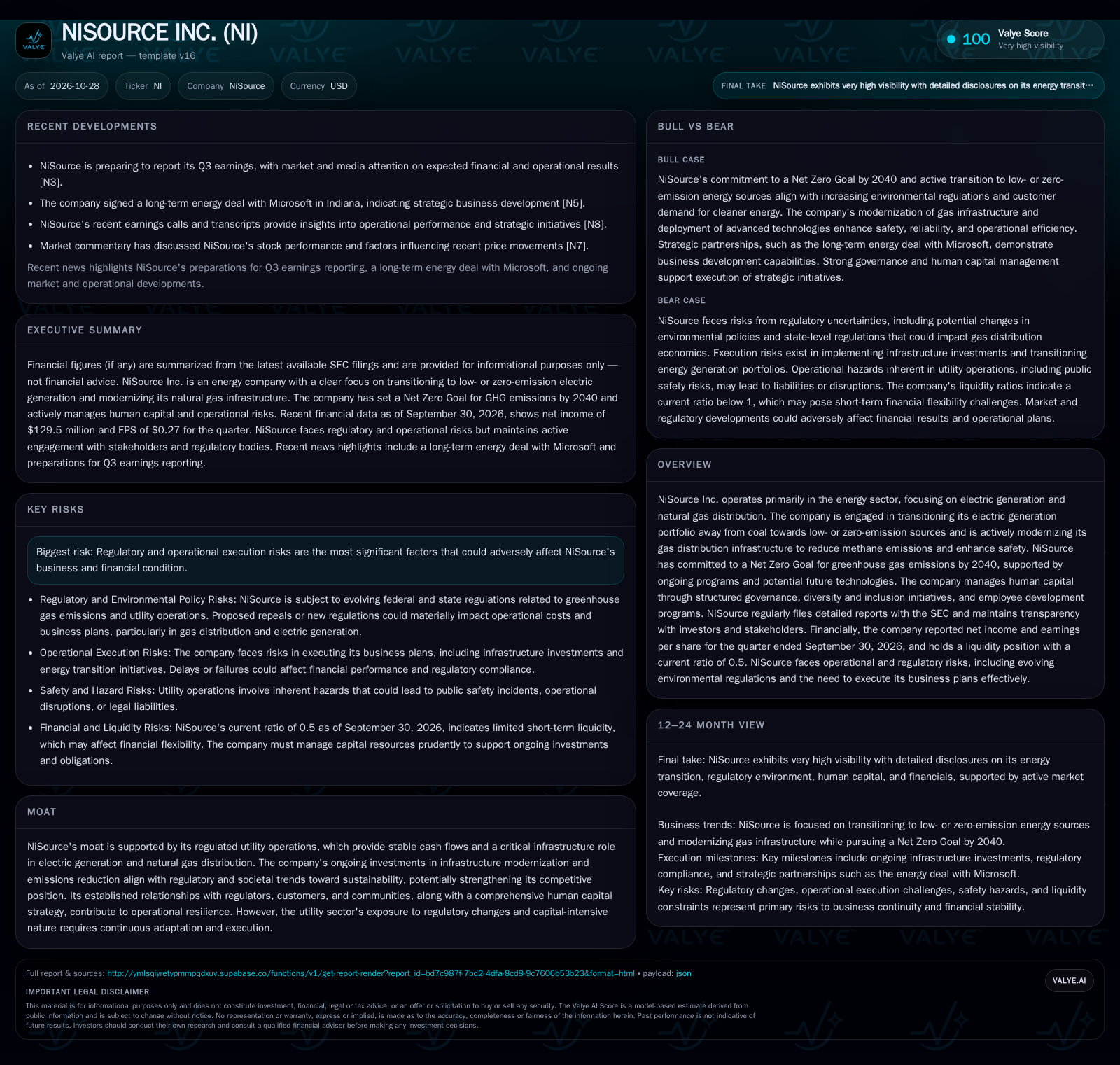
NiSource’s business model is currently defined by its Net Zero 2040 goal, anchored by a 72% reduction in Scope 1 emissions from 2005 levels as of the end of 2024 [S2]. The company has recently signed a long-term energy deal with Microsoft in Indiana, signaling its ability to secure blue-chip customers for future-oriented energy supply [N5]. Financially, NiSource reported net income of $129.5 million and EPS of $0.27 for the quarter ended September 30, 2026, but its liquidity position is notably tight: cash and equivalents of $57.5 million, a current ratio of 0.5, and a cash ratio of 0.01 as of quarter-end [S2]. These facts frame a company simultaneously executing on ambitious decarbonization and growth initiatives while navigating real financial constraints and sector-wide uncertainty.
How NiSource’s Transition Model Could Create—and Constrain—Value
At its core, NiSource operates as a regulated utility, generating revenue through approved rates on electric and natural gas distribution. The economics of such businesses are shaped by the capital-intensity of infrastructure investment, the predictability (or volatility) of regulatory rate cases, and the ability to recover costs plus a return on equity.
The transition to low- and zero-emission sources demands substantial upfront capital for coal plant retirements, new generation assets (renewables, storage), and gas system modernization (pipe replacement, leak detection, technology pilots). While regulatory frameworks typically allow for cost recovery, the speed and completeness of recovery are subject to regulatory approval and political climate. This introduces lag risk: NiSource may be forced to outlay capital before it is certain of full rate recovery.
Fixed costs dominate the utility cost base—labor, maintenance, depreciation—while variable costs (fuel, purchased power) may diminish as renewables scale. This structure creates operating leverage: incremental revenue from new customers or load growth could disproportionately benefit margins if fixed costs are already covered. Conversely, cost overruns, delays, or disallowed investments can quickly erode profitability.
The company reported cash and liquidity metrics for the period; these figures do not by themselves establish operating runway, investment capacity, financial flexibility, or financing capacity. If external financing becomes more expensive or less available, NiSource may need to defer projects or adjust payout policies, directly impacting its ability to deliver on decarbonization promises.
Regulated Moats, Substitution Threats, and the Role of Partnerships
NiSource’s traditional moat is regulatory: exclusive service territories for gas and electric distribution, with customer switching friction driven by infrastructure lock-in and the essential nature of service. Rate-regulated returns provide revenue visibility, but regulatory risk is rising as states and the federal government debate the future of gas infrastructure and set more aggressive emissions targets.
The competitive landscape is evolving. Electrification trends could threaten long-term gas volume growth, particularly if heat pumps and distributed renewables erode residential gas demand. At the same time, new entrants—renewable developers, storage operators, and tech firms—are targeting large commercial and industrial customers with direct supply or behind-the-meter solutions.
NiSource’s partnership with Microsoft is illustrative: large-scale, long-term deals with corporates seeking decarbonized supply could become a differentiator if the company can deliver reliable, clean energy at competitive cost. However, the risk remains that regulatory and technology shifts could empower customers to bypass traditional utility models, especially if distributed energy resources become more cost-effective.
If Regulatory Certainty and Execution Align, Decarbonization Could Drive Premium Multiples
In the favorable scenario, NiSource successfully executes its coal retirements and gas modernization without major delays or cost overruns. Regulatory bodies approve timely and full cost recovery, allowing the company to maintain or expand allowed returns and fund future growth through ongoing capital access.
Strategic partnerships—like the Microsoft deal—demonstrate a scalable model for attracting commercial customers seeking clean energy, supporting revenue growth and enhancing the company’s ESG profile. If NiSource can leverage new technologies (hydrogen blending, renewable natural gas, long-duration storage) ahead of peers, it could lock in a first-mover advantage as the utility sector decarbonizes.
Evidence for this scenario would include: regulatory approval of major rate cases and cost recovery for new investments, additional large-scale commercial partnerships, declining emissions and safety incidents, and stable or improving credit metrics despite heavy capital spending. Confirmation would also come from sustained EPS growth and the ability to raise capital at reasonable rates.
Navigating the Messy Middle: Incremental Progress, Episodic Headwinds
The most plausible path is one of steady but uneven progress: NiSource continues to phase out coal, modernize its gas network, and pilot new technologies, but faces periodic regulatory delays, cost inflation, and project execution risks. Some investments may face partial disallowance or delayed recovery, creating periodic earnings volatility.
Customer load growth is modest, with electrification offsetting some gas attrition but not delivering breakout expansion. Strategic partnerships, like the Microsoft deal, are additive but do not transform the revenue base. The company maintains access to capital, but rising rates and tighter liquidity require careful prioritization of projects and disciplined cost management.
Confirmation would come from continued (but lumpy) emissions reductions, periodic rate case settlements, and manageable leverage ratios. Falsification would be persistent regulatory setbacks, sustained negative free cash flow without clear paths to recovery, or a loss of investment-grade credit ratings.
When Policy Shifts, Project Delays, and Capital Constraints Collide
In the adverse scenario, regulatory or legislative changes—such as repeal of supportive EPA standards or new state-level restrictions—disrupt the economics of gas distribution or delay coal retirement cost recovery. Cost overruns or technical setbacks in infrastructure projects erode allowed returns, while lower-than-expected customer demand or distributed energy adoption reduces revenue growth.
If access to external capital becomes constrained, the company may have to negotiate asset sales or seek regulatory relief under duress.
This scenario would be confirmed by regulatory disallowance of major investments, persistent negative free cash flow, a spike in safety incidents or public opposition, and deteriorating credit metrics. Early warning signs include adverse rate case outcomes, failed debt offerings, or public pushback on infrastructure projects.
Milestones That Will Reveal If NiSource’s Transition Can Deliver Sustainable Returns
Approval and timing of major rate cases tied to coal retirement and gas modernization projects: tracking whether regulators allow full, timely cost recovery.
Incremental emissions-reduction progress: reporting on Scope 1 and 2 reductions and the pace toward the 2040 Net Zero target.
Execution metrics for infrastructure projects: on-time, on-budget delivery of coal retirements, pipe replacements, and modernization efforts.
Capital market access: terms and frequency of new debt/equity issuance, credit rating agency commentary, and cost of capital.
Growth in large-scale commercial partnerships: number, size, and duration of additional contracts like the Microsoft deal, if disclosed.
Customer load and attrition trends: net changes in gas and electricity customers, and any evidence of load loss to electrification or distributed resources, if disclosed.
Disclaimer: This is research-only, informational analysis and not investment advice. It may include AI-generated interpretation and general industry context. Always verify important details using primary sources.

Comments