
Fortive After the Ralliant Spin: Segment Performance, Margin Drivers, and the Next Phase of Operational Discipline
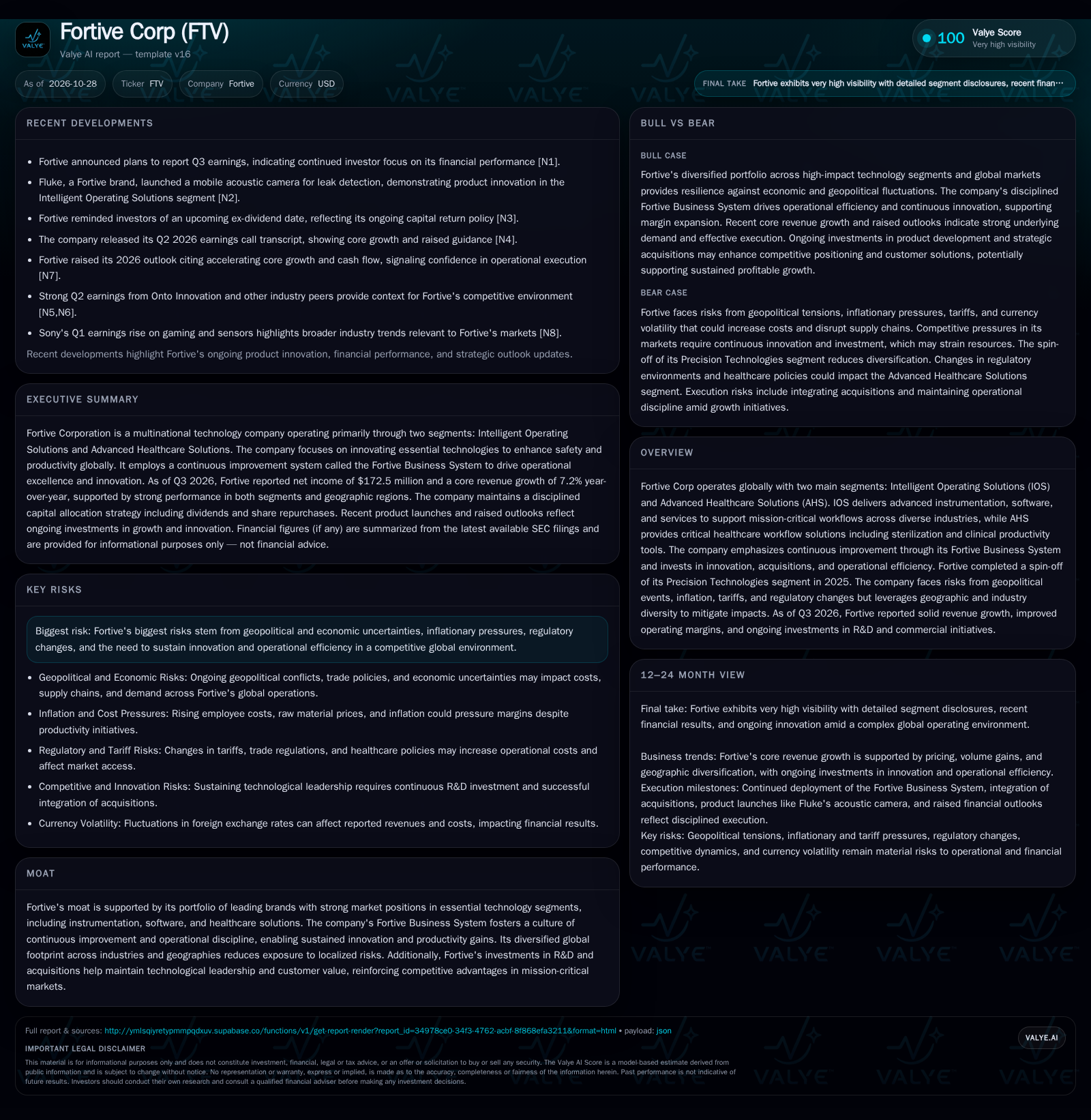
With the Precision Technologies spin-off complete, Fortive’s Q3 2026 results highlight strong core growth in Intelligent Operating Solutions and margin recovery across the portfolio. The company’s continuous improvement culture, disciplined capital allocation, and global reach anchor its resilience—but inflation, competitive intensity, and healthcare mix shifts pose strategic tests as Fortive pursues the next leg of profitable growth.
Fortive’s Q3 2026 saw 7.2% core revenue growth and a significant margin rebound, especially in its Intelligent Operating Solutions segment. The company’s operational playbook and geographic diversity support its ability to adapt, but inflation, mix drag in healthcare, and ongoing integration demands mean sustained execution is critical to maintain momentum and protect margins. Watch for evidence of continued pricing power, customer retention, and successful innovation launches.
Fortive’s latest quarter provides a revealing snapshot of a company in active transition: the Precision Technologies spin-off is in the rearview, leaving a sharper focus on industrial workflows and healthcare solutions. Core revenue and margin gains in Q3 2026 suggest that the Fortive Business System’s operational rigor is paying dividends, particularly in the IOS segment. However, margin compression in healthcare, inflationary headwinds, and a more concentrated business mix introduce new execution challenges. How Fortive manages these crosscurrents will determine if it can maintain its track record of disciplined growth and shareholder returns.
Recent Margin Recovery and Segment Divergence Define Fortive’s Operating Landscape
Fortive reported Q3 2026 core revenue growth of 7.2%, with the IOS segment outpacing at 9.1% core growth and the AHS segment at 3.1% [S2]. Operating profit margin rebounded sharply to 21.3% from 15.5% in the prior year, reflecting contributions from higher volume, pricing initiatives, productivity improvements, and one-time tariff refunds [S2]. Notably, the IOS segment’s operating margin expanded to 29.1%, while AHS margin contracted to 11.2% due to mix, labor, and inflationary pressures [S2]. The spin-off of Precision Technologies (now Ralliant Corp) in June 2025 is now fully reflected in Fortive’s segment disclosures, concentrating the company’s exposure on IOS and AHS [S1]. Fortive’s raised 2026 outlook, citing accelerating core growth and cash flow, signals management’s confidence in its post-spin operating model [N7].
Volume, Pricing, and Productivity: The Levers Behind Fortive’s Margin Structure
Fortive’s business model is characterized by high gross margins (64.2% in Q3 2026 [S2]) due to its mix of advanced instrumentation, workflow software, and service solutions. The IOS segment in particular benefits from professional instrumentation and software offerings, which tend to carry higher contribution margins and recurring service opportunities. The company’s operating leverage is visible in the margin expansion reported this quarter, where incremental sales—particularly in IOS—translated into disproportionate profit growth, aided by pricing actions and productivity gains.
Fixed costs are managed through the Fortive Business System, which systematically targets waste and drives process improvement. However, the AHS segment’s margin compression illustrates how inflation, wage growth, and unfavorable product mix can erode the benefits of scale, especially in healthcare where reimbursement and capital spending cycles are less predictable. The cited source reports dividend-related activity; that disclosure alone does not establish dividend-policy continuity, management confidence, or a material constraint on capital flexibility. [S2]
Defending Share in Mission-Critical Markets Amid Intensifying Innovation Cycles
Fortive’s competitive moat is anchored in its portfolio of leading brands (e.g., FLUKE, SERVICECHANNEL, INDUSTRIAL SCIENTIFIC, ADVANCED STERILIZATION PRODUCTS) and its reputation for reliability in mission-critical applications [S1]. In the IOS segment, differentiation comes from the integration of advanced instrumentation with workflow software, supporting customer stickiness and potential for recurring service revenue. However, the company faces ongoing pressure from both established peers and new entrants leveraging digitization and IoT, particularly in industrial automation and healthcare technology.
The recent launch of Fluke’s mobile acoustic camera for leak detection demonstrates Fortive’s commitment to innovation, but sustaining this pace is resource-intensive. The spin-off of Precision Technologies increases strategic clarity but also heightens dependence on fewer verticals, making share defense and customer retention in IOS and AHS even more critical. In healthcare, competitive intensity is high, and product cycles are shaped by regulatory standards, reimbursement dynamics, and hospital budget constraints. Fortive’s global reach (44% of sales ex-US in 2025) provides some insulation from local shocks, but also introduces currency and geopolitical risk [S1] [S2].
Margin Expansion Sustained by Innovation, Pricing Power, and Cross-Segment Synergies
A favorable scenario would see Fortive leveraging its operational discipline and global sales reach to continue outpacing end-market growth, particularly in IOS. If recent pricing actions hold and are supplemented by new product launches with demonstrable ROI for customers—such as advanced leak detection, predictive maintenance, or healthcare workflow automation—Fortive could sustain high-single-digit core growth and further expand operating margins.
Confirmation would come from continued gross and operating margin improvement, accelerating R&D productivity (evidenced by innovation-driven revenue mix), and customer retention rates that outpace sector averages (if disclosed). Announcements of successful cross-selling between IOS and AHS or evidence of platform stickiness (e.g., multi-year software agreements, if reported) would further support the scenario. Upside could be amplified by favorable macro trends such as increased infrastructure investment, industrial automation, or healthcare digitization driving incremental demand.
Execution Delivers Steady Growth, but Mix and Cost Pressures Temper Margin Gains
The most plausible outcome is that Fortive maintains mid-single-digit core growth, with IOS continuing to outperform AHS. Operating margins remain healthy but do not expand significantly from current levels as pricing power is partially offset by wage inflation, supply chain volatility, and ongoing investment needs. The Fortive Business System ensures productivity gains, but the healthcare segment’s margin recovery is gradual, constrained by reimbursement and mix dynamics.
Supporting evidence would include sustained core revenue growth in the 5-7% range, stable or modestly improving margin metrics, and continued investment in R&D and salesforce expansion (as observed in recent quarters). If disclosed, steady customer retention and renewal rates, as well as balanced geographic performance, would reinforce the scenario. Any material divergence in segment profitability or a significant uptick in restructuring or integration costs would challenge the base case.
Margin Compression and Integration Drag Erode Post-Spin Momentum
A less favorable scenario would see inflation, wage growth, and adverse product mix in AHS outpacing Fortive’s ability to offset these pressures with pricing and productivity. If competitive intensity in IOS accelerates—driven by digital disruptors or aggressive pricing from global peers—volume growth could slow and margin expansion stall. Integration risks from acquisitions or operational missteps could further compress profitability, particularly if growth investments fail to deliver expected returns.
Downside confirmation would include declining segment margins, R&D expense outpacing revenue growth without corresponding innovation wins, or rising SG&A as a percentage of sales. A deterioration in free cash flow due to elevated debt service or capital allocation missteps (e.g., overpaying for acquisitions) would compound the challenge. External shocks such as tariff escalation, regulatory changes, or significant currency swings could amplify these pressures.
Testing Fortive’s Strategy: Evidence Required for Margin, Growth, and Resilience Claims
Monitor quarterly core revenue growth rates by segment and region to assess whether IOS continues to drive above-market expansion and if AHS can regain momentum.
Track gross and operating margin trends, with particular focus on the sustainability of pricing and productivity gains versus cost and mix headwinds.
Watch for disclosures on recurring revenue mix, software/service contract renewals, and customer retention rates—especially in IOS—to test the durability of Fortive’s competitive moat.
Follow R&D investment as a percentage of revenue and the cadence of new product launches (e.g., post-Fluke acoustic camera), evaluating whether innovation is translating into incremental revenue and margin.
Assess SG&A and restructuring costs as a share of sales for signs of operational discipline or emerging overhead drag.
Monitor net interest expense and debt levels for potential pressure on free cash flow and capital allocation flexibility.
Track management commentary and evidence of successful acquisition integration, as well as any material changes in capital return policies (buybacks, dividends).
Disclaimer: This is research-only, informational analysis and not investment advice. It may include AI-generated interpretation and general industry context. Always verify important details using primary sources.

Comments