
Frontier Airlines: Ultra Low-Cost Model Confronts Profit
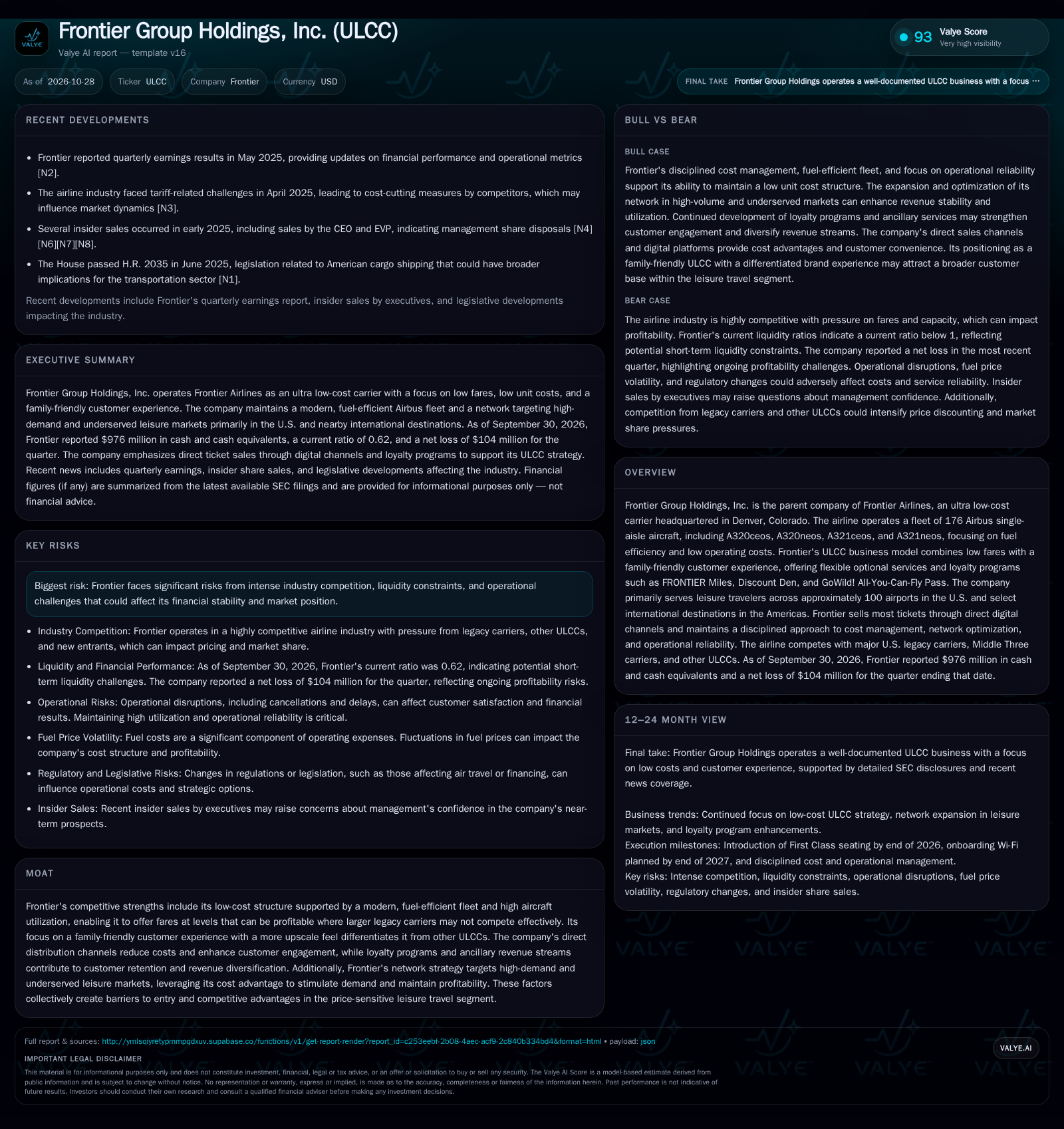
Frontier Airlines remains committed to its ultra low-cost carrier model, featuring a fuel-efficient Airbus fleet and direct-to-consumer sales. Despite network discipline and ancillary revenue initiatives, the carrier reported a net loss and sub-1 current ratio, underscoring the tension between cost leadership and the realities of sector volatility.
Frontier Airlines’ ultra low-cost strategy leverages high aircraft utilization and a modern fleet to target price-sensitive leisure travelers. The carrier’s ability to stimulate demand with low fares may hinge on operational discipline, growth in ancillary revenues, and resilience to industry pressures from both legacy and peer ULCC competitors. [S2]
Frontier Airlines, the flagship subsidiary of Frontier Group Holdings, continues to double down on its ultra low-cost carrier (ULCC) model by operating a fuel-efficient Airbus fleet and focusing on cost discipline, direct sales, and ancillary revenue streams. Despite these efforts, the company reported a net loss of $104 million and a current ratio of just 0.62 as of September 30, 2026, highlighting the operational and financial headwinds facing the business. As competition intensifies across both legacy and peer ULCC carriers, Frontier’s ability to translate its low-cost structure into sustainable profitability will be tested by sector volatility, cost inflation, and evolving consumer expectations. [S1] [S2]
The company reported cash and liquidity metrics for the period; these figures do not by themselves establish operating runway, investment capacity, financial flexibility, or financ
Frontier Airlines reported a net loss of $104 million for the quarter ended September 30, 2026, with basic and diluted EPS of -$0.45. Cash and cash equivalents stood at $976 million, but the company’s current ratio of 0.62 and cash ratio of 0.45 suggest near-term liabilities exceed current assets, underscoring persistent liquidity pressures. The 176-aircraft fleet remains concentrated in fuel-efficient Airbus single-aisle models, signaling continued commitment to cost leadership. These facts are central to the company’s current thesis: while the business model is structurally low-cost, the balance sheet and P&L reflect the acute pressures of the post-pandemic airline environment, marked by fare competition, demand volatility, and input cost unpredictability. [S2]
Understanding the Economics Behind Ultra Low-Cost Air Travel
Frontier’s business model relies on high aircraft utilization, dense seating configurations, and direct digital sales to minimize unit costs and maximize ancillary revenue opportunities. The core economic engine is volume-driven: base fares are kept low to stimulate demand, particularly among leisure travelers, while profitability is supported by a la carte service fees, memberships (Discount Den), and loyalty programs (FRONTIER Miles, GoWild!). Fixed costs are significant—aircraft leases, maintenance, and airport fees—but by maintaining a young, fuel-efficient fleet, Frontier seeks to mitigate variable cost exposure, especially to fuel price swings.
Operating leverage is a double-edged sword: high utilization rates can drive strong margins in periods of stable demand, but downturns or operational disruptions rapidly erode profitability. Capital needs remain high in an asset-intensive sector, with ongoing investment required to maintain fleet competitiveness and adapt to regulatory or consumer shifts. If ancillary revenues and digital channel penetration continue to grow, incremental margin expansion is plausible—but the model’s inherent sensitivity to demand shocks and exogenous costs remains a structural risk.
A critical factor in Frontier’s cost structure is the balance between fixed and variable costs, which shapes its operational flexibility. Fixed costs such as aircraft leases and maintenance contracts create a high breakeven threshold, necessitating consistently high load factors to achieve profitability. However, variable costs, particularly fuel and labor, can fluctuate significantly. Frontier’s investment in a young, fuel-efficient Airbus fleet helps mitigate fuel cost volatility but does not fully insulate the company from sudden spikes in input prices or labor market pressures. This dynamic implies that while the ULCC model can excel in stable or growing demand environments, it remains vulnerable to cost shocks that compress margins rapidly if demand softens.
Moreover, the reliance on ancillary revenues introduces both opportunities and risks. Ancillary income streams—such as baggage fees, seat selection charges, and subscription memberships—can enhance profitability by monetizing services beyond the base fare. However, these revenues depend heavily on consumer willingness to pay for add-ons, which is sensitive to economic conditions and competitive pricing. If leisure travelers become more price-conscious or competitors intensify fee-based competition, ancillary revenue growth could stall, limiting margin expansion. Therefore, Frontier’s ability to innovate in ancillary offerings and maintain customer acceptance will be pivotal in sustaining the unit economics of its ULCC model.
Differentiation Strategies Amid a Crowded ULCC Market
Frontier’s primary competitors span legacy U.S. carriers (American, Delta, United, Southwest), middle-tier airlines (Alaska, JetBlue, Hawaiian), and peer ultra low-cost carriers such as Spirit, Allegiant, and Sun Country. The ULCC value proposition hinges on underpricing legacy carriers while serving secondary and underserved markets, but barriers to entry are relatively low—other ULCCs can replicate the low-fare, high-fee model unless differentiated by network, operational reliability, or brand.
Frontier attempts to stand out via a family-friendly, slightly more upscale image, and by emphasizing ancillary services and loyalty programs. Its direct-to-consumer digital channels reduce distribution costs and may aid customer retention, but these are not insurmountable advantages. In practice, fare wars, capacity additions by competitors, and consumer price sensitivity compress margins across the sector. The question is whether Frontier can maintain enough cost and operational discipline to remain profitable as competitive intensity rises, especially if legacy carriers continue to target leisure travelers with their own basic economy offerings.
Ancillary Revenue Expansion and Network Efficiency as Potential Growth Catalysts
A favorable scenario for Frontier would see ancillary revenue per passenger rise meaningfully—driven by greater uptake of optional services, memberships, and dynamic pricing. If the company can further optimize its route network to maximize aircraft utilization and load factors, fixed costs would be spread over more passenger-miles, supporting margin recovery. Expansion into underserved markets or successful introduction of new offerings (such as First Class seating and Wi-Fi, as planned) could enhance yield without sacrificing volume.
Evidence of this scenario playing out would include a reversal of recent net losses, sustained improvement in operating margin, and growth in average ancillary revenue per passenger. Consistent gains in direct channel ticket sales and loyalty program membership would further confirm traction. If disclosed, unit revenue and unit cost trends that outpace peer ULCCs would be a strong validation of structural advantage.
Margin Fluctuations Reflecting a Maturing ULCC Environment
The most plausible near-term path for Frontier is one of continued margin volatility and incremental improvement, but not a rapid return to sustained profitability.
Confirmation of this scenario would come from quarterly results showing modest revenue growth, steady or slightly improving utilization rates, and a gradual narrowing of net losses. If disclosed, relatively stable load factors and ancillary revenue per passenger would suggest incremental execution. Falsification would come from further deterioration in liquidity metrics, a string of operational disruptions, or an inability to stabilize costs relative to competitors.
Financial Strains and Industry Shocks Could Lead to Restructuring
Intensified competition from both legacy and peer ULCCs could trigger price discounting that outpaces cost reductions, while regulatory or macroeconomic shocks (such as a demand downturn) could accelerate losses.
Signs of deferred capital expenditures, network retrenchment, or management turnover would also be red flags. If disclosed, a sharp drop in ancillary revenue per passenger or direct channel sales would suggest waning pricing power and customer engagement.
Key Developments Shaping Frontier’s Future in Ultra Low-Cost Aviation
Quarterly net income and operating margin progression—whether the company can return to or sustain profitability after recent losses. [S2]
Ancillary revenue per passenger, if disclosed, as a measure of success in diversifying revenue beyond base fares.
Load factor and aircraft utilization rates, as core drivers of fixed-cost absorption and network efficiency.
Direct channel ticket sales as a proportion of total sales—continued growth would reinforce cost advantage and customer relationship depth. [S1]
Membership growth in loyalty and subscription programs (FRONTIER Miles, Discount Den, GoWild!), as a proxy for customer retention and ancillary revenue potential.
Progress on planned product enhancements (First Class, Wi-Fi) and their impact on yield and customer mix, if disclosed.
Any material changes in executive or board composition, given recent insider sales and potential implications for management confidence. [N4] [N6] [N7] [N8]
Disclaimer: This is research-only, informational analysis and not investment advice. It may include AI-generated interpretation and general industry context. Always verify important details using primary sources.

Comments