
Chefs' Warehouse: Margin Leverage, Specialty Scale, and the Realities of Foodservice Volatility
Chefs' Warehouse is expanding through organic growth and targeted acquisitions, leveraging a vast specialty portfolio and pricing discipline to support gross margin gains. Yet, rising operating costs and foodservice sector exposure test the durability of its model as it manages a newly refinanced debt structure.
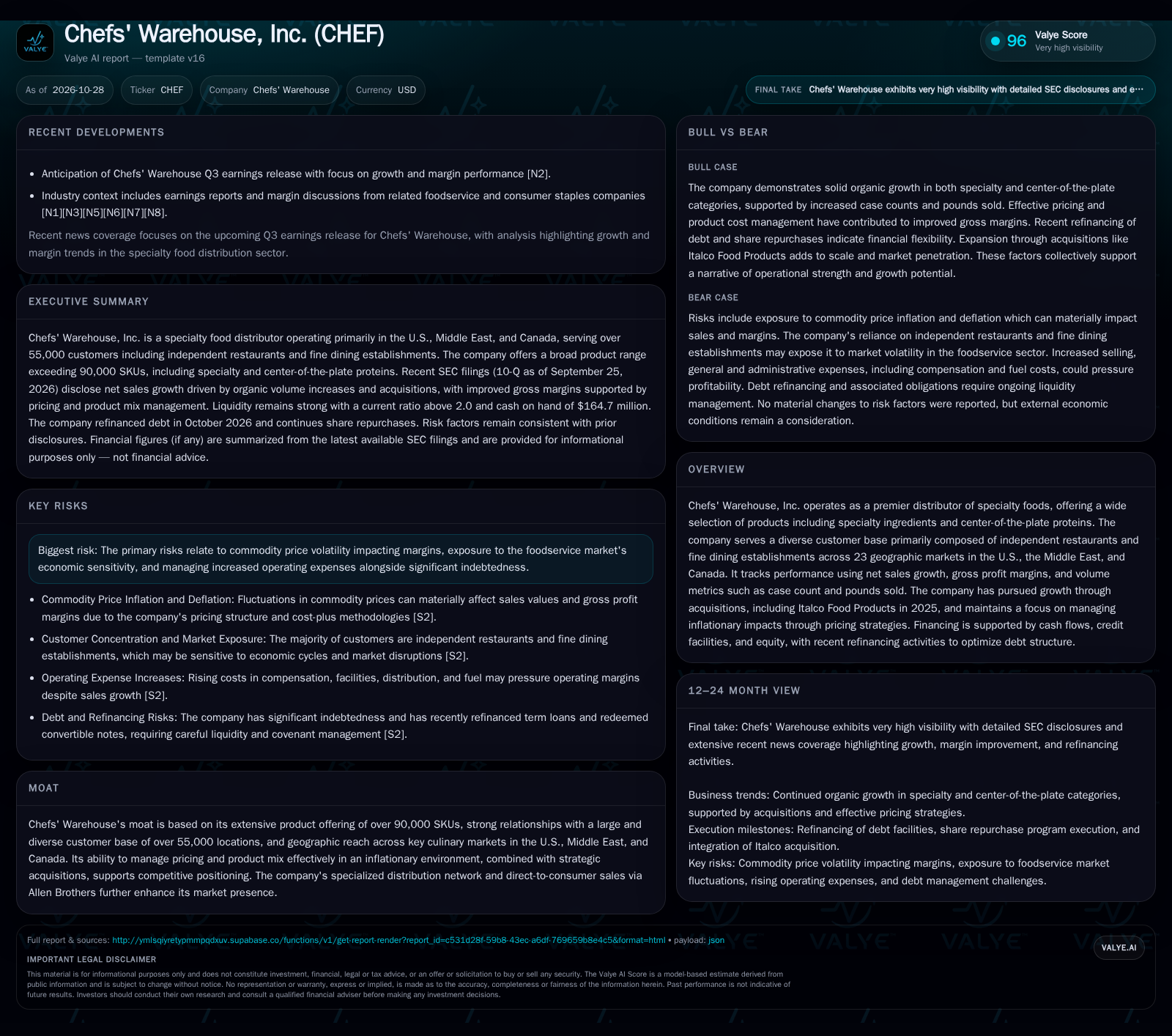
Chefs' Warehouse delivered double-digit sales growth and improved gross margins in the latest quarter, driven by organic volume and the Italco acquisition. With over 90,000 SKUs and 55,000+ customer locations, the company’s scale and specialty focus anchor its position, but exposure to foodservice cycles and rising expenses pose ongoing risks. Recent refinancing extends debt maturities, highlighting a need for sustained cash generation and disciplined margin management amid sector volatility. [S2]
Chefs' Warehouse, Inc. is demonstrating its ability to blend specialty food distribution scale with margin management, reporting robust sales and gross profit growth in the most recent quarter. The company's strategy—anchored in broad product variety, deep customer relationships, and targeted acquisitions—has supported organic expansion and helped offset rising operating costs. Yet, with a customer base heavily concentrated in independent restaurants and fine dining, Chefs' Warehouse remains exposed to sector volatility and the challenge of maintaining profitability as cost pressures mount. Recent debt refinancing extends financial runway but underscores the importance of operational discipline in an inflation-sensitive, service-oriented market. [S2]
Recent Performance Highlights Margin Gains and Debt Recomposition
In the thirteen weeks ended September 25, 2026, Chefs' Warehouse reported net sales of $1.135 billion, up 11.2% from the prior year, with organic growth accounting for 10.3 percentage points and the Italco acquisition contributing 0.9%. Gross profit rose to $284.3 million, with gross margin expanding to 25.0%, an 84 basis point increase attributed to pricing discipline, product cost management, and a favorable shift in product mix. SG&A expenses increased 12.1% to $233.4 million, reflecting higher compensation, distribution, and facilities costs. Interest expense declined 14.6% to $9.0 million due to lower debt levels and rates. In October 2026, the company refinanced its term loan, entering a new $675 million facility maturing in 2033, and redeemed its convertible notes, extending debt maturities and potentially improving potential financial flexibility. [S2]
How Specialty Scale and Pricing Drive Margin Expansion—But at a Cost
Chefs' Warehouse generates revenue primarily through the distribution of specialty foods and center-of-the-plate proteins to over 55,000 customer locations. The company’s economics are shaped by SKU breadth (over 90,000 items), which allows it to serve diverse culinary needs and command premium pricing in specialty and high-quality protein categories. This breadth can can increase basket size and customer stickiness, but also adds complexity and inventory risk.
Gross margin improvement in the latest quarter suggests the company is successfully passing on higher input costs and optimizing mix toward higher-margin products. However, these gains must be balanced against rising SG&A expenses, a significant portion of which are relatively fixed in the short term—distribution, facilities, and compensation. Operating leverage is achievable when volume growth outpaces these fixed costs, but wage, fuel, and logistics inflation can quickly erode margin expansion if not offset by pricing or efficiency gains.
The company reported cash and liquidity metrics for the period; these figures do not by themselves establish operating runway, investment capacity, financial flexibility, or financing capacity. Recent refinancing of the term loan to 2033 provides runway, but servicing this debt requires sustained cash generation. Share repurchases signal confidence but also require careful balancing with liquidity for operations and acquisitions.
Specialty Breadth and Customer Intimacy Versus Scale Players and Substitution
Chefs' Warehouse differentiates itself through its extensive specialty product portfolio and deep relationships with independent restaurants and fine dining establishments—segments underserved by broadline distributors. Its product variety and service orientation allow it to command a premium versus larger, lower-cost competitors focused on mainstream or commodity SKUs.
However, the company faces counterforces from national broadline distributors, specialty importers, and regional players, many of whom are expanding their specialty offerings. Substitution risk arises if customers shift toward lower-cost alternatives or if large distributors use scale to compress margins in specialty categories. Furthermore, direct sourcing by large restaurant groups or the emergence of digital platforms for procurement could erode Chefs' Warehouse’s value proposition.
Switching costs in specialty distribution are moderate: while relationships and service matter, price sensitivity rises during downturns, and customers can experiment with competitors on a SKU-by-SKU basis. The company’s ability to maintain share depends on continuously curating unique products, providing high-touch service, and managing costs in line with customer expectations.
If Specialty Momentum and Margin Discipline Outrun Cost Inflation
An upside scenario materializes if Chefs' Warehouse sustains high single-digit to low double-digit organic growth in specialty and center-of-the-plate categories, leveraging acquisitions like Italco to deepen regional penetration and broaden product mix. Effective pricing power—demonstrated by the recent gross margin expansion—could continue if the company maintains its reputation as a premier specialty distributor and passes through cost increases without volume attrition.
Operating leverage would emerge as SG&A growth moderates relative to revenue, especially if recent investments in logistics and technology yield efficiency gains. The refinancing of the term loan locks in favorable terms, reducing interest expense and freeing up cash for further share repurchases or bolt-on acquisitions. Confirmation would come from sustained volume growth (case count and pounds sold), continued margin expansion, sequential improvement in operating income, and evidence of successful integration of acquired businesses. [S2]
Falsification would be signaled by volume declines, inability to pass on costs, or margin compression despite revenue growth—suggesting that pricing power or product differentiation is eroding.
Growth Moderates as Cost Pressures and Sector Cycles Shape Results
The most plausible scenario is one where Chefs' Warehouse continues to grow above industry averages, but at a decelerating pace as the independent restaurant sector contends with cyclical pressures and cost inflation persists. Gross margins may remain stable or see modest improvement if pricing discipline is maintained, but SG&A growth likely continues to track revenues, limiting operating leverage.
Debt refinancing provides stability, but the company must balance cash deployment between operations, acquisitions, and shareholder returns. The integration of Italco and any further acquisitions will be closely scrutinized for synergies and margin impact. Confirmation would be seen in steady volume growth, consistent gross margins, and manageable increases in operating expenses. Falsification would occur if SG&A outpaces revenue or if sector weakness leads to customer churn and shrinking volumes.
Margin Compression and Foodservice Weakness Undermine Profitability
A downside scenario could unfold if commodity cost volatility returns or intensifies, limiting the company’s ability to pass through price increases and compressing gross margins. Rising labor, fuel, and logistics costs could further squeeze profitability, particularly if volumes stagnate or decline due to economic shocks or a downturn in the independent restaurant sector.
Chefs' Warehouse’s customer concentration in fine dining and independents amplifies vulnerability to consumer spending pullbacks, while competition from broadliners and digital entrants could drive price wars and customer attrition. In such a scenario, operating leverage turns negative, cash flow deteriorates, and debt service becomes more burdensome despite recent refinancing. Confirmation would come from declining case counts, margin erosion, and rising interest or liquidity concerns—potentially forcing asset sales or curtailment of acquisitions.
Testing the Specialty Distribution Thesis: Metrics and Milestones to Track
Quarterly organic case count and pounds sold growth, by category, as a direct signal of underlying demand and volume momentum—if disclosed.
Sequential gross margin performance, to determine if pricing power and product mix management can continue to offset cost inflation.
SG&A as a percentage of net sales, to assess whether operating leverage is emerging or if cost inflation is eroding margin gains.
Integration progress and performance metrics for recent acquisitions, especially Italco, to evaluate the success of bolt-on growth.
Customer retention rates or churn among independent restaurants and fine dining clients would help gauge competitive resilience—if disclosed.
Any shifts in customer mix or product mix that could signal changing market dynamics or increased exposure to lower-margin segments.
Disclaimer: This is research-only, informational analysis and not investment advice. It may include AI-generated interpretation and general industry context. Always verify important details using primary sources.

Comments