
Odyssey Health’s Early-Stage Medical Device Ambitions Meet Financial Strain and Regulatory Hurdles
Odyssey Health, Inc. is pursuing innovative medical devices and new market entry, but its lack of regulatory approvals, minimal revenue, and acute liquidity shortfall raise existential questions about its ability to bridge development to commercialization.
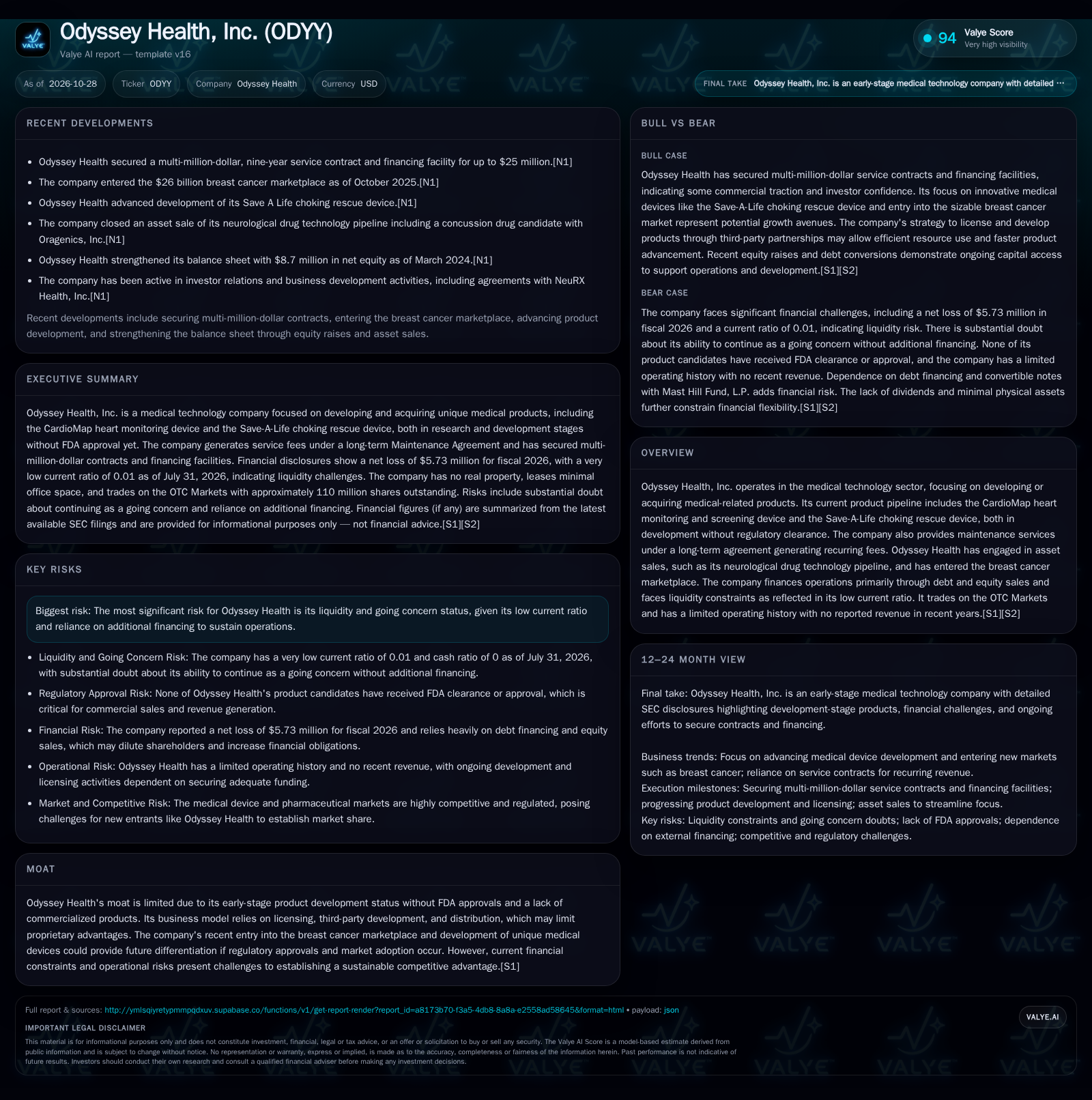
Odyssey Health, Inc. is an early-stage medical technology company developing the CardioMap and Save-A-Life devices, but none are FDA-cleared. Despite recent multi-million-dollar contracts and a nine-year service agreement, the firm reported a net loss of $5.73 million for fiscal 2026 and ended July 2026 with a current ratio of 0.01 and no cash. Its business model relies on licensing and third-party partnerships, but it faces substantial doubt about its ability to continue as a going concern and depends on further financing to survive. [S1] [S2]
Odyssey Health, Inc. is attempting to carve out a niche in the medical technology landscape with novel devices like the CardioMap heart monitor and Save-A-Life choking rescue tool. Despite some service contract wins and a recently expanded focus into the breast cancer market, the company remains firmly pre-revenue with none of its technologies FDA-approved. The financial picture is stark: as of July 2026, Odyssey reported a net loss of $5.73 million, negligible cash, and a current ratio of just 0.01, underscoring an urgent need for new capital. Odyssey’s future hinges not just on the technical or clinical merits of its pipeline, but on its ability to survive financially long enough to achieve regulatory and commercial milestones. [S1] [S2]
Product Pipeline, Service Contracts, and Financial Red Flags: Where Odyssey Stands Now
Odyssey Health’s core activities center on two medical devices in development—CardioMap, a heart monitoring and screening device, and Save-A-Life, a choking rescue device. Neither has received FDA clearance or approval as of the company’s latest filings. [S1] [S2] This is a critical gating factor for any commercial sales or broader market adoption.
To generate operating income, Odyssey provides maintenance and related services under a long-term agreement with Mast Hill Fund, L.P., earning approximately $252,450 annually. [S1] Separately, it has secured a multi-million-dollar, nine-year service contract and a financing facility for up to $25 million, suggesting some ability to attract institutional partners, though the details of utilization and drawdown are not established. [S1] [S2]
Despite these efforts, the company reported a net loss of $5.73 million for the fiscal year ended July 31, 2026. [S1] Its balance sheet is acutely stressed: as of that date, Odyssey had $147,859 in current assets versus $12.3 million in current liabilities, a current ratio of 0.01, and a cash ratio of 0. [S1] The company has publicly acknowledged substantial doubt about its ability to continue as a going concern. [S1] [S2]
How Odyssey Could Monetize: Licensing, Service Fees, and the Economics of Medical Device Commercialization
Odyssey Health’s business model, as described, is predicated on developing or acquiring unique medical devices and licensing or commercializing them—often by engaging third parties for development, manufacturing, and distribution. This asset-light approach minimizes fixed costs but also means the company is reliant on external partners for execution and may have to share economics through royalties or service fees.
The recurring maintenance services agreement provides some baseline revenue, but at approximately $252,450 per year, this is not material relative to operating losses or potential future scale. [S1] The recent nine-year, multi-million-dollar contract could represent a directional step toward more meaningful recurring revenue, but the absence of FDA-approved products means Odyssey’s pathway to significant product sales or licensing income is, for now, theoretical.
Medical device commercialization typically requires substantial upfront investment in R&D and regulatory activities, with the potential for high-margin recurring revenues if and when products achieve regulatory clearance and market adoption. Without FDA approval, Odyssey cannot market or sell its devices in the U.S., and the economics remain aspirational. The company’s history of financing operations through debt and equity sales reflects the capital-intensive nature of the business and the absence of internally generated cash flow. [S1] [S2]
What Differentiation Looks Like—And Why It’s Not Yet a Moat
Odyssey Health’s potential differentiation lies in the novelty of its product concepts: a non-invasive heart screening device and a portable choking rescue tool. These solutions address large, well-established markets—cardiac diagnostics and emergency medical devices—where clinical need and willingness to pay are high.
However, the medical device landscape is crowded with entrenched incumbents, from large diversified device makers to specialized startups. Barriers to entry are significant: regulatory approval, clinical validation, and integration into healthcare workflows are all required before commercial traction is possible.
Odyssey’s use of third-party partnerships for development and distribution could enable faster scaling if products are approved, but it also means the company may be limited in capturing end-customer economics and building proprietary switching costs. At present, with no FDA-cleared products and no established brand or distribution channels, Odyssey lacks the elements of a defensible moat. Any future competitive advantage would depend on achieving regulatory milestones, demonstrating superior clinical outcomes, and securing reimbursement or adoption in healthcare settings.
A Bridge to Commercialization: What a Successful Turnaround Would Require
A favorable scenario for Odyssey Health would begin with successful additional fundraising—via the existing $25 million facility or new equity/debt—providing enough runway to complete pivotal R&D and regulatory filings for at least one of its devices.
If the CardioMap or Save-A-Life device achieves FDA clearance, Odyssey could begin commercial sales or license the technology to a larger medical device company, unlocking milestone payments, royalties, or direct sales revenue. Entry into the breast cancer market could further diversify the pipeline and attract strategic interest.
Confirmation of this scenario would come from announcements of regulatory submissions (such as 510(k) or PMA filings), successful capital raises, new licensing or distribution agreements, or disclosed purchase orders from healthcare buyers. Falsification would occur if Odyssey fails to secure financing, misses regulatory milestones, or is forced to suspend development due to lack of funds.
Survival Mode: Incremental Progress, Ongoing Cash Burn, and the Search for a Lifeline
The most plausible near-term outcome is that Odyssey Health remains in a holding pattern: raising small amounts of equity or debt to fund operations quarter-to-quarter while advancing its R&D pipeline at a constrained pace. The service contract and maintenance fees provide some recurring revenue, but not enough to cover ongoing expenses.
Progress toward regulatory submissions would be slow and dependent on securing piecemeal financing. The company may continue to pursue asset sales or licensing deals to generate cash, but its negotiating leverage is limited by its distressed balance sheet and lack of commercialized products.
This scenario would be confirmed by continued net losses, limited or dilutive capital raises, and incremental news about preclinical or clinical development rather than major commercial breakthroughs. A reversal of the going concern warning or a significant licensing deal would challenge this base case.
Liquidity Exhaustion and the Risk of Restructuring or Wind-down
The primary risk is that Odyssey Health is unable to secure sufficient new financing to cover operating expenses and service its debt. With a current ratio of 0.01 and no cash on hand, the company is operating on borrowed time. [S1]
If additional capital is not raised, Odyssey could be forced to suspend R&D activities, sell remaining assets at distressed valuations, or enter restructuring or liquidation. Convertible note holders could become the primary claimants on remaining assets, and existing equity holders could be substantially diluted or wiped out.
Evidence for this scenario would include failure to announce new financings, a material adverse change in auditor opinion, or the cessation of product development activities. The going concern warning and absence of revenue are already red flags; further deterioration would confirm the downside.
Milestones That Will Determine Odyssey Health’s Fate
Progress on FDA submissions or clinical trial initiations for CardioMap or Save-A-Life—any regulatory milestone would indicate advancement toward commercialization.
Announcements of new equity or debt financings, or utilization of the $25 million facility—confirmation of near-term survival.
Expansion or renewal of the multi-million-dollar service contract, or disclosure of new service agreements—could indicate growing recurring revenue.
Updates on product licensing or distribution deals—would demonstrate external validation and the ability to monetize intellectual property.
Reduction in net operating losses or a shift to positive operating cash flow—would signal improving business fundamentals.
Changes to the going concern warning or auditor commentary—an improvement would suggest increased financial stability.
If disclosed, new patent grants or successful intellectual property defenses—would support potential future competitive advantage.
Evidence of customer pilot programs or purchase orders—would validate product-market fit and early demand.
Disclaimer: This is research-only, informational analysis and not investment advice. It may include AI-generated interpretation and general industry context. Always verify important details using primary sources.

Comments