
S&P Global: Strategic Reviews, Data Moats, and the Disruptive Edge of AI in a Competitive Information Economy
With robust Q3 2026 earnings and new strategic reviews underway, S&P Global stands at a crossroads: its entrenched position in indices and analytics faces mounting pressure from AI-powered upstarts, free data sources, and rapid technological change. The company’s ability to convert its proprietary data assets and innovation investments into durable value will define the next phase of its business model.
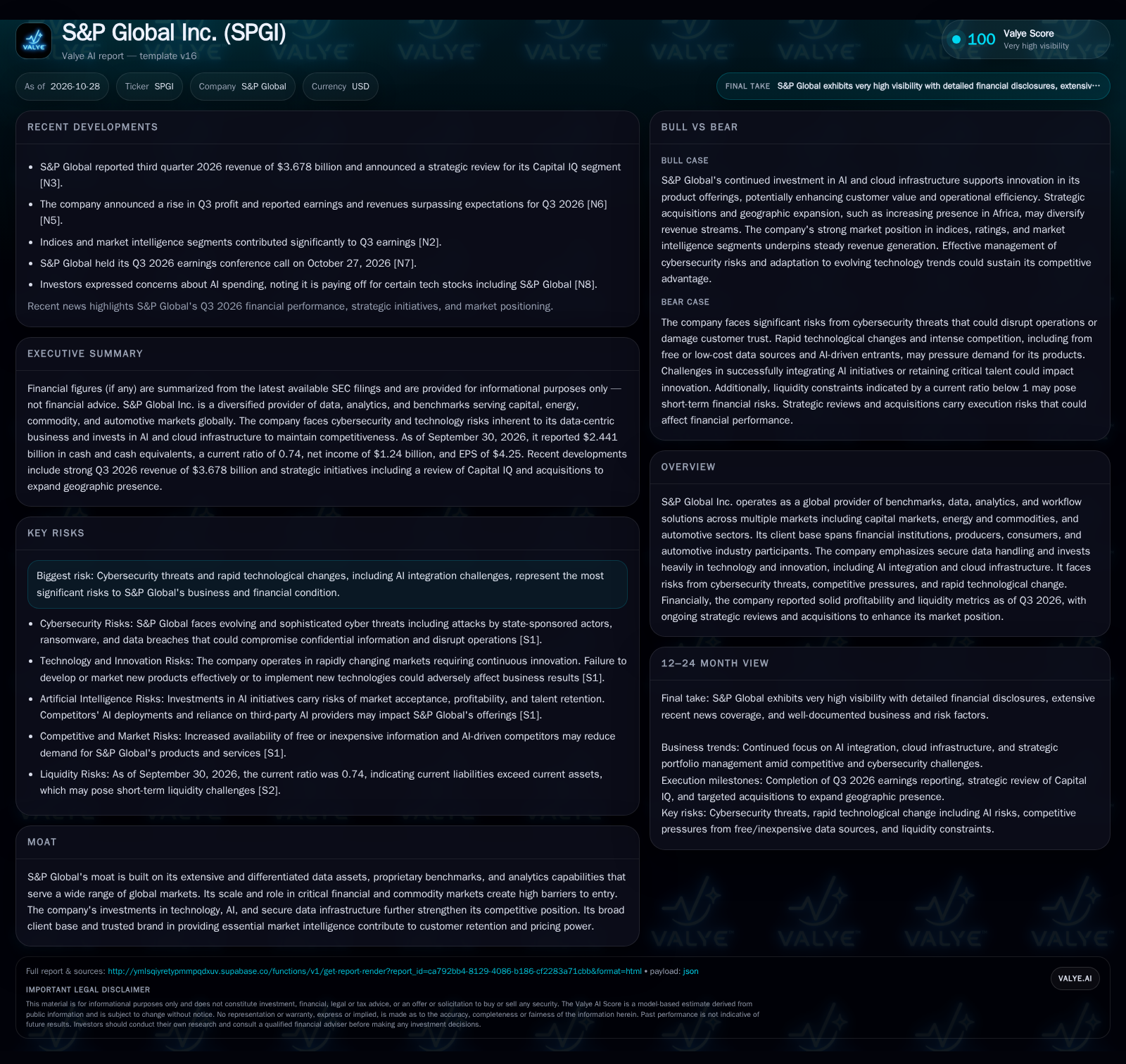
S&P Global reported strong Q3 2026 results, with $3.678 billion in revenue and $1.24 billion in net income, while launching a strategic review of its Capital IQ segment. The company’s market position relies on proprietary data and analytics, but faces intensifying competition from AI-driven offerings and free data sources. Its future hinges on successful technology adoption, effective cybersecurity management, and the ability to monetize and differentiate its data in an evolving landscape. reported liquidity position but current liabilities outpace current assets, adding short-term financial complexity.
S&P Global’s Q3 2026 performance underscores both the resilience and the complexity of operating a global data and analytics franchise in a landscape redefined by AI, cybersecurity threats, and the commoditization of information. Recent earnings surpassed expectations and the company’s indices and market intelligence arms continue to anchor profitability, but a strategic review of the Capital IQ segment signals a willingness to reshape the portfolio in response to shifting industry dynamics. With free data proliferating and AI-driven competitors accelerating, the company’s next act will depend on leveraging its proprietary assets and technological investments to maintain relevance and pricing power.
Earnings Strength, Strategic Reviews, and Portfolio Moves Define the Q3 2026 Landscape
S&P Global reported Q3 2026 revenue of $3.678 billion and net income of $1.24 billion, with EPS of $4.25, exceeding market expectations and confirming the continued earnings power of its core business lines [S2] [N3] [N5] [N6]. The company initiated a strategic review of its Capital IQ segment, signaling potential divestiture, restructuring, or reinvestment as management responds to evolving competitive pressures and client needs [N3]. Indices and market intelligence remain the primary contributors to profitability, while recent acquisitions target new geographic markets and expanded capabilities in data center analytics and Africa [N1] [N2] [N3]. On the balance sheet, S&P Global reported $2.441 billion in cash and equivalents, with a current ratio of 0.74, indicating a short-term liquidity profile that merits close attention but does not signal immediate distress [S2].
How S&P Global Monetizes Data, Benchmarks, and Analytics in a Disruptive Era
S&P Global’s business model is anchored in monetizing proprietary data, indices, benchmarks, and analytics through a mix of recurring subscriptions, licensing, workflow solutions, and one-time transactions. Core products—credit ratings, market indices, and data feeds—are typically priced on a subscription basis, supporting high revenue visibility and attractive margins. The fixed-cost leverage of data and analytics platforms means incremental revenue can drive substantial operating leverage, provided customer retention remains strong.
However, the economics are shifting. The marginal cost of digital data distribution is near zero, but value creation now depends on the uniqueness, timeliness, and actionability of insights. As AI and alternative data sources proliferate, S&P Global must continually invest in proprietary data acquisition, cloud infrastructure, and AI-driven analytics to justify premium pricing. Capital intensity is moderate, with spending concentrated on technology, data security, and talent acquisition rather than physical assets. The company’s ability to maintain pricing power and renewals is increasingly tied to differentiated content, integration into customer workflows, and the stickiness of mission-critical analytics.
The company reported cash and liquidity metrics for the period; these figures do not by themselves establish operating runway, investment capacity, financial flexibility, or financing capacity.
Defending the Data Moat: S&P Global’s Role Amid Intensifying AI-Driven Competition
S&P Global’s historical moat is built on the breadth, depth, and credibility of its proprietary data, indices, and analytics, which are deeply embedded in global financial, commodity, and automotive markets. This centrality creates high switching costs for many institutional clients, particularly where benchmarks are regulatory or industry standards. However, the competitive landscape is undergoing rapid transformation. AI-native platforms, alternative data providers, and open-source information aggregators are compressing the value of basic data and analytics, eroding the exclusivity that once underpinned S&P Global’s pricing power [S1].
Peer competitors include major data and analytics conglomerates, fintechs, and specialized AI firms. The threat is particularly acute where public or low-cost data can substitute for proprietary offerings, or where AI can automate insight generation. S&P Global’s response—investing in AI, cloud infrastructure, and workflow integration—aims to reinforce its moat by making its data more actionable and indispensable. Nonetheless, the risk remains that innovation cycles outpace the company’s ability to adapt, or that customer relationships become less sticky if switching costs fall.
Unlocking New Value: If AI Integration and Strategic Repositioning Succeed
If S&P Global successfully leverages its AI investments and proprietary data to launch new, differentiated analytics products, it could reinforce its position at the center of critical financial workflows, deepening client dependence and supporting higher pricing. The strategic review of Capital IQ could result in a refocused, more profitable business, or a redeployment of capital into higher-growth segments (e.g., energy transition analytics, data center intelligence, or emerging markets such as Africa) [N3] [N1].
The most compelling upside would come from demonstrating that S&P Global’s platforms are not commoditized, but instead uniquely essential to clients—through features like predictive analytics, seamless workflow integration, or regulatory-grade data. Confirmation would include robust renewal rates, successful cross-selling of new AI-enhanced solutions, and evidence that new product launches or acquisitions translate into outsized revenue growth and margin expansion. Conversely, failure to see adoption of new AI products, or customer migration to lower-cost alternatives, would falsify this scenario.
Sustaining Premium Data Economics Amid Evolving Risks and Competitive Pressures
The most plausible trajectory for S&P Global is continued modest growth anchored by its core indices and analytics franchises, supported by incremental gains from technology investments and targeted acquisitions. Revenue and earnings would remain resilient, but margin expansion could be limited by ongoing investment needs and competitive pricing pressure from AI-driven and low-cost alternatives [N2] [N5].
In this scenario, the company maintains its relevance by adapting product offerings, enhancing cybersecurity, and selectively optimizing the portfolio—such as through the Capital IQ review. Confirmation would come from steady revenue growth, sustained profitability in core segments, and successful execution of portfolio changes without major disruption or customer attrition. Falsification would be signaled by declining renewal rates, margin erosion, or failure to deliver new solutions that differentiate from commoditized data providers.
Commoditization and Cyber Risks: When Data Loses Its Edge
The principal risk to S&P Global’s model is that the proliferation of free or inexpensive data, coupled with fast-moving AI competitors, accelerates the commoditization of information. If clients increasingly turn to alternative sources or automated analytics, S&P Global could see pricing pressure, lower renewal rates, and margin compression [S1]. Simultaneously, a major cybersecurity incident—especially one that disrupts operations or undermines client trust—could have severe reputational and financial consequences.
The downside scenario would be confirmed by loss of major clients, revenue declines in historically resilient segments, or a significant, public cybersecurity breach. Failure to execute on AI integration, or inability to retain key technology talent, would exacerbate these risks. Early warning signs would include negative operating leverage, increased customer churn, and news of clients migrating to AI-native or open-source alternatives.
Milestones That Will Define S&P Global’s Next Phase of Value Creation
Progress and outcome of the Capital IQ strategic review, including divestiture, restructuring, or reinvestment.
Adoption and revenue contribution from new AI-driven analytics and workflow solutions—if disclosed, segment-level growth rates would help test the thesis.
Renewal and retention rates for subscription-based products, especially in indices and market intelligence.
Margin trends, particularly the ability to maintain or expand operating margins as technology and cybersecurity investments rise.
Incidence and severity of cybersecurity events; disclosure of any material breaches or operational disruptions.
Customer migration patterns—any evidence of major clients shifting to alternative or AI-native data providers.
Integration success and financial impact of recent acquisitions, especially in Africa and data center analytics.
Disclaimer: This is research-only, informational analysis and not investment advice. It may include AI-generated interpretation and general industry context. Always verify important details using primary sources.

Comments