
Wells Fargo: Interest Income Tailwinds, Digital Ambitions, and the Realities of Regulatory Overhang
Wells Fargo enters late 2026 with renewed momentum in interest income, a sprawling asset base, and a diversified service model—but faces persistent regulatory scrutiny and intensifying competition from fintechs and traditional peers. The question is whether operational improvements and digital initiatives will be enough to unlock margin expansion and defend its market position.
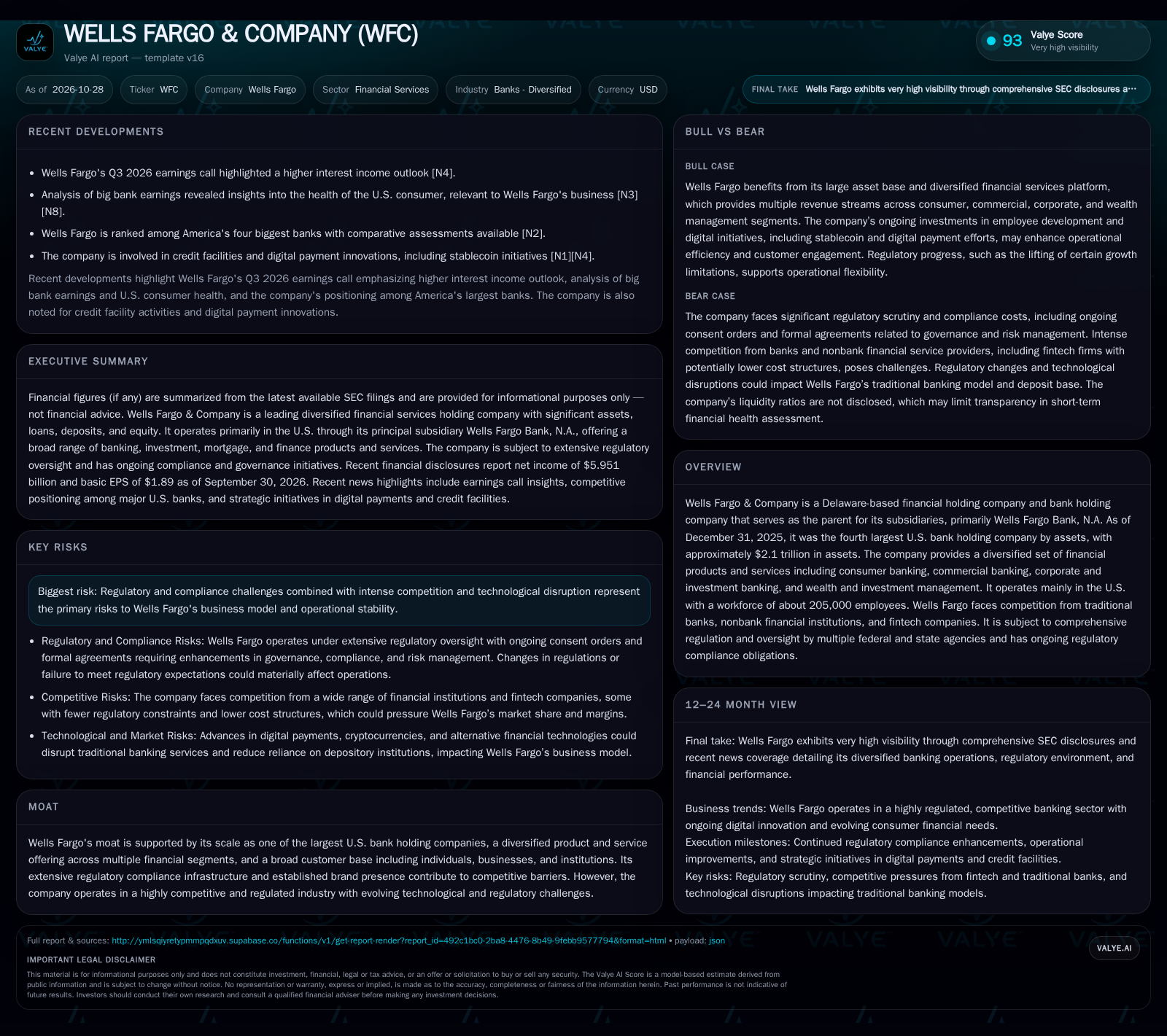
Wells Fargo’s Q3 2026 results reveal nearly $6 billion in net income and a positive outlook for interest income, reflecting the benefits of a large, diversified balance sheet. However, ongoing regulatory constraints and fierce competition from fintechs and nonbanks threaten to erode traditional advantages. The company’s future will hinge on regulatory progress, digital execution, and its ability to adapt to shifting consumer and technological trends. [S1] [S2] [N4]
Wells Fargo stands at a strategic crossroads in late 2026. With a $2.1 trillion balance sheet, a broad service lineup, and nearly $6 billion in quarterly net income, the bank’s scale and diversification are undeniable. Yet persistent regulatory scrutiny and the rapid evolution of digital finance threaten to erode long-held advantages. The company’s recent focus on digital payments and stablecoin innovation hints at a willingness to adapt, but execution risk remains high in an environment where both legacy competitors and nimble fintechs are vying for relevance. The central question: Can Wells Fargo convert its operational improvements and digital investments into sustainable margin gains, or will structural headwinds and compliance costs cap its upside?
Q3 2026 Operating Snapshot: Interest Income Momentum and Regulatory Hurdles
Wells Fargo reported net income of $5.951 billion for the third quarter of 2026, with basic earnings per share of $1.89 [S2]. This performance reflects a positive outlook for interest income, as highlighted in the Q3 earnings call [N4], and underscores the earnings power of its $2.1 trillion asset base, which includes $986.2 billion in loans and $1.4 trillion in deposits as of year-end 2025 [S1].
The company remains the fourth largest U.S. bank holding company by assets [S1]. While some regulatory growth limitations have recently been lifted, Wells Fargo continues to operate under consent orders and formal agreements that require ongoing improvements in governance, compliance, and risk management [S1].
Recent strategic moves include participation in credit facilities and digital payment innovations, such as stablecoin initiatives [N4], signaling a pivot toward technology-driven banking solutions even as regulatory and competitive challenges persist.
How Wells Fargo’s Diversified Model Drives Earnings—and Where Pressure Points Emerge
Wells Fargo’s business model generates revenue across four primary segments: Consumer Banking and Lending, Commercial Banking, Corporate and Investment Banking, and Wealth and Investment Management [S1]. The company earns money mainly through net interest income—the spread between interest revenues on loans and the cost of funding those loans with customer deposits. This dynamic has historically favored large diversified banks during periods of rising interest rates, as they can reprice loans faster than deposits.
Non-interest income, from sources such as wealth management fees, investment banking, and payment services, adds stability and diversification. However, fee income is sensitive to capital markets activity and competitive pricing pressure, especially as fintech entrants undercut legacy fee structures.
Operating leverage is significant: much of the bank’s cost base is fixed (branches, compliance, technology infrastructure), so incremental revenue growth can drive margin expansion. However, regulatory compliance costs and ongoing investments in digital transformation dilute this leverage. The capital intensity of banking—requiring substantial equity to support lending and absorb credit losses—limits the pace and risk appetite of expansion, particularly under regulatory scrutiny.
Defending the Franchise: Scale, Regulation, and the Fintech Threat
Wells Fargo’s competitive moats historically included its national brand, massive customer base, and ability to cross-sell products across segments [S1]. Its balance-sheet scale enables low funding costs and broad product reach. However, the company faces intense competition not only from the other three major U.S. banks but increasingly from nonbank financial firms and fintechs, which often operate with lighter regulatory burdens and more agile technology stacks.
Fintechs and digital-native banks are eroding barriers to entry in payments, lending, and wealth management. In particular, the rise of digital wallets, stablecoins, and alternative lending platforms threatens to siphon off high-value customers and reduce banks’ pricing power. Wells Fargo’s investments in digital payment innovations and stablecoin initiatives [N4] represent a necessary response, but it is unclear whether these efforts will be sufficient to offset the structural advantages enjoyed by more nimble competitors.
Regulation remains a double-edged sword: it protects incumbents from certain forms of competition but also imposes high fixed costs and limits on risk-taking, especially for banks still under consent orders.
Digital Execution and Regulatory Relief Unlock Margin Expansion
The most favorable scenario for Wells Fargo is one where its digital transformation efforts—such as stablecoin-based payments and next-generation banking services—drive material efficiency gains, enhance customer engagement, and open new fee revenue streams. If the company can deliver seamless digital experiences at scale, it could recapture some of the wallet share lost to fintechs and reduce operating costs.
A critical catalyst would be the full resolution of outstanding consent orders and continued regulatory relief, freeing up management to pursue growth initiatives and capital redeployment (including share buybacks or increased dividends). Rising interest rates or stable net interest margins could further boost profitability.
Evidence supporting this scenario would include accelerating adoption of digital products by core customers, visible reductions in regulatory compliance costs, and above-peer growth in fee-based and non-interest income. A narrowing of the expense ratio and a clear path to higher return on equity would further confirm the upside thesis.
Incremental Progress Amid Persistent Headwinds
The most plausible trajectory is one of steady, incremental improvement. Wells Fargo continues to benefit from its large deposit base and diversified revenue streams, while interest income remains robust in a stable or modestly rising rate environment. Digital initiatives yield moderate operational efficiencies and help retain core customers, but do not dramatically shift the competitive landscape.
Regulatory burdens persist, keeping compliance costs elevated and constraining risk appetite. Competitive pressure from fintechs and nonbanks continues to compress certain fee lines and forces ongoing investment in technology and customer experience.
This scenario would be confirmed by stable net interest margins, slow but steady growth in digital product adoption, and continued but gradual progress on regulatory remediation. Return on equity remains solid but unexceptional, with cost-to-income ratios improving only modestly.
Regulatory Slippage and Digital Disruption Undermine Core Economics
The risk scenario is one where regulatory progress stalls or reverses, leading to new enforcement actions, additional fines, or extended consent orders. This would keep compliance costs high, distract management, and potentially trigger additional restrictions on growth or capital return.
Simultaneously, if digital payment platforms, stablecoins, and alternative lending channels continue to gain market share at the expense of traditional banks, Wells Fargo could see margin compression and loss of high-value customer relationships. Fee income could decline faster than cost savings materialize, and deposit growth could slow or even reverse if consumers migrate to more attractive digital alternatives.
Evidence of this scenario would include negative headlines regarding regulatory setbacks, persistent or rising compliance expenses, market share losses in key product lines, and a deterioration in return on equity or net interest margin.
Testing the Wells Fargo Investment Thesis: What Could Move the Needle Next
Progress on resolving consent orders and regulatory actions—updates here would clarify capital flexibility and management bandwidth.
Trends in net interest margin and interest income, especially relative to peer banks in a shifting rate environment.
Adoption rates for new digital banking and payment products (if disclosed), including stablecoin or digital wallet initiatives.
Non-interest income growth, particularly from fee-based services and wealth management.
Expense ratio and the trajectory of regulatory compliance costs, as a measure of operational efficiency.
Market share movements in core deposit and lending categories versus both legacy banks and digital challengers.
Employee retention and engagement metrics, which could impact service quality and execution of transformation initiatives.
Any material changes in the regulatory environment or new enforcement actions that could affect operational latitude or capital return policies.
Disclaimer: This is research-only, informational analysis and not investment advice. It may include AI-generated interpretation and general industry context. Always verify important details using primary sources.

Comments