
Fannie Mae’s Role in U.S. Mortgage Finance: Navigating Conservatorship, Credit Exposure, and the Policy Overhang
Fannie Mae remains pivotal in U.S. housing finance, generating $4.18 billion in quarterly net income amid ongoing conservatorship and significant regulatory risk. Its earnings power, scale, and government ties create a unique competitive position—but future performance hinges on credit risk management and evolving policy.
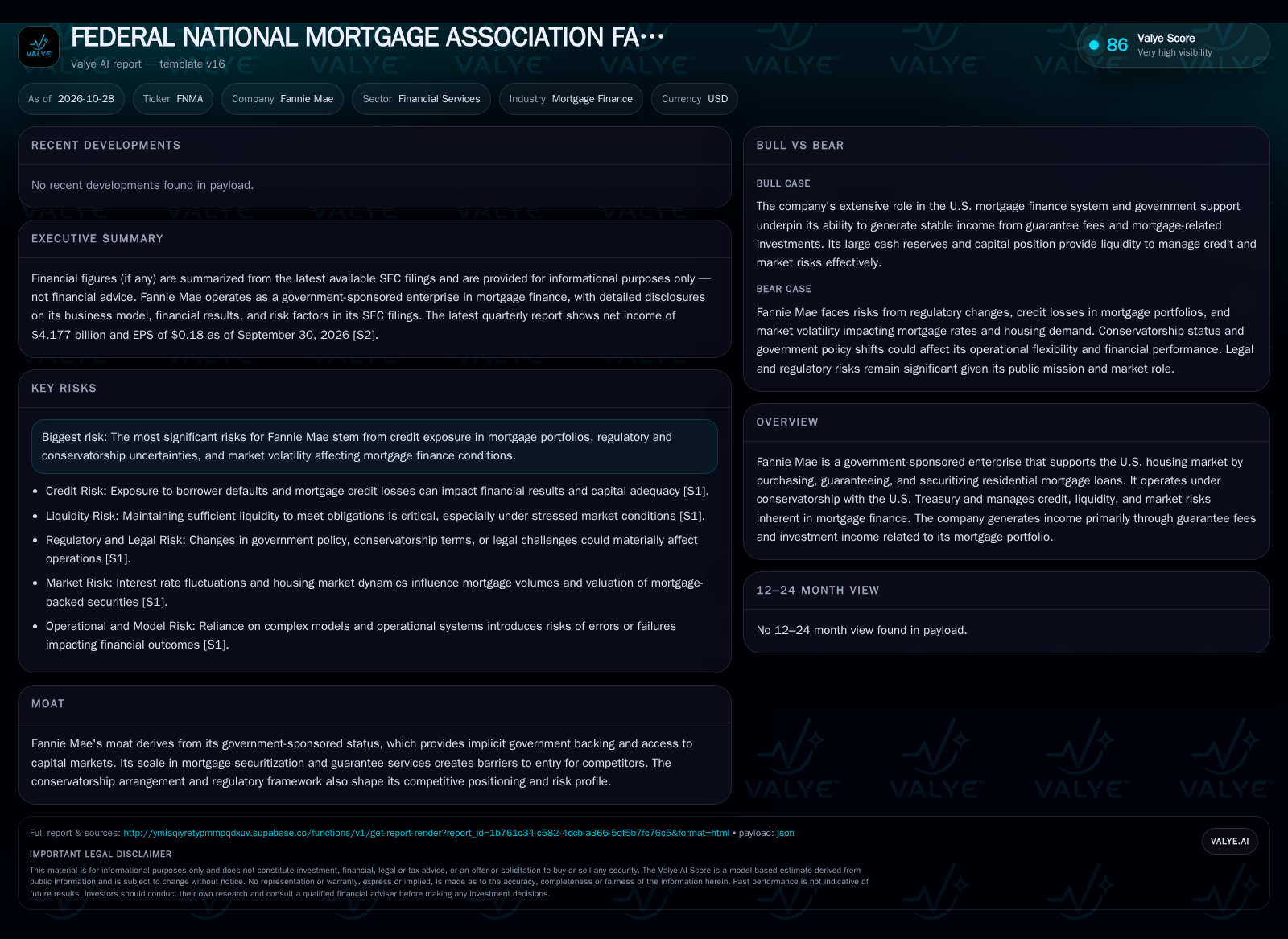
Fannie Mae reported $4.177 billion in net income for the quarter ended September 30, 2026, underlining its earnings resilience despite ongoing conservatorship and regulatory uncertainty. However, future outcomes are tightly linked to credit risk, housing market trends, and policy shifts.
Fannie Mae’s central role in the U.S. mortgage market is both its greatest strength and source of persistent uncertainty. As a government-sponsored enterprise under conservatorship, the company’s ability to generate stable earnings through guarantee fees and mortgage investments is underpinned by implicit government support and massive scale. Yet, its future is tightly bound to regulatory developments, housing market cycles, and the management of credit risk in its vast mortgage portfolio. With $4.18 billion in net income last quarter, Fannie Mae’s core economics remain robust, but the interplay of credit performance, policy direction, and operational discipline will determine whether this resilience is durable or vulnerable to external shocks.
Recent Earnings and Structural Constraints Define Fannie Mae’s Present Reality
Fannie Mae reported net income of $4.177 billion and earnings per share of $0.18 for the quarter ended September 30, 2026 [S2]. This level of profitability demonstrates the company’s continued earnings power as a central intermediary in U.S. mortgage finance. As of June 30, 2025, Fannie Mae held $38.2 billion in cash and cash equivalents, underscoring its access to liquidity [S2]. However, the company remains under conservatorship with the U.S. Treasury, which continues to shape its strategic flexibility and capital allocation options [S1]. The company reported cash and liquidity metrics for the period; these figures do not by themselves establish operating runway, investment capacity, financial flexibility, or financing capacity.
How Fannie Mae Earns: Guarantee Fees, Securitization, and Embedded Leverage
Fannie Mae’s revenue model is centered on purchasing, guaranteeing, and securitizing residential mortgage loans [S1]. The primary income stream is the guarantee fee—a spread charged for assuming credit risk on conforming mortgages that are packaged into mortgage-backed securities (MBS). Additional earnings are generated through net interest income on retained mortgage portfolios, though conservatorship and regulatory capital requirements limit risk appetite and portfolio growth.
The economics of this model reflect a high degree of operating leverage: fixed costs are substantial due to compliance, systems, and risk management infrastructure, but incremental guarantee fee revenue from additional mortgage volume comes at relatively low marginal cost. This scale effect is amplified by Fannie Mae’s dominant market share in conventional mortgage securitization. However, credit losses, prepayment speeds, and interest rate volatility can cause significant swings in net income, especially during housing downturns.
Capital and funding needs are shaped by regulatory requirements and liquidity risk management, rather than market-driven capital allocation. The company must maintain sufficient capital buffers and liquidity to absorb credit losses and meet obligations under stress scenarios, with government support mechanisms providing a unique backstop not available to private competitors.
Government Sponsorship, Scale, and Barriers to Entry in Mortgage Securitization
Fannie Mae’s competitive position is defined by its government-sponsored status, which confers both advantages and constraints. The implicit government backing lowers funding costs, enhances investor confidence in its mortgage-backed securities, and ensures access to capital markets even in periods of financial stress. These factors, combined with decades of operational scale and data, create formidable barriers to entry for private competitors.
However, Fannie Mae’s operations are tightly regulated, with business practices, capital standards, and product offerings subject to federal oversight. While this limits strategic flexibility, it also protects the company from direct competition in its core conforming loan segment. Private-label securitizers and mortgage insurers serve as partial substitutes, but lack both the scale and the perceived safety net of Fannie Mae’s securities.
The primary competitive threat is not from traditional rivals, but from potential regulatory changes, housing finance reform, or disruptive policy shifts that could alter the company’s mandate, capital structure, or market share.
If Credit Performance Holds and Policy Remains Favorable, Earnings Resilience Could Persist
In a favorable scenario, U.S. housing fundamentals remain stable, credit losses in Fannie Mae’s mortgage portfolio stay low, and no disruptive regulatory changes are enacted. Under these conditions, the company continues to generate robust guarantee fee income and maintains its dominant share of the conforming loan market. Low delinquency rates, steady home prices, and benign interest rate trends would support strong net income and potentially allow for gradual capital build or even future changes to conservatorship arrangements.
Confirmation of this scenario would include ongoing low credit loss provisions, stable or growing guarantee fee income, and positive signals from regulators regarding the company’s operational stability or path out of conservatorship. Evidence to the contrary would be rising delinquencies, negative housing market trends, or renewed policy uncertainty.
Most Plausible Outlook: Earnings Power Balanced by Policy Overhang and Credit Cyclicality
The most likely outcome is that Fannie Mae continues to generate strong, but potentially variable, earnings from its core securitization and guarantee business, while remaining constrained by conservatorship and regulatory oversight. Credit costs may rise modestly if housing market conditions soften or interest rates remain volatile, but the company’s scale and government ties provide a buffer against acute financial distress.
This scenario would be confirmed by moderate credit loss trends, stable guarantee fee margins, and continued adherence to regulatory capital and liquidity standards. Potential falsifiers include a sharp spike in mortgage defaults, significant housing market decline, or unexpected regulatory actions that alter the company’s business model or capital framework.
Adverse Chain: Housing Downturn, Credit Losses, and the Policy Trap
If the U.S. housing market weakens materially—due to rising unemployment, higher interest rates, or external economic shocks—Fannie Mae could face a surge in mortgage delinquencies and credit losses. In this scenario, guarantee fee income may be insufficient to offset loss provisions, and the company’s capital buffers could be tested. Regulatory responses might further constrain business flexibility or require additional capital retention, reducing the company’s ability to generate distributable earnings.
Confirmation of this scenario would include a rapid rise in non-performing loans, higher credit loss provisions, negative net income, and/or restrictive regulatory interventions. Conversely, resilience in credit metrics and a stable policy environment would help falsify the downside case.
Signals That Will Define Fannie Mae’s Earnings Quality and Policy Trajectory
Quarterly trends in credit loss provisions and actual mortgage default rates—rising losses or delinquencies would test the thesis of earnings resilience.
Changes in regulatory capital and liquidity requirements, or any new policy directions regarding conservatorship or housing finance reform.
Movements in guarantee fee income and net interest margin, as indicators of core business health and pricing power.
Updates on the status or terms of conservatorship, including any statements from the U.S. Treasury or federal housing regulators.
Market share shifts in the conforming mortgage segment versus private-label securitizers or non-bank lenders, if disclosed.
Disclosure of stress-test outcomes or scenario analyses by management, which would help gauge readiness for adverse conditions.
Evidence of operational or model risk events—such as large-scale servicing errors or data/model failures—that could impact financial results.
Disclaimer: This is research-only, informational analysis and not investment advice. It may include AI-generated interpretation and general industry context. Always verify important details using primary sources.

Comments