
Etsy’s Marketplace at a Crossroads: Platform Trust, Buyer Engagement, and the Next Phase of E-commerce Differentiation
Etsy’s solid profitability and liquidity highlight its operational scale, but future value creation hinges on maintaining marketplace trust and re-energizing buyer and seller engagement amid economic volatility and intensifying competition.
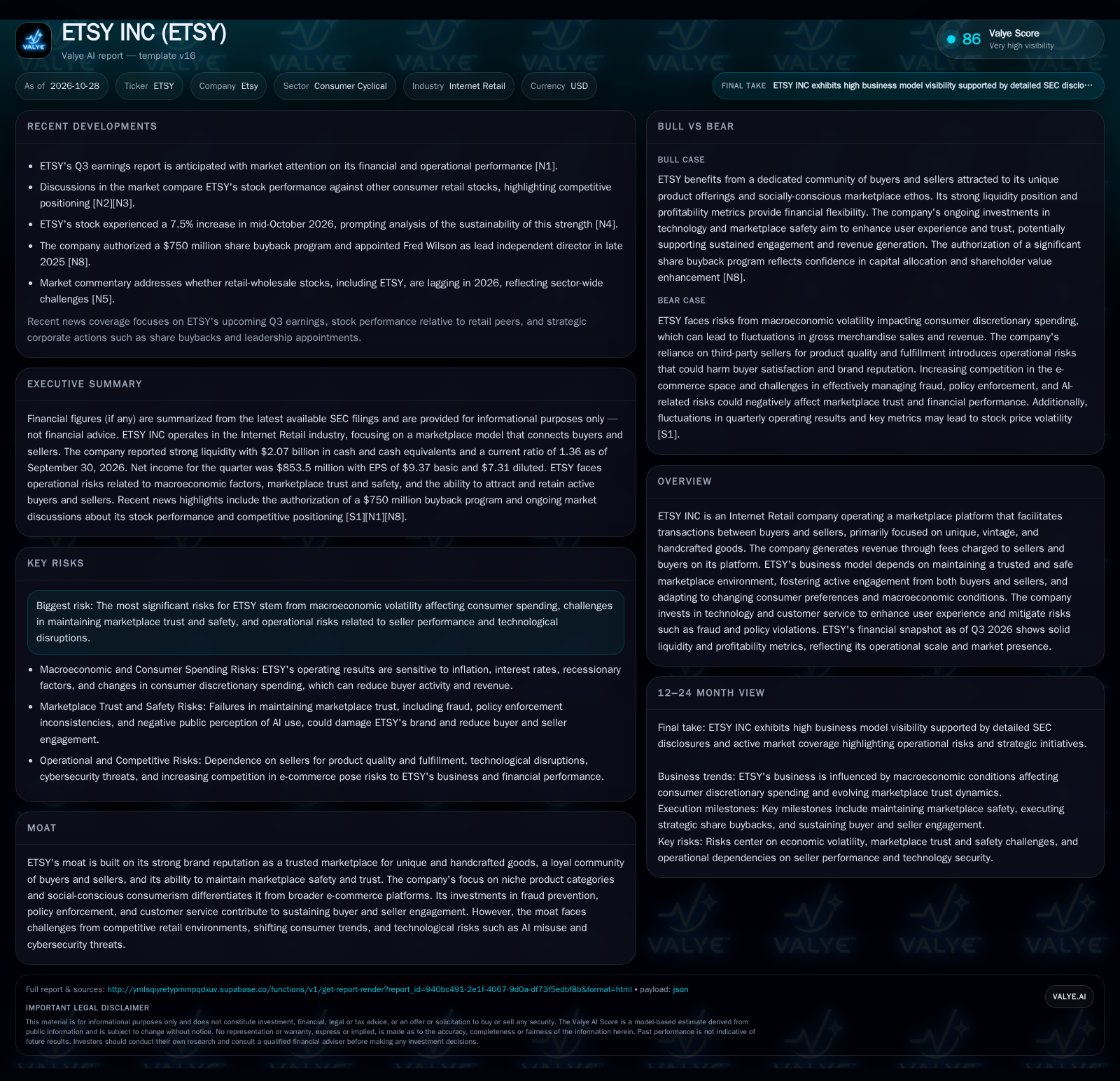
Etsy reported Q3 2026 net income of $853.5 million and maintains over $2 billion in cash, signaling operational strength. However, its reliance on a differentiated marketplace experience faces pressure from macroeconomic headwinds and the need to sustain active buyer and seller participation. The company’s ability to manage trust, technology risks, and competitive threats will likely determine whether it can extend its current momentum or face deceleration as the broader retail landscape evolves. [S1]
Yet beneath the surface, Etsy’s long-term value proposition will depend on its capacity to nurture buyer and seller engagement, uphold marketplace trust, and adapt to shifting e-commerce dynamics. With competition intensifying and consumer discretionary spending under pressure, Etsy’s next phase will test whether its unique platform can remain a destination for both creators and shoppers, or whether it risks commoditization and margin compression.
Recent Results Spotlight Etsy’s Profitability and Liquidity, but Engagement Remains Central
Etsy reported net income of $853.5 million for the quarter ending September 30, 2026, with basic earnings per share of $9.37 and diluted EPS of $7.31. The company’s cash and cash equivalents totaled approximately $2.07 billion, yielding a current ratio of 1.36 and a cash ratio of 1.08. [S1]
However, management continues to highlight the platform’s dependence on attracting and retaining active buyers and sellers, as well as sustaining marketplace trust. Operational risks related to fraud, policy enforcement, and the use of AI technologies are front-of-mind, reflecting the reality that Etsy’s brand and economics are tightly coupled to platform integrity and community vibrancy [S1].
Marketplace Fee Model, Operating Leverage, and the Dynamics of Buyer/Seller Activity
Etsy’s revenue is primarily driven by transaction, listing, and payment processing fees charged to sellers, with additional services (such as advertising) providing incremental income. This asset-light model allows for significant operating leverage: incremental gross merchandise sales (GMS) typically flow through at high margin once fixed platform and marketing costs are covered.
However, Etsy’s economics are highly sensitive to the volume and mix of buyer and seller activity. Periods of strong consumer discretionary spending or successful platform engagement initiatives can drive outsized revenue and margin expansion. Conversely, macro headwinds, shifts in consumer behavior, or lapses in marketplace trust can lead to abrupt slowdowns in GMS and revenue growth.
Variable costs are relatively low compared to traditional retail, but maintaining technology infrastructure, customer service, and compliance capabilities introduces ongoing fixed expense. Investment in fraud prevention, policy enforcement, and AI oversight is increasingly critical as marketplace scale and complexity grow.
Capital needs are moderate, given the digital nature of the business, but strategic capital allocation—such as share buybacks, marketing, or potential acquisitions—remains a lever for management, especially with over $2 billion in cash on hand [S1].
Etsy’s Differentiation Versus Broader E-commerce and Specialty Marketplaces
Etsy’s competitive edge has long rested on its reputation as a curated platform for unique, handmade, and vintage items—differentiating it from mass-market e-commerce giants. The company’s socially conscious brand, coupled with a loyal community of creators and buyers, creates a degree of stickiness and identity distinct from generic online retail.
However, this moat is not immune to erosion. Larger platforms can increasingly target overlapping product categories, employ advanced personalization, and offer broader logistics capabilities, challenging Etsy’s value proposition. Additionally, specialized niche marketplaces or direct-to-consumer brands can siphon off both buyers and sellers seeking more control or better economics.
Switching frictions for sellers may include accumulated reviews, network effects from repeat buyers, and platform-specific tools. For buyers, habit and the breadth of unique inventory matter, but these can be undermined by lapses in trust, inconsistent product quality, or negative experiences with fraud or policy enforcement.
Ultimately, Etsy’s ability to maintain its perceived uniqueness and community ethos in the face of platform scaling, technological disruption, and heightened competition will determine the durability of its moat.
Platform Trust and Community Engagement Drive Accelerated Growth
In a favorable scenario, Etsy successfully doubles down on marketplace trust, employing robust AI-powered fraud detection and transparent policy enforcement to further differentiate its platform as a safe, reliable destination for both buyers and sellers. Investments in community features, seller tools, and personalized buyer experiences increase engagement and retention, driving a rebound in active user growth.
Macroeconomic stabilization or a recovery in consumer discretionary spending would amplify these effects, leading to renewed GMS acceleration. The company’s operating leverage enables margin expansion as incremental revenue outpaces cost growth. Strategic capital deployment—such as targeted marketing or selective acquisitions—could further entrench Etsy’s position in high-value product categories.
Confirmation of this scenario would include sequential GMS and active buyer/seller growth, improving take rates, positive sentiment around marketplace safety initiatives, and evidence of new or returning buyers engaging more deeply with the platform.
Fluctuating Consumer Demand and Persistent Competitive Pressure Define the Next Phase
The most plausible path forward is one where Etsy continues to generate solid profitability and maintains reported liquidity position, but faces ongoing headwinds from macroeconomic uncertainty and competitive encroachment. Buyer and seller activity fluctuates in line with broader consumer spending cycles, with engagement initiatives and trust investments partially offsetting external pressures.
Marketplace trust and safety remain stable but require constant vigilance; isolated incidents or negative press may periodically dampen sentiment, but do not trigger wholesale platform abandonment. Revenue and GMS growth moderate relative to historical highs, and margin expansion is constrained by the need to continually invest in technology, compliance, and customer support.
This scenario would be corroborated by stable but not accelerating GMS, a steady active buyer/seller base, ongoing discussion of competitive threats in management commentary, and incremental but not transformative improvements in platform trust and safety metrics.
Marketplace Trust Erodes, Buyer Churn Accelerates, and Competitive Substitution Intensifies
In a negative scenario, Etsy experiences a breakdown in marketplace trust—potentially due to a high-profile fraud incident, AI misuse, or repeated policy enforcement failures. This leads to a visible decline in buyer and seller confidence, with active user counts falling and negative sentiment spreading across social channels.
Simultaneously, macroeconomic deterioration further suppresses discretionary spending, while alternative platforms and direct-to-consumer brands gain share by offering lower fees, better service, or improved buyer protection.
Revenue and GMS decline, and operating leverage works in reverse as fixed costs become harder to cover, compressing margins.
Evidence of this scenario would include declining sequential GMS and active user metrics, a spike in negative reviews or social media complaints, management guidance cuts, or an uptick in regulatory scrutiny related to platform safety or AI governance.
Tracking Etsy’s Marketplace Health and Strategic Differentiation in a Shifting Retail Landscape
Periodic changes in gross merchandise sales (GMS) and active buyer/seller counts—especially sequential trends—would provide early signals of engagement health and top-line momentum if disclosed.
Take rate evolution (revenue as a percentage of GMS) could help test pricing power and the effectiveness of new seller services if management discloses it.
Incidence and resolution rates of fraud or policy violations, including the impact of AI-driven trust and safety initiatives, would clarify platform risk exposure if disclosed.
Trends in customer service satisfaction scores and net promoter score (NPS) would help reveal shifts in buyer and seller sentiment if available.
Updates on capital allocation—such as further share repurchases, marketing investment, or M&A activity—would indicate management’s willingness to deploy cash for growth or shareholder returns.
Comparative performance versus other niche and mainstream e-commerce platforms, including shifts in share of wallet, would help contextualize Etsy’s competitive standing.
Management commentary on macroeconomic headwinds, consumer sentiment, and discretionary spending trends remains critical for understanding external pressures.
Visible changes in platform policy, AI governance, or regulatory posture—especially in response to emerging risks—would inform the sustainability of Etsy’s marketplace trust.
Disclaimer: This is research-only, informational analysis and not investment advice. It may include AI-generated interpretation and general industry context. Always verify important details using primary sources.

Comments