
Rogers Corporation: Innovation-Driven Growth Ambitions in a Shifting Technology Landscape
Rogers Corporation’s third-quarter profitability, liquidity strength, and leadership continuity set the stage for its $1.5 billion sales target by 2030. The company’s push into AI data centers, battery materials, and EVs must overcome intense competition, technology substitution risk, and execution challenges in scaling advanced materials.
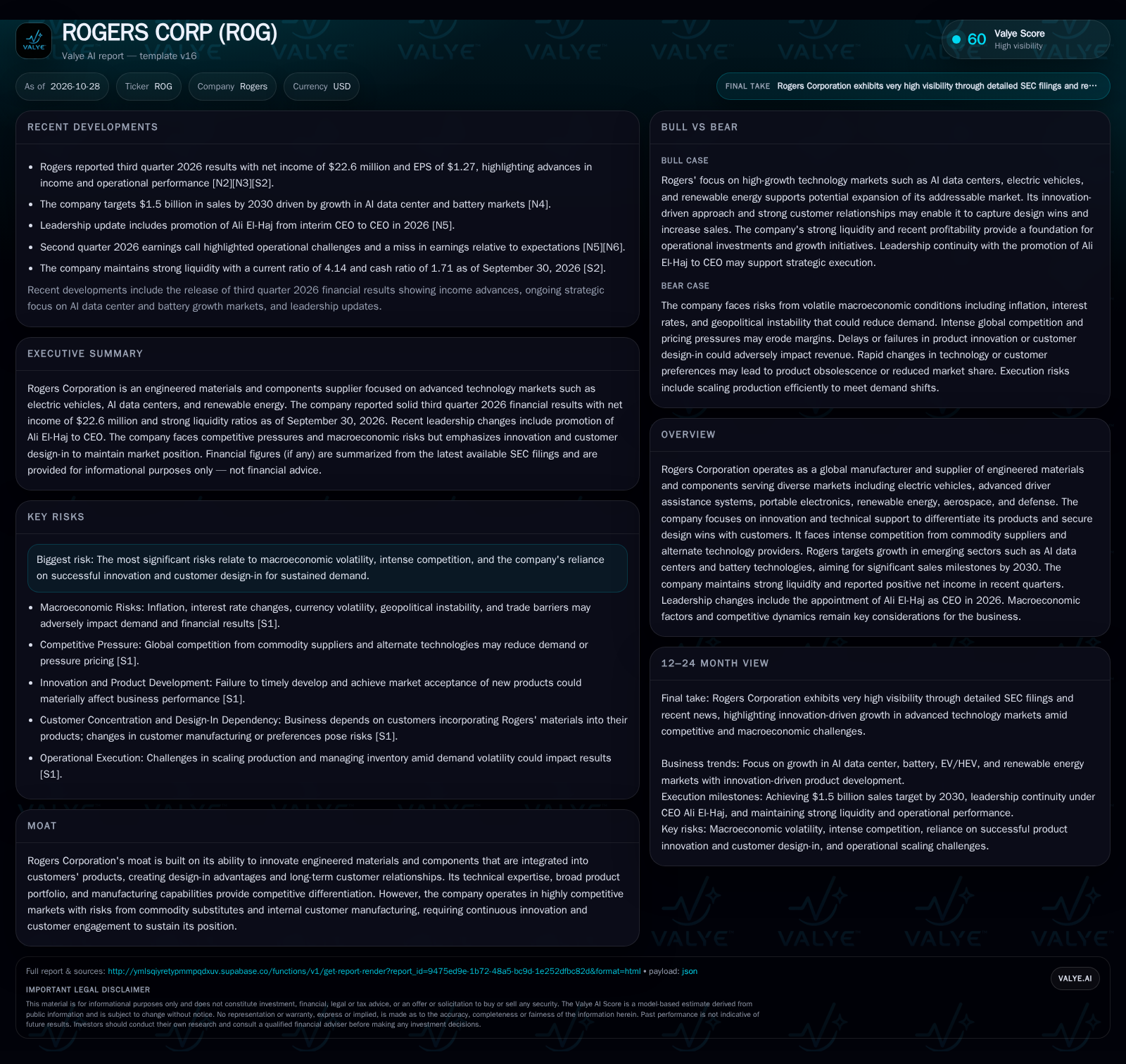
Rogers Corporation reported $22.6 million in net income and reported liquidity position for Q3 2026, with a strategic focus on high-growth sectors such as AI data centers and battery technology. The new CEO, Ali El-Haj, will drive the company toward a $1.5 billion sales goal by 2030, but success will hinge on sustaining innovation, design-in wins, and navigating fierce competition from commodity and alternative technology suppliers. Macroeconomic volatility and operational execution remain central risks.[N2] [N4] [S2]
Rogers Corporation stands at a critical juncture as it leverages its engineered materials expertise to pursue aggressive growth in advanced technology sectors. Reporting $22.6 million in net income for the third quarter of 2026 and maintaining reported liquidity position, Rogers is positioning itself to capture share in high-potential markets like AI data centers, electric vehicles, and battery technologies. The recent appointment of Ali El-Haj as CEO signals strategic continuity, yet the company’s ability to reach its ambitious $1.5 billion sales target by 2030 will depend on consistent innovation, successful customer design-in, and resilience against macroeconomic and competitive headwinds.
Recent Profitability, Liquidity, and Strategic Direction Define Rogers’ Near-Term Outlook
The company reported cash and liquidity metrics for the period; these figures do not by themselves establish operating runway, investment capacity, financial flexibility, or financing capacity. [N2] [N3] [S2] [N4] [N5]
How Rogers’ Business Model Converts Innovation into Revenue—and Its Economic Levers
Rogers generates revenue by supplying engineered materials and components—such as high-performance laminates, elastomers, and specialty foams—to customers in advanced sectors including electric vehicles, AI data centers, aerospace, and renewable energy. The business model depends heavily on securing customer ‘design-in’ wins, where Rogers’ materials become integral to the customer’s end product. This can create semi-recurring revenue streams as long as the end product remains in production, but it also exposes the company to risks from customer product cycles and potential insourcing.
Pricing power is nuanced: while innovation and technical differentiation may allow premium pricing in new or high-spec applications, the company faces ongoing pricing pressure from commodity suppliers and alternative technologies. Volume growth is tethered to the secular expansion of targeted end markets—such as EVs and AI infrastructure—but is vulnerable to macroeconomic slowdowns and technology substitution. The product mix is evolving toward higher-value segments, but the pace of mix improvement depends on the success rate of new product adoption.
Fixed costs in R&D, technical support, and advanced manufacturing create operating leverage, meaning incremental revenue from successful design-in wins can deliver outsized margin gains.
Competitive Landscape: Technical Differentiation Versus Commodity and Technology Substitution
Rogers’ competitive position is anchored in its technical expertise, breadth of engineered materials, and the ability to collaborate closely with customers to secure design-in status. This creates switching frictions, as customers are often reluctant to requalify alternative materials for complex or regulated applications. However, these advantages are not absolute. The company faces intense competition from both global commodity material suppliers—who can undercut on price—and alternative technology providers, including vertically integrated OEMs and new entrants leveraging novel materials or manufacturing processes.
The threat of substitution is particularly acute in rapidly evolving sectors like batteries, AI hardware, and automotive electronics, where performance and cost paradigms can shift quickly. Rogers must continually innovate to stay ahead of both established competitors and disruptive substitutes. In some segments, customer consolidation or insourcing (bringing materials development in-house) could reduce Rogers’ bargaining power and share of wallet. Long-term customer relationships and a reputation for reliability help mitigate churn, but the durability of these advantages will be tested as the technology landscape evolves.
Unlocking the $1.5 Billion Ambition: What Would Drive a Breakout Growth Cycle?
A favorable scenario would see Rogers capitalizing on secular surges in AI data center buildouts, EV adoption, and advanced battery deployment. By winning key design-in slots for next-generation platforms, Rogers could achieve outsized volume growth and capture higher-margin business as its materials become essential to large-scale deployments. Innovation in high-performance, differentiated materials—such as thermal management solutions for AI chips or advanced dielectrics for battery systems—could enable premium pricing and fend off commodity pressures.
Evidence that would confirm this scenario includes sequential acceleration in revenue from AI, battery, and EV end markets (if disclosed), a rising proportion of sales from new product categories, and margin expansion linked to mix improvement. Announcements of major customer design wins, multi-year supply agreements, or expanded manufacturing capacity would further validate the breakout thesis. Conversely, if sales growth remains tepid in targeted sectors or margin gains are absent despite end-market expansion, the upside scenario would be called into question.
Steady Progress and Execution Hurdles: Most Likely Outcomes for Rogers
The most plausible path for Rogers involves moderate growth anchored by incremental share gains in EVs, AI infrastructure, and renewable energy, offset by persistent competitive and macroeconomic challenges. Pricing pressure from commodity suppliers and the cyclical nature of some end markets could keep gross margins in check, even as the product mix gradually improves.
Confirmation of this scenario would come from stable or modestly growing revenue, maintenance of positive net income, and steady gross margins—even if not expanding meaningfully. If Rogers is able to consistently announce new design-in wins and demonstrate operational discipline (e.g., inventory management, cost control), it would support the base case. Signs of execution missteps, such as recurring earnings misses or inventory build-ups without corresponding sales growth, would suggest downside risk.
Where the Thesis Could Break: Margin Compression and Lost Relevance
A negative outcome would be driven by a combination of macroeconomic shocks (such as a sharp slowdown in EV or data center investment), intensifying price wars from commodity suppliers, or failure to keep pace with technology shifts. If Rogers is unable to win key design-in slots for next-generation platforms or if major customers shift to alternative suppliers or in-house solutions, revenue could stagnate or decline. Margin compression could accelerate if the company is forced to compete primarily on price or absorb higher input costs without offsetting volume growth.
Indicators confirming this scenario would include declining sales in core growth segments, sustained margin erosion, inventory write-downs, or a series of earnings disappointments. Loss of major customers, delays in bringing new products to market, or visible signs of customer insourcing would further undermine the investment case. If liquidity deteriorates due to operating losses or working capital stress, the downside scenario would be amplified.
Milestones and Markers That Will Determine Rogers’ Trajectory Through 2030
Sequential revenue growth in AI data center, battery, and EV end markets (if disclosed) would help test whether Rogers is capturing the targeted secular growth.
Gross margin trends and mix improvement—especially the share of revenue from new, higher-value products—would reveal whether innovation is translating into economic gains.
Design-in win announcements or major supply agreements with leading OEMs would indicate success in securing long-term customer integration.
Operational execution metrics, such as inventory turnover and working capital management, would signal discipline in scaling for demand volatility.
Net income consistency and avoidance of recurring earnings misses would serve as a litmus test for financial resilience.
R&D and capital expenditure levels (if disclosed) would clarify whether the company is investing sufficiently to sustain innovation leadership.
Customer concentration metrics and churn rates—if reported—would help assess the durability of Rogers’ customer relationships and switching frictions.
Disclaimer: This is research-only, informational analysis and not investment advice. It may include AI-generated interpretation and general industry context. Always verify important details using primary sources.

Comments