
Natural Health Trends Corp: Direct Selling Resilience Tested by Regulatory Flux and Market Headwinds
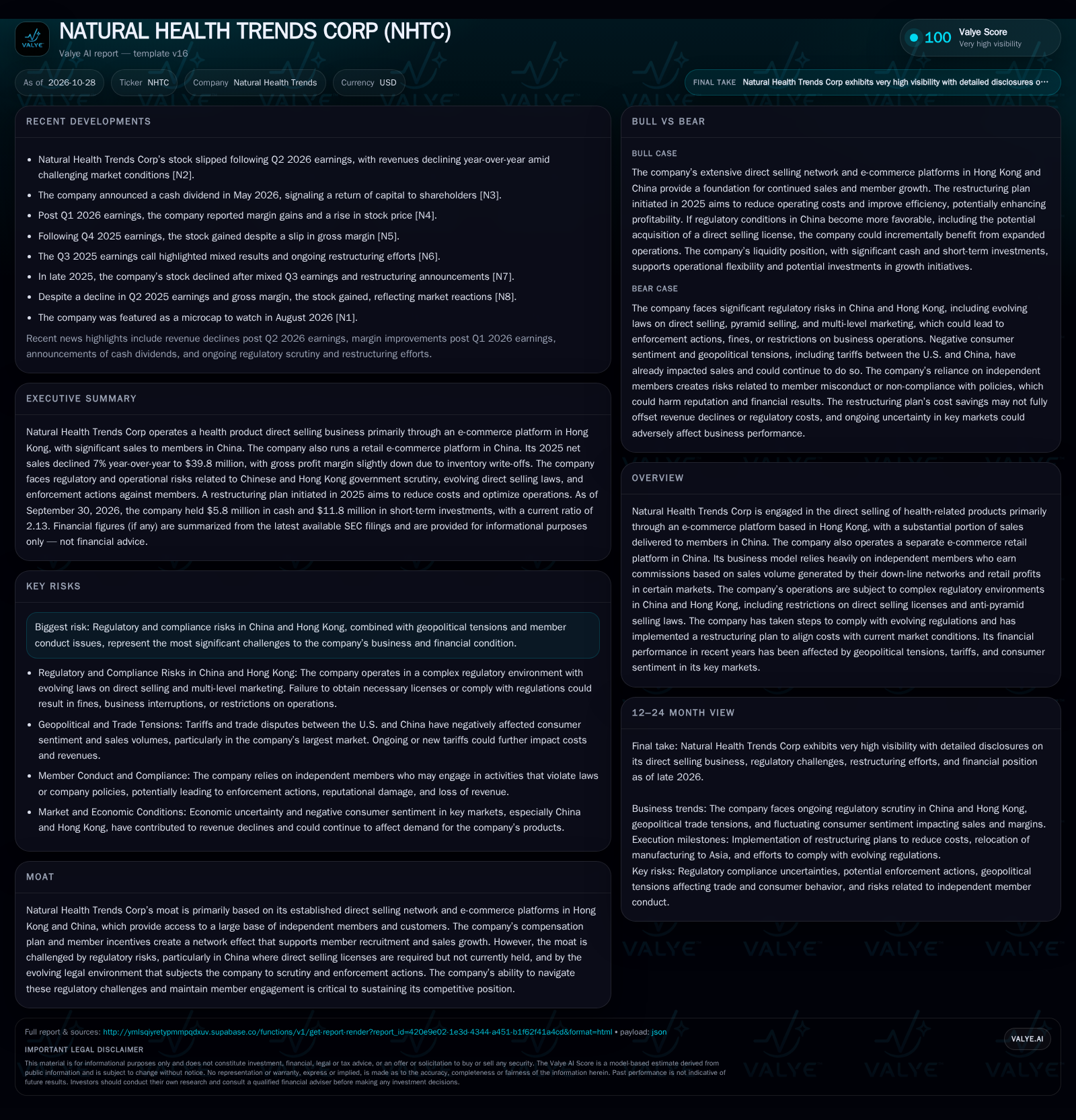
Natural Health Trends Corp’s core direct selling business faces intensifying regulatory scrutiny in China and Hong Kong, persistent consumer uncertainty, and a shrinking top line. While recent restructuring aims to stabilize margins and preserve liquidity, the company’s future hinges on regulatory clarity, member engagement, and the ability to adapt its model for evolving legal and market realities.
Natural Health Trends Corp’s 2026 results reflect declining sales and mounting regulatory pressure in its core Chinese and Hong Kong markets. [S2]
Natural Health Trends Corp operates at the intersection of regulatory complexity and volatile consumer demand, with its direct selling model in China and Hong Kong relying on a vast network of independent members. Despite a 2025 restructuring initiative designed to align costs with market realities, the company remains exposed to shifting legal frameworks, enforcement risks, and negative macroeconomic sentiment—especially in its largest markets.
Recent Results Underscore Regulatory and Market Strain
Natural Health Trends Corp reported net sales of $39.8 million for fiscal 2025, a 7% decline from $43.0 million in 2024, with Hong Kong sales also down by 7%—a drop management attributes to negative consumer sentiment and economic uncertainty. The company initiated a restructuring plan in 2025, including workforce optimization and manufacturing relocation to Asia, which is expected to yield approximately $1.5 million in annualized cost savings, though the exact timing and magnitude are subject to change. As of September 30, 2026, the company reported $5.8 million in cash, $11.8 million in short-term investments, a current ratio of 2.13, and a cash ratio of 1.7. However, Q3 2026 saw a net loss of $232,000, reflecting ongoing margin pressure and the challenge of offsetting revenue declines through cost reductions. [S2]
Regulatory and operational risks remain acute: the company withdrew its China direct selling license application in 2019 and intends to reapply only when conditions are favorable; success and timing are uncertain. The business continues to face scrutiny under Chinese and Hong Kong laws targeting direct selling, pyramid selling, and multi-level marketing, with enforcement actions against members historically leading to temporary suspensions and reputational risk. [S1] [S2]
Direct Selling Model Economics: Leverage, Costs, and Vulnerabilities
Natural Health Trends’ revenue is driven primarily by sales of health-related products through an e-commerce platform, with commissions paid weekly to independent members based on down-line purchases and, in select markets, retail profits. This model supports rapid geographic reach and low fixed overhead, but creates high variable costs: commissions accounted for approximately 41% of net sales in 2025. The company’s compensation plan includes caps and periodic modifications, providing management some levers to control payout levels and incentivize desired member behaviors, though abrupt changes risk destabilizing the network. [S1] [S2]
Cost structure is now more flexible following the 2025 restructuring, which included relocating manufacturing to Asia and workforce optimization—decisions that target $1.5 million in annualized cost savings. However, the model’s high dependency on down-line sales volume means that revenue shocks translate quickly into profit compression. Operating leverage is limited: while certain fixed costs have been reduced, the variable nature of the commission structure constrains margin expansion unless volumes recover meaningfully. The company reported cash and liquidity metrics for the period; these figures do not by themselves establish operating runway, investment capacity, financial flexibility, or financing capacity. [S2]
Network Effects, Regulatory Barriers, and the Threat of Disruption
Natural Health Trends’ principal competitive asset is its established network of independent sales members in Hong Kong and China, supported by e-commerce infrastructure and a compensation plan designed to incentivize recruitment and retention. This creates a network effect: the value of the platform increases with the number of engaged members, making it difficult for new entrants to match the reach and sales momentum.
However, this moat is challenged by several counterforces. Regulatory scrutiny in China is intense, with authorities targeting both illegal direct selling and pyramid selling schemes. The company’s lack of a direct selling license in China places it at a disadvantage relative to licensed peers, constraining its ability to market and recruit. Consumer trust in the category is fragile, especially following government crackdowns. Substitute channels—including mainstream e-commerce and social commerce platforms—offer alternative routes for health and wellness products, often with fewer regulatory entanglements and lower customer acquisition costs.
Competitively, Natural Health Trends is exposed to both established multi-level marketing firms with global compliance infrastructure and to local players more agile in adapting to Chinese regulatory nuances. The ability to navigate legal risks, sustain member engagement without running afoul of regulators, and differentiate product offerings will determine whether the existing network effect endures or erodes.
What Regulatory Easing and Member Engagement Could Unlock
A favorable scenario for Natural Health Trends would involve a combination of regulatory normalization, improved consumer sentiment, and successful adaptation of its compensation plan to reignite member activity. If the company is able to secure a direct selling license in China, it could unlock more aggressive marketing, recruitment, and potentially regain market share from less compliant competitors. This would likely be accompanied by a rebound in sales volumes and a more stable regulatory footing, reducing the risk of enforcement disruptions.
Successful execution of the 2025 restructuring—demonstrated by sustained margin improvement and maintained cash reserves—would further amplify upside potential. Evidence that would confirm this scenario includes: a material uptick in net sales and member recruitment in China, formal progress or approval on the direct selling license application, and sustained or rising gross margins despite regulatory costs. Conversely, continued stagnation in top-line growth or persistent regulatory uncertainty would falsify this pathway.
Adapting to Prolonged Regulatory Uncertainty and Tepid Demand
The most plausible near-term trajectory is one of cautious adaptation: Natural Health Trends continues to operate within the constraints of current Chinese and Hong Kong regulations, relying on its existing e-commerce and member platforms but unable to meaningfully expand without a direct selling license. The company focuses on cost discipline, extracting the targeted $1.5 million in annualized savings and maintaining liquidity, but faces continued revenue pressure as consumer sentiment in its core markets remains muted.
Confirmation of this scenario would include stable or modestly declining sales, evidence of expense control (e.g., lower SG&A as a percent of sales), and preservation of cash and investment balances. Falsification would come from either a regulatory breakthrough enabling expansion, or—conversely—a major enforcement action or further sales collapse that accelerates losses and erodes liquidity.
Regulatory Clampdown or Member Attrition Drives Accelerated Decline
A more adverse scenario would see regulatory authorities in China or Hong Kong intensifying scrutiny of direct selling and multi-level marketing, leading to fines, business interruptions, or outright restrictions on Natural Health Trends’ operations. Member misconduct—if widespread or highly publicized—could also trigger enforcement actions and reputational damage, causing rapid member attrition and a collapse in sales volume.
Economic shock or renewed tariff escalation between the U.S. and China could further erode consumer demand, amplifying top-line decline. In this scenario, cost savings from restructuring would be insufficient to stem losses, and liquidity could deteriorate quickly, forcing the company to curtail operations, seek external financing, or exit key markets. Evidence supporting this pathway would include regulatory warnings, legal actions, sharp sequential revenue declines, or material cash burn absent offsetting capital raises.
Factors That Will Shape Natural Health Trends’ Next Phase
Progress on the reapplication for a direct selling license in China—timing, official communications, or regulatory signals—would be a decisive catalyst for the business outlook.
Trends in net sales and member recruitment, especially within China and Hong Kong, would help test whether the core network remains resilient or is eroding.
Gross margin trajectory post-restructuring: improvement would indicate successful cost management, while further compression would signal persistent demand or pricing pressure.
Regulatory disclosures, enforcement actions, or government campaigns targeting the direct selling sector in China and Hong Kong should be closely monitored for impact on business continuity.
Changes in commission expense as a percentage of net sales would indicate shifts in member engagement or compensation plan effectiveness.
Any evidence of member misconduct, negative media coverage, or public enforcement actions would be highly relevant to future sales and reputation.
Disclaimer: This is research-only, informational analysis and not investment advice. It may include AI-generated interpretation and general industry context. Always verify important details using primary sources.

Comments