
Cadence Design Systems: Harnessing AI to Transform EDA Economics and Competitive Dynamics
Cadence's Q3 2026 results underscore robust AI-driven demand and an expanding platform that blends core EDA, silicon IP, and system-level simulation. The company's deep integration of AI, strategic acquisitions, and cloud delivery position it at the heart of semiconductor complexity—but competitive pressures, cyclical industry risks, and execution on new verticals remain central to the investment debate.
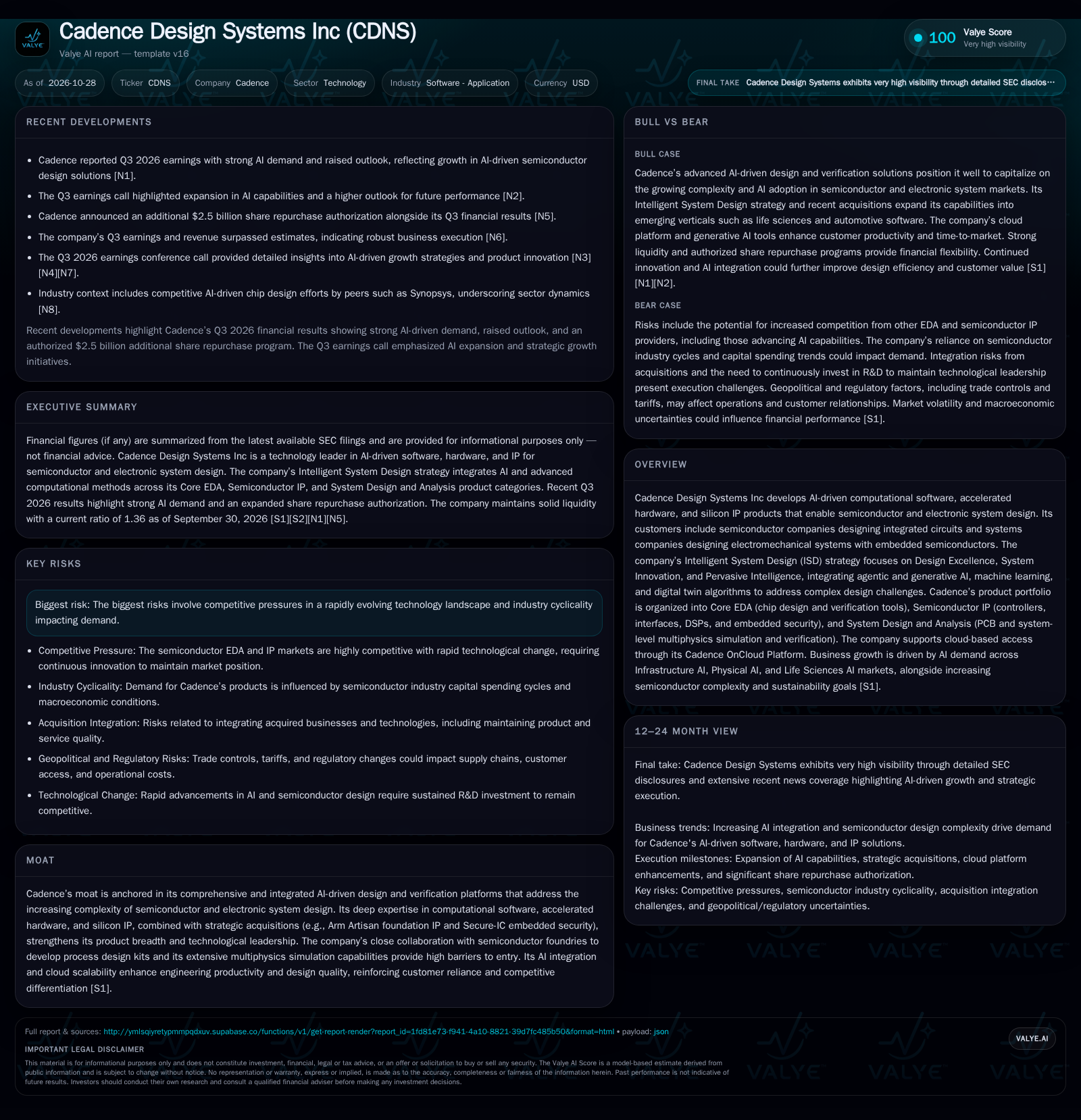
Cadence Design Systems delivered strong Q3 2026 results on the back of AI-driven demand, raising its outlook and authorizing an additional $2.5 billion in share repurchases. Its strategy centers on AI-powered EDA, silicon IP, and system-level tools, with a push into cloud and new verticals. The competitive landscape is intensifying—especially as rivals pursue their own AI integration—and Cadence’s ability to sustain technology leadership, expand into high-growth verticals, and navigate industry cycles will shape its long-term trajectory. [S1] [S2] [N1] [N2] [N5]
Cadence Design Systems stands at the intersection of two powerful trends: surging AI adoption and the escalating complexity of semiconductor and electronic system design. Its Q3 2026 results highlight not just robust financial execution but also the success of a strategy built on integrating AI into EDA tools, silicon IP, and system-level simulation. The addition of a $2.5 billion share repurchase authorization speaks to management’s confidence, but the real story lies in Cadence’s ability to defend its competitive moat as peers accelerate their AI initiatives and industry cycles remain unpredictable. The next phase for Cadence will be defined by its agility in sustaining technology leadership, scaling new verticals, and managing the operational challenges that come with rapid innovation.
Cadence’s Recent Momentum Fueled by AI Demand and Shareholder Engagement
Cadence reported strong financial performance for Q3 2026, driven by robust demand for AI-enabled design solutions. Net income for the quarter was $289.7 million, with basic EPS of $1.06 and diluted EPS of $1.05. The company ended the quarter with $1.452 billion in cash and equivalents and a current ratio of 1.36. These results were accompanied by a raised business outlook and the announcement of an additional $2.5 billion share repurchase authorization, signaling both operational strength and a commitment to shareholder returns. The Q3 earnings call and news coverage emphasized the centrality of AI in driving growth and highlighted Cadence’s ongoing investments in product innovation and platform expansion. [S2] [N1] [N2] [N5]
Monetizing Design Complexity Through Software, IP, and System Integration
Cadence’s revenue model is built around a mix of software licensing, hardware sales, and IP royalties. Traditional EDA software is typically sold via time-based licenses (subscription or term), creating recurring revenue and high gross margins. Hardware platforms (such as Palladium and Protium) for emulation and prototyping are sold or leased, often at high price points and with services or maintenance attached, yielding periodic but lumpy revenue. The semiconductor IP segment generates revenue through upfront license fees and ongoing royalties as customers deploy designs in volume silicon.
The integration of AI and machine learning into EDA tools has the potential to increase pricing power by delivering measurable improvements in design efficiency, performance, and time-to-market—critical value drivers for semiconductor and system companies racing to meet next-gen product cycles. As design complexity rises, customers may be more willing to pay premiums for solutions that compress development timelines and reduce risk. Meanwhile, the move toward cloud-based EDA (via Cadence OnCloud) could shift some revenue from perpetual or on-premise models to consumption-based or SaaS-like arrangements, potentially smoothing revenue recognition but requiring ongoing investment in cloud infrastructure and security.
Operating leverage is inherent in the software-heavy business model: incremental software sales generally carry minimal variable cost, while hardware and IP components introduce some margin variability. R&D and engineering investments remain high to maintain technological leadership and support new product launches, but scale in software and IP can drive margin expansion if growth persists.
Evaluating Cadence’s Competitive Moat Amid AI-Driven Industry Shifts
Cadence’s core competitive advantage lies in its integrated suite of EDA tools, deep IP portfolio, and system-level simulation capabilities—all increasingly enhanced by AI and cloud scalability. High switching costs are driven by the mission-critical nature of EDA tools, the steep learning curve for engineers, and the integration of Cadence software into customers’ design flows. Collaboration with leading semiconductor foundries and the development of process design kits (PDKs) further embed Cadence in the ecosystem.
However, the competitive landscape is intensifying. Traditional rivals, most notably Synopsys, are also investing aggressively in AI-driven design automation and system-level solutions. New entrants, including cloud-native EDA startups and hyperscale cloud providers, may seek to disrupt traditional license models or offer differentiated workflows. The risk of technology substitution—such as AI-native design tools that bypass legacy EDA workflows—remains a longer-term threat, particularly if open-source or vertical-specific solutions gain traction.
Cadence’s recent expansion into life sciences, automotive, and other verticals leverages its simulation and digital twin capabilities, but the company will face both established domain-specific software competitors and the challenge of adapting its core technology for new customer requirements.
Growth Opportunities Emerging from AI Adoption and Cloud Transition
If AI-driven design automation becomes standard across the semiconductor industry, Cadence could see accelerated adoption of its AI-enabled EDA suite, driving both higher pricing and expanded seat counts. Successful execution on cloud delivery could further lower adoption barriers, allowing smaller or geographically distributed design teams to access advanced tools without heavy upfront infrastructure investment. In this scenario, Cadence’s investments in generative AI, digital twin technology, and system-level simulation would reinforce its leadership and open new high-growth verticals—such as life sciences, automotive, and industrial digitalization.
Key confirming evidence would include sustained double-digit growth in software and IP revenue, increasing cloud adoption rates, and expansion of large enterprise contracts in new verticals. Additional signals could be major design wins with leading-edge semiconductor customers, successful integration of acquired technologies (e.g., Secure-IC for embedded security), and visible share gains relative to peers. If disclosed, metrics such as the proportion of revenue from AI-enabled or cloud-delivered products would provide concrete validation.
Maintaining Premium EDA Economics Despite Industry Cycles and Competitive Pressures
The most plausible trajectory for Cadence is continued growth at a premium to the broader semiconductor market, underpinned by rising design complexity, AI adoption, and sustained investment in R&D. Core EDA and IP products are likely to show steady expansion, with incremental gains from system-level simulation and new verticals. Cloud delivery may gradually increase as a portion of revenue, but the transition is likely to be measured as conservative customers balance security, performance, and regulatory considerations.
Competitive pressure is likely to intensify, particularly as major rivals enhance their own AI and cloud offerings. However, high switching costs and the mission-critical nature of Cadence’s tools should help sustain pricing and retention. Industry cyclicality will remain a headwind; periods of semiconductor capital spending slowdown may temper near-term growth, but the structural trend toward greater design complexity and AI integration should support long-term demand.
Evidence supporting this scenario would include mid-to-high single-digit annual revenue growth, stable or modestly expanding operating margins, and continued product launches or platform enhancements. Signs of customer retention, steady wallet share, and incremental vertical expansion would also confirm the base case.
Risks from AI-Native Competitors and Macro Challenges to Growth and Margins
A negative outcome could result if a disruptive technology—such as AI-native chip design platforms or low-cost open-source EDA—gains rapid traction, eroding Cadence’s pricing power and customer lock-in. Alternatively, if major semiconductor customers cut capital spending in response to macroeconomic shocks, geopolitical events, or inventory corrections, Cadence could face revenue and margin pressure.
Execution risk around integrating new acquisitions or expanding into verticals could also lead to higher costs and operational distraction. Competitive missteps—such as a lag in AI capabilities relative to peers, or failure to adapt to cloud-native workflows—would compound downside risk.
Evidence for this scenario would include revenue deceleration, customer losses or pricing concessions, margin compression, or missed product milestones. If disclosed, rising churn rates or a shrinking share of wallet among top customers would be red flags. Negative industry news regarding semiconductor demand or regulatory shocks could also signal downside risk.
Factors Influencing Cadence’s Market Position and Financial Outcomes
Trends in AI-enabled product adoption: If disclosed, growth in the proportion of revenue attributable to AI-driven EDA tools and platforms would indicate successful differentiation.
Cloud migration metrics: Uptake of Cadence OnCloud, including the number of customers, workload volume, or the share of revenue from cloud delivery, would clarify the pace of SaaS transition.
Revenue and margin trends in new verticals: Monitoring contributions and profitability from life sciences, automotive, and other system-level simulation markets will test expansion ambitions.
Competitive win/loss rates: Customer announcements, design wins, or disclosures of major competitive contracts would help assess share gains or losses to key rivals.
R&D intensity and capital allocation: Changes in R&D spend as a percentage of revenue, as well as the impact of share repurchases on long-term investment capacity, will indicate management’s commitment to innovation.
Integration milestones for recent acquisitions: Progress reports, product launches, or customer adoption tied to acquired technologies (e.g., Secure-IC) would test execution.
Semiconductor industry capital spending outlook: External signals from major chipmakers or foundries on capex trends will inform demand visibility for Cadence’s core products.
Customer retention and churn rates: If disclosed, these metrics would help validate the durability of Cadence’s installed base and pricing power.
Disclaimer: This is research-only, informational analysis and not investment advice. It may include AI-generated interpretation and general industry context. Always verify important details using primary sources.

Comments