
American Electric Power: Regulated Utility Scale, Capital Ambition, and the Challenge of Liquidity Constraints
AEP’s $100 billion capital plan and recent earnings growth underscore its ambition and regulatory resilience.
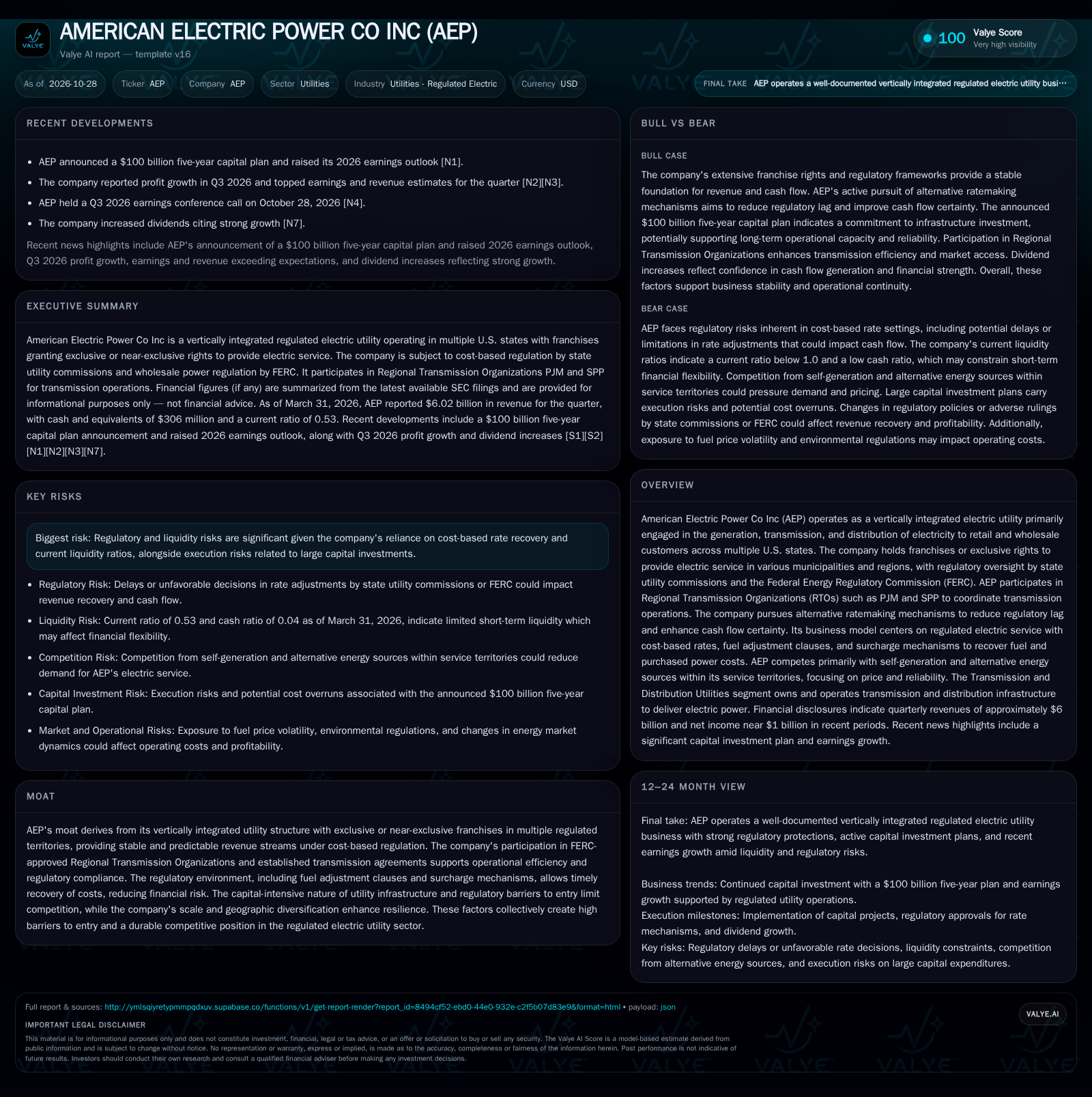
American Electric Power (AEP) reported Q3 2026 profit growth, raised its earnings outlook, and announced a $100 billion five-year capital plan, reflecting confidence in its regulated utility model. The company increased its dividend, but short-term liquidity remains tight, with a current ratio of 0.53 and a cash ratio of 0.04 as of March 2026. While AEP’s extensive franchise rights and cost-recovery mechanisms support stable revenues, execution on large-scale investments, regulatory risk, and competition from alternative energy sources pose ongoing challenges. Monitoring capital deployment, regulatory outcomes, and evolving market dynamics will be critical.
American Electric Power (AEP), one of the largest regulated electric utilities in the U.S., is pursuing an aggressive $100 billion capital investment plan while navigating the complexities of regulated rates, evolving energy demand, and increasing competition from alternative sources. The next phase for AEP hinges on capital deployment discipline, regulatory partner alignment, and adaptability to shifting customer and competitive dynamics.
Recent Profit Growth, Ambitious Investment, and Tight Liquidity Shape AEP’s Present
AEP reported profit growth in Q3 2026, surpassing both earnings and revenue estimates, and raised its 2026 earnings outlook—pointing to operational momentum and management confidence [N2] [N3] [N1]. The company simultaneously announced a $100 billion five-year capital plan, signaling a major commitment to grid modernization, transmission expansion, and long-term infrastructure resilience [N1]. The cited source reports dividend-related activity; that disclosure alone does not establish dividend-policy continuity, management confidence, or a material constraint on capital flexibility. [N7] [S2] These facts frame a company with significant long-term ambitions but near-term financial constraints, raising the stakes for successful execution and regulatory cooperation in the years ahead.
How Regulated Revenue, Cost Recovery, and Massive Capex Interact in AEP’s Model
AEP’s vertically integrated model generates revenue primarily through regulated electric service, with the majority of earnings derived from cost-based rates approved by state commissions and, for transmission and wholesale, by FERC. This system allows for a high degree of revenue predictability, as fuel, purchased power, and certain capital investments can be recovered via fuel adjustment clauses, trackers, or surcharge mechanisms. As a result, AEP’s core economics are characterized by high fixed costs (infrastructure, maintenance, and regulatory compliance) and relatively low variable costs per unit of electricity delivered.
The company’s announced $100 billion capital plan will likely be funded through a mix of retained earnings, debt issuance, and potentially equity, given the scale and the current liquidity snapshot. Large utility capex programs typically aim to expand regulated rate base, supporting future revenue and earnings growth if allowed by regulators. However, such plans introduce execution risk and elevate the importance of alternative ratemaking mechanisms (e.g., construction work in progress recovery, forward test years, and formula rates) to reduce regulatory lag and smooth cash flow. AEP’s short-term liquidity constraints may require careful pacing of project spend and/or refinancing, especially if capital markets or regulatory approvals become less favorable.
Regulatory Moats, Franchise Barriers, and the Threat of Distributed Alternatives
AEP’s competitive position is anchored by exclusive or near-exclusive franchise rights in multiple states—structural advantages that limit direct competition and provide stable customer bases. Regulatory frameworks and cost-recovery mechanisms further enhance predictability and help insulate the business from commodity price shocks. However, the company is not immune to competitive pressures: self-generation (including commercial and residential solar, battery storage, and microgrids) and alternative energy sources within its service areas represent credible threats to demand growth, especially as distributed technologies become more cost-effective and policy-supported.
Compared to independent power producers or unregulated energy providers, AEP benefits from regulatory protection but faces higher scrutiny on capital efficiency and customer rates. Its scale and transmission footprint, participation in RTOs, and capital access are advantages, but the capital intensity and pace of decarbonization required by policy and customers could compress returns if regulators resist full cost recovery or if alternative providers erode load growth. The next phase of competition will likely hinge on AEP’s ability to align capital investment with regulatory and customer priorities while defending its role as the default provider in its territories.
If Regulatory Alignment and Project Execution Hold, AEP Could Unlock Rate Base Growth and Enhanced Shareholder Returns
The favorable scenario for AEP is one where regulators continue to support forward-looking ratemaking, allow timely recovery of capital investments, and facilitate mechanisms that minimize regulatory lag. If the $100 billion capital plan is executed on time and on budget, AEP’s regulated rate base could expand materially, supporting multi-year revenue and earnings growth. This would likely underpin further dividend increases and potentially justify a premium valuation given the predictability and growth profile.
Evidence that would confirm this scenario includes repeated regulatory approvals for major projects, successful deployment of capital with minimal delays or cost overruns, and continued outperformance on earnings and cash flow. If customer rates remain competitive and load attrition from self-generation is limited, AEP’s scale and infrastructure investments could reinforce its position as a core beneficiary of grid modernization and electrification trends.
Most Likely: Steady Regulated Returns Tempered by Execution Hurdles and Modest Competitive Erosion
The most plausible outcome is that AEP achieves incremental rate base expansion and maintains stable regulated returns, but faces periodic regulatory pushback and execution delays on portions of its capital plan. Regulatory frameworks will likely provide cost recovery for most major investments, but some lag or partial disallowances may occur, especially if cost overruns or rate pressures emerge.
This scenario would be confirmed by a pattern of regulatory approvals interspersed with occasional delays or contested filings, capital spending in line with plan but with some project-level slippage, and financial metrics (earnings, cash flow) tracking within guided ranges. Modest customer attrition to self-generation or alternative providers may show up in flat or slightly declining load growth, but not enough to destabilize the core model.
If Regulatory or Market Shocks Hit, Capital Plan Could Stall and Liquidity Pressures Mount
The adverse scenario emerges if regulatory commissions or FERC delay or deny approval for major projects, disallow recovery of key investments, or impose rate freezes in response to customer or political pressure. Coupled with cost overruns or supply-chain setbacks, this could stall portions of the $100 billion capital plan and strain AEP’s already tight short-term liquidity, potentially forcing asset sales, dividend cuts, or dilutive equity issuance.
Downside evidence would include repeated regulatory setbacks, a spike in project delays or cancellations, rising short-term borrowing, and deterioration in credit metrics. If alternative energy adoption or self-generation accelerates beyond expectations, AEP could face margin compression and more pronounced load loss, further challenging its ability to earn allowed returns and fund capital commitments.
Testing AEP’s Thesis: Milestones and Metrics That Will Determine Its Trajectory
Regulatory approval timelines and final orders for major projects under the $100 billion capital plan.
Quarterly capital deployment rates and any disclosed project-level delays or cost overruns.
Updates to the current ratio, cash ratio, and short-term borrowing levels—especially if liquidity pressures increase or capital markets tighten.
Earnings and cash flow guidance versus actuals, particularly in relation to dividend coverage.
Any changes in customer load growth, especially commercial and industrial, or reported attrition to self-generation or alternative providers.
Disclosures or commentary regarding regulatory lag, contested filings, or partial disallowances of cost recovery.
Progress on alternative ratemaking mechanisms (e.g., use of riders, forward test years, formula rates) to accelerate cost recovery.
If disclosed, updates on credit rating agency outlooks or covenant compliance in the context of large capital commitments.
Disclaimer: This is research-only, informational analysis and not investment advice. It may include AI-generated interpretation and general industry context. Always verify important details using primary sources.

Comments