
GE Vernova’s Strategic Shift: Acquisitions, Scale, and the Complexities of Power Decarbonization
Riding a surge in Q3 profits and a raised 2026 outlook, GE Vernova’s position atop the global power value chain is being tested by supply chain volatility, capital intensity, and the realities of energy transition economics. The company’s next phase will hinge on its ability to monetize its massive installed base and execute on both innovation and acquisition integration.
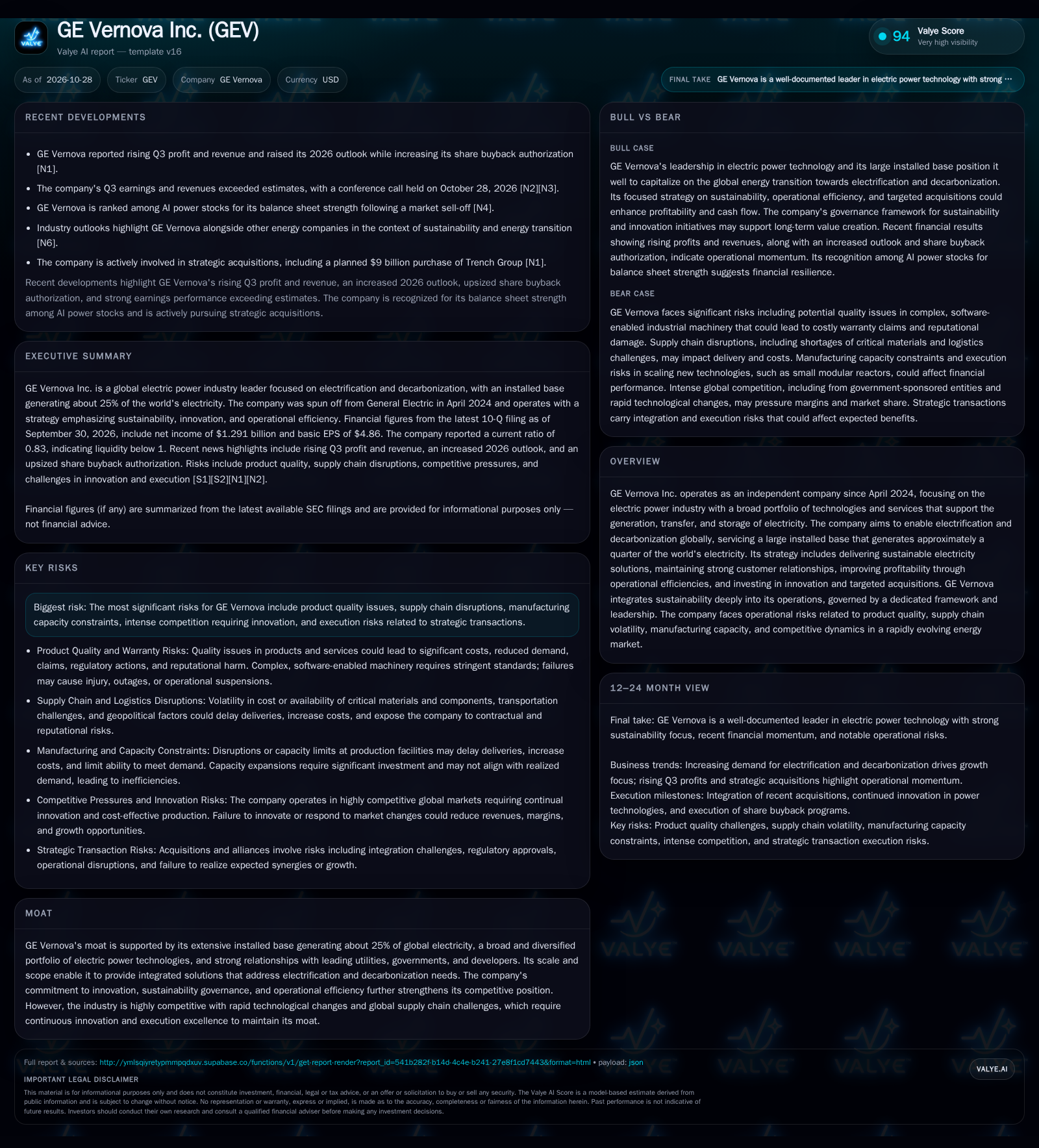
GE Vernova, spun off from GE in April 2024, now operates as a global leader in power generation, transmission, and storage. Its Q3 2026 profit and revenue exceeded estimates, driving an increased 2026 outlook and a larger share buyback. The company’s installed base generates roughly 25% of the world’s electricity, but a current ratio of 0.83 and a $9 billion acquisition plan signal capital allocation complexity. Execution on innovation, supply chain risk management, and integration of new assets will define its ability to sustain margins and growth in a fiercely competitive and capital-intensive sector. [S2] [N1] [N2]
GE Vernova’s transformation from a GE division into an independent power technology leader has produced immediate results: Q3 2026 profits and revenues outpaced expectations, and management responded by raising its 2026 outlook and authorizing a larger share buyback. The company’s global installed base, responsible for roughly a quarter of the world’s electricity generation, remains its most formidable asset. As the energy sector pivots toward decarbonization and grid modernization, GE Vernova’s ability to convert its installed-base advantage and innovation agenda into sustained margin expansion will be under close scrutiny. [S2] [N1] [N2]
Robust Profit Growth, Liquidity Constraints, and an Acquisition-Focused Strategy
GE Vernova reported net income of $1.291 billion and basic earnings per share of $4.86 for Q3 2026, outpacing analyst estimates and supporting a raised 2026 outlook. This operational momentum has been matched by an upsized share buyback authorization, signaling management’s short-term confidence. However, the company closed the quarter with current assets of $51.681 billion against current liabilities of $62.467 billion, yielding a current ratio of 0.83 and a cash ratio of zero—highlighting a tight liquidity position. The planned $9 billion acquisition of Trench Group underscores a willingness to pursue growth through scale, but also elevates the stakes for capital discipline and integration success. [S2] [N1] [N2]
Economics of Installed Base, Service Efficiency, and Capital Needs in Power Tech
GE Vernova’s business model relies on a combination of large-scale equipment sales (turbines, grid infrastructure, storage systems) and long-term service contracts for its massive installed base. The latter provides recurring, higher-margin revenue as customers depend on GE Vernova for maintenance, upgrades, and digital optimization. The economics of this model hinge on the durability and value of the installed base—equipment that generates approximately 25% of global electricity creates a recurring pipeline for service, retrofit, and software opportunities. However, the sector is capital-intensive: new installations, grid upgrades, and decarbonization projects require significant upfront investment, both for GE Vernova and its customers. Fixed costs—R&D, manufacturing infrastructure, and global logistics—are high, but can be leveraged if volume grows or service penetration deepens. Variable costs, especially for materials and logistics, add volatility, while customer capital cycles and regulatory changes can drive lumpiness in order flow.
The capital intensity inherent in GE Vernova’s sector also implies a delicate balance between funding innovation and managing working capital. Investments in new technology development and manufacturing capacity must be carefully timed to avoid overextension, especially given the long sales cycles and project timelines typical in power infrastructure. Moreover, the company’s ability to leverage digital tools—such as predictive maintenance and asset performance management—can materially improve service efficiency and customer retention, but these require upfront R&D and integration costs. Customer capital spending cycles, often influenced by regulatory policies and macroeconomic conditions, further complicate forecasting, making flexible capital allocation and scenario planning vital to sustaining growth and profitability.
Competitive Strength through Scale and Installed Base Amid Technological Risks
GE Vernova’s competitive advantage stems from scale, technological breadth, and its deep relationships with utilities and governments. Its installed base could increase switching friction: customers are often embedded in multi-decade service cycles, and the complexity of retrofitting or swapping core power infrastructure favors incumbents. However, the industry is fiercely competitive, with global peers ranging from industrial conglomerates to state-backed entities and fast-moving technology entrants targeting grid software and distributed energy. Rapid innovation—especially in grid-edge technology, renewables integration, and digitalization—means incumbency alone is no guarantee of future share. Pricing power is strongest in differentiated service and mission-critical upgrades, but can be eroded by price competition, regulatory mandates, or disruptive technology. Acquisitions like Trench Group could broaden the portfolio and reinforce the moat, but also introduce integration risk and the need to sustain technological leadership across a wider range of products and systems.
The interplay between scale and technological agility is central to GE Vernova’s competitive positioning. While a large installed base could increase switching costs and recurring revenue opportunities, it also demands continuous innovation to prevent obsolescence. Competitors with more focused technology portfolios or those leveraging modular, software-driven solutions may undercut traditional equipment-centric models. Consequently, GE Vernova must not only defend its core assets but also anticipate shifts toward decentralized energy resources, grid-edge intelligence, and hybrid systems integration. The company’s success will depend on its capacity to integrate acquisitions effectively, harmonize diverse technologies, and accelerate digital transformation initiatives that enhance customer value beyond hardware alone.
Margin Growth Fueled by Decarbonization Trends and Deeper Service Engagement
If global electrification and decarbonization initiatives accelerate, GE Vernova stands to benefit from rising demand for both new infrastructure and modernization of aging assets. Its installed base could serve as a springboard for high-margin service contracts, digital upgrades, and retrofit solutions, particularly as utilities seek to decarbonize without disrupting reliability. Successful integration of Trench Group could add both capability depth and cross-selling opportunities, while operational efficiency initiatives (lean manufacturing, portfolio streamlining) could further enhance margins. Confirmation of this scenario would include sustained revenue and margin growth, rising service contract penetration, and evidence that new technologies (e.g., grid software, advanced storage) are gaining commercial traction. A declining ratio of fixed costs to gross profit, or a shift in revenue mix toward services and digital, would further validate the thesis.
Increased regulatory emphasis on decarbonization could catalyze demand for GE Vernova’s advanced technologies and services, particularly if policy incentives align with infrastructure modernization timelines. Enhanced collaboration with utilities and governments to co-develop tailored solutions may open new revenue streams, while enabling earlier adoption of emerging technologies. Additionally, operational improvements in supply chain resilience—such as diversified sourcing and localized manufacturing—could reduce cost volatility and improve delivery timelines, further strengthening margins. If the company successfully leverages data analytics and AI-driven insights to optimize asset performance and customer engagement, it could deepen service penetration and create differentiated offerings that command premium pricing.
Maintaining Market Leadership Despite Capital Intensity and Execution Challenges
The most plausible trajectory is that GE Vernova maintains its leadership in global power equipment and services, benefiting from steady demand for grid modernization and decarbonization, but contending with cyclical order flow, pricing pressure, and supply chain volatility. Service revenues provide a buffer against equipment-cycle swings, but margin expansion is gradual due to competition and input cost fluctuations. Integration of acquisitions proceeds without major disruption, but does not deliver outsized synergies in the near term. Liquidity remains tight, requiring disciplined working capital and capital allocation, especially as large deals are absorbed. Evidence for this scenario would include stable or modestly rising revenues, flat-to-slightly improving margins, and no major deterioration in liquidity or order backlog. Setbacks in innovation commercialization, or persistent supply chain bottlenecks, would challenge the base case.
Risks from Supply Chain Disruptions, Quality Lapses, and Integration Failures
GE Vernova’s risk profile is acute: supply chain disruptions (materials shortages, logistics bottlenecks), product quality failures, or unsuccessful integration of acquisitions could erode both financial performance and customer trust. Cost overruns or delays in delivering new technology would jeopardize margin targets, while competitive encroachment—especially from digital-native entrants or aggressive state-backed players—could force price concessions and reduce service contract capture. A negative scenario would be marked by rising warranty or remediation costs, declining order intake, or an increase in net working capital needs that further strains liquidity. If the company is forced to curtail investment in innovation or slow acquisition integration due to funding constraints, its competitive position could erode quickly.
Evaluating GE Vernova’s Claims on Margins, Liquidity, and Innovation in Energy Shift
Service contract penetration and renewal rates—if disclosed—would clarify the stability and growth potential of recurring revenue streams.
Order backlog trends, especially for grid modernization and decarbonization projects, would indicate forward revenue visibility and customer demand health.
Gross margin progression and the service vs. equipment revenue mix, as available, would help test the impact of business model evolution and operational efficiency.
Integration milestones and realized synergies from the Trench Group acquisition would reveal execution quality and capital allocation discipline.
Warranty claims, product quality incidents, or major supply chain disruptions would be early warning signs for downside risk.
Commercial traction of new technologies (e.g., grid software, advanced storage solutions) would validate the company’s innovation agenda.
Any changes to credit facilities, debt covenants, or external funding arrangements would signal evolving liquidity risk or capital strategy.
Disclaimer: This is research-only, informational analysis and not investment advice. It may include AI-generated interpretation and general industry context. Always verify important details using primary sources.

Comments