
Valero Energy: Margin Windfall, Liquidity Strength, and the Cyclical Realities of Modern Refining
Yet, the durability of these results hinges on volatile commodity cycles, regulatory shifts, and the pace of energy transition.
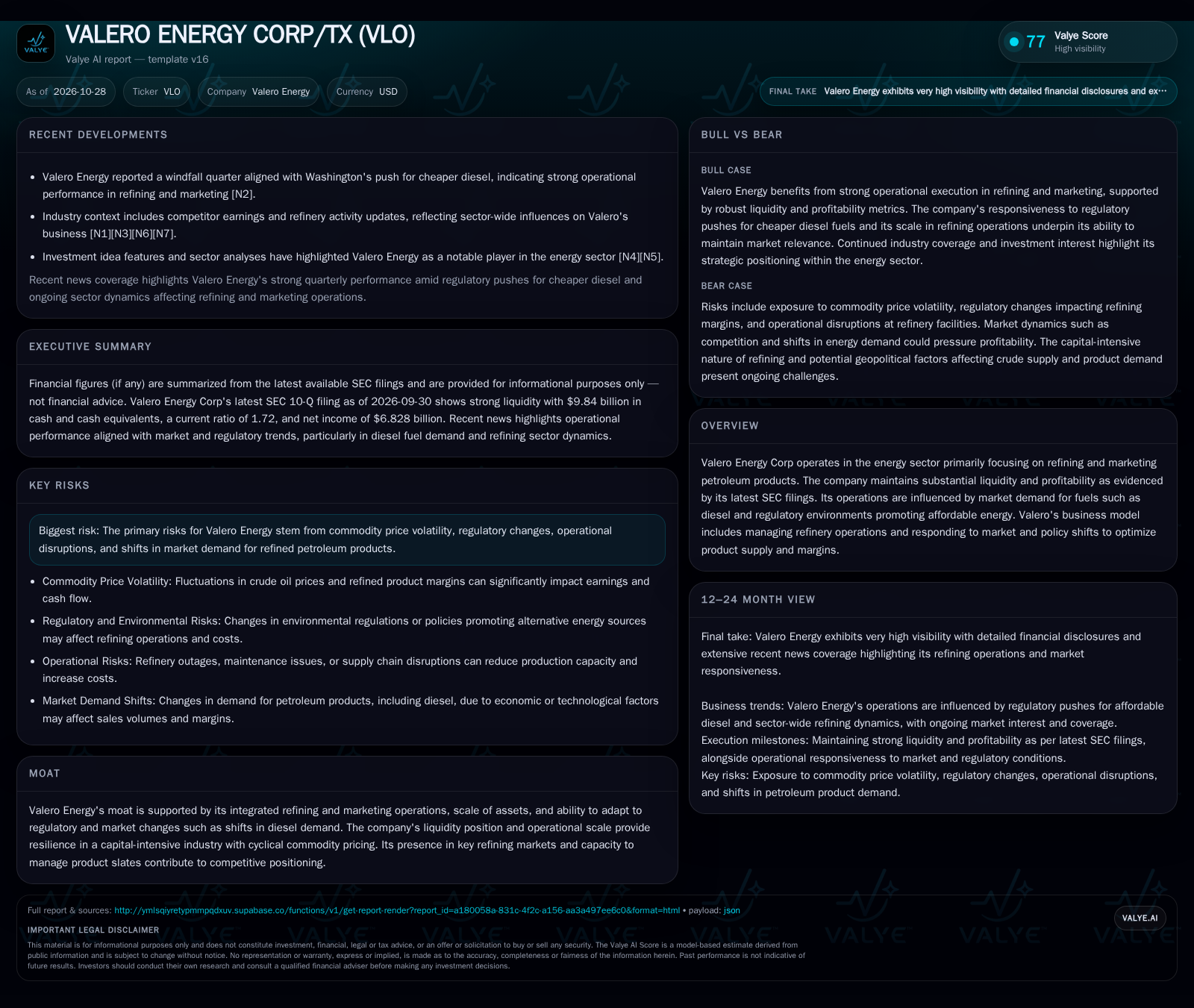
Valero Energy delivered a windfall quarter with $6.828 billion in net income and $9.84 billion in cash as of September 2026, reflecting strong refining margins and operational execution [S2] [N2].
Valero Energy’s latest financials capture the high-wire act of modern refining: the company parlayed robust market conditions into $6.8 billion in quarterly net income and amassed nearly $10 billion in cash reserves [S2]. This windfall, in step with broader policy pushes for affordable diesel, demonstrates Valero’s ability to monetize its scale and operational agility when market tides are favorable [N2]. Yet, the sustainability of such results is inherently uncertain, as the refining sector’s fortunes are dictated by commodity cycles, regulatory winds, and the accelerating energy transition. Investors and industry observers must parse not only the numbers, but the mechanisms that could amplify—or erode—Valero’s current momentum.
Windfall Profits and Liquidity: Valero’s Recent Performance in Focus
Valero Energy reported $6.828 billion in net income for the period ending September 30, 2026, with basic diluted EPS of $23.90/$23.89, and held $9.84 billion in cash and cash equivalents [S2]. The company reported cash and liquidity metrics for the period; these figures do not by themselves establish operating runway, investment capacity, financial flexibility, or financing capacity. [S2] This quarter’s results were propelled by strong refining margins, coinciding with policy initiatives to keep diesel prices low [N2]. These figures matter because they highlight Valero’s ability to convert favorable market and policy conditions into exceptional short-term profitability and a robust balance sheet. However, the volatility of these drivers raises questions about sustainability as industry cycles and regulatory regimes evolve.
Refining Economics: Margin Capture, Operating Leverage, and Capital Intensity
Valero’s core business—refining and marketing petroleum products—relies on the ability to optimize product mix, throughput, and feedstock sourcing in response to shifting commodity prices and demand. Refining is a margin business: profits are derived from the ‘crack spread’ between crude input costs and refined product selling prices. When spreads widen, as seen in the latest quarter, operating leverage can drive outsized gains in net income. However, fixed costs remain high—refineries are capital-intensive assets requiring ongoing investment in maintenance, safety, and regulatory compliance. Variable costs, notably for feedstock and energy, can swing sharply, compressing margins during downturns. The need for periodic large-scale capital expenditures, coupled with swings in working capital, means that even with strong cash generation, reinvestment and debt servicing are constant demands. While recent results illustrate high margin capture, the long-term economics remain cyclical and sensitive to both external shocks and internal execution.
A critical factor influencing refining economics is the integration of advanced process technologies that enhance yield optimization and energy efficiency. Refineries capable of adjusting their configurations to maximize high-value product outputs, such as diesel and jet fuel, can better withstand margin compression periods. Additionally, the timing and scale of capital investments in upgrading facilities to process heavier or more sour crude grades can materially affect feedstock flexibility and cost structures. However, such investments carry execution risks and may not pay off if crude differentials narrow or demand patterns shift unexpectedly. Hence, the interplay between capital allocation decisions and evolving crude slate economics forms a key determinant of long-term profitability.
Navigating a Shifting Competitive and Policy Landscape
Valero’s scale, liquidity, and operational flexibility provide advantages in a fragmented North American refining sector. As one of the largest independent refiners, Valero can optimize feedstock sourcing, access diverse markets, and benefit from economies of scale in procurement and logistics. Yet, the sector is intensely competitive, with peers ranging from integrated oil majors to regional independent refiners. The main competitive levers are refinery complexity, geographic location, and the ability to adjust product slates to market signals. Substitutes—such as biofuels, electric vehicles, and alternative energy sources—are gradually eroding long-term demand for refined products, especially gasoline. Regulatory and policy pressures, including emissions standards and renewable fuel mandates, introduce cost uncertainty and may require significant capital outlays for compliance. The recent focus on affordable diesel suggests short-term policy alignment, but the longer-term trend is toward decarbonization and demand substitution.
Geopolitical developments and trade policies also shape the competitive landscape by influencing crude supply sources, export opportunities, and regulatory compliance costs. For example, tariffs or sanctions on certain crude grades can alter feedstock availability and pricing, while cross-border fuel trade restrictions may limit market access. Refiners with diversified asset footprints and logistical capabilities are better positioned to navigate these complexities. Moreover, the pace of adoption of alternative fuels and electrification varies regionally, affecting demand trajectories differently across markets. Consequently, Valero’s strategic positioning must consider not only domestic factors but also international market dynamics and policy environments that could impact competitive advantages.
The refining sector’s exposure to environmental, social, and governance (ESG) considerations is increasingly influencing capital markets and stakeholder expectations. Investors and regulators are scrutinizing carbon intensity, emissions reduction plans, and community impacts, which may translate into higher compliance costs or capital allocation shifts. Companies that proactively integrate ESG frameworks into their operations and strategic planning may gain access to more favorable financing and partnership opportunities. Conversely, failure to adapt could result in reputational risks and elevated cost of capital. Thus, the ability to balance traditional refining economics with evolving ESG imperatives is becoming a critical competitive factor shaping long-term resilience.
Margin Expansion Sustains: What an Extended Run Could Look Like
If refining margins remain elevated—due to persistent supply constraints, robust end-market demand, or delayed capacity additions—Valero could continue to deliver outsized earnings and cash flow. Confirmation would come from sustained high crack spreads, stable or growing refined product demand (especially diesel and jet fuel), and muted regulatory headwinds. Evidence such as consecutive quarters of high net income, ongoing policy support for domestic refining, and limited new capacity announcements from competitors would support this scenario. Falsification would occur if margins revert sharply, demand weakens, or regulatory costs escalate, compressing profitability.
Volatility Returns: Earnings Normalize as Cycles Reassert Themselves
The most plausible trajectory is a reversion to mean: refining margins moderate as supply chains normalize, policy headwinds and tailwinds offset, and demand for petroleum products plateaus or slowly declines. Valero’s earnings and cash generation would decline from peak levels but remain robust due to scale, operational discipline, and prudent capital management. Confirmation would be quarterly net income and margins that track historical averages, steady maintenance capex, and balanced capital allocation. Falsification would be a persistent deviation from historical margin bands—either due to a structural supply shortfall or an abrupt demand collapse.
Margin Compression and Demand Disruption: Adverse Cycles Take Hold
In a downside scenario, global or regional demand for refined products could fall sharply—due to recession, accelerated electric vehicle adoption, or aggressive regulatory action. Simultaneously, crude feedstock prices could rise or remain volatile, compressing crack spreads and rendering some refining capacity uneconomic. Valero’s fixed cost base would amplify the impact, potentially forcing asset rationalizations or capital project deferrals. Confirmation would come from consecutive quarters of margin compression, rising inventories, negative free cash flow, and indications of capacity shutdowns or write-downs in the sector. Falsification would be resilience in earnings despite adverse macro conditions, indicating strong cost control or superior asset positioning.
Benchmarks to Assess the Durability of Valero’s Margin Advantage
Quarterly crack spread trends for Valero’s refining regions, if disclosed, would clarify margin sustainability.
Refined product sales volumes and product mix evolution—especially shifts toward diesel, jet fuel, or renewable fuels—would help test demand resilience.
Capital expenditure updates, including maintenance versus growth spend, would signal management’s confidence and strategic priorities.
Developments in U.S. and global regulatory policy—such as emissions standards or renewable fuel mandates—could materially alter cost structures and compliance needs.
Competitive capacity changes, including refinery restarts or closures by peers, would affect industry utilization and margin dynamics.
Evidence of cost discipline or operational efficiency gains, such as reductions in per-barrel operating expenses, would support margin durability.
Working capital swings and changes in inventory levels, if disclosed, would provide insight into market positioning and potential margin risks.
Announcements of strategic investments in renewables or low-carbon technologies would signal adaptation to long-term demand shifts.
Disclaimer: This is research-only, informational analysis and not investment advice. It may include AI-generated interpretation and general industry context. Always verify important details using primary sources.

Comments