
Clean Harbors: Recurring Revenue, Acquisition Strategy, and Competitive Dynamics in Environmental Services
Clean Harbors’ Q3 2026 results highlight strong profitability and a robust balance sheet, supported by recurring revenue streams and disciplined acquisition activity. As competition in environmental and industrial services intensifies, the company’s ability to extract value from recent technology investments and integration of acquired businesses will be critical to sustaining growth and maintaining margins.
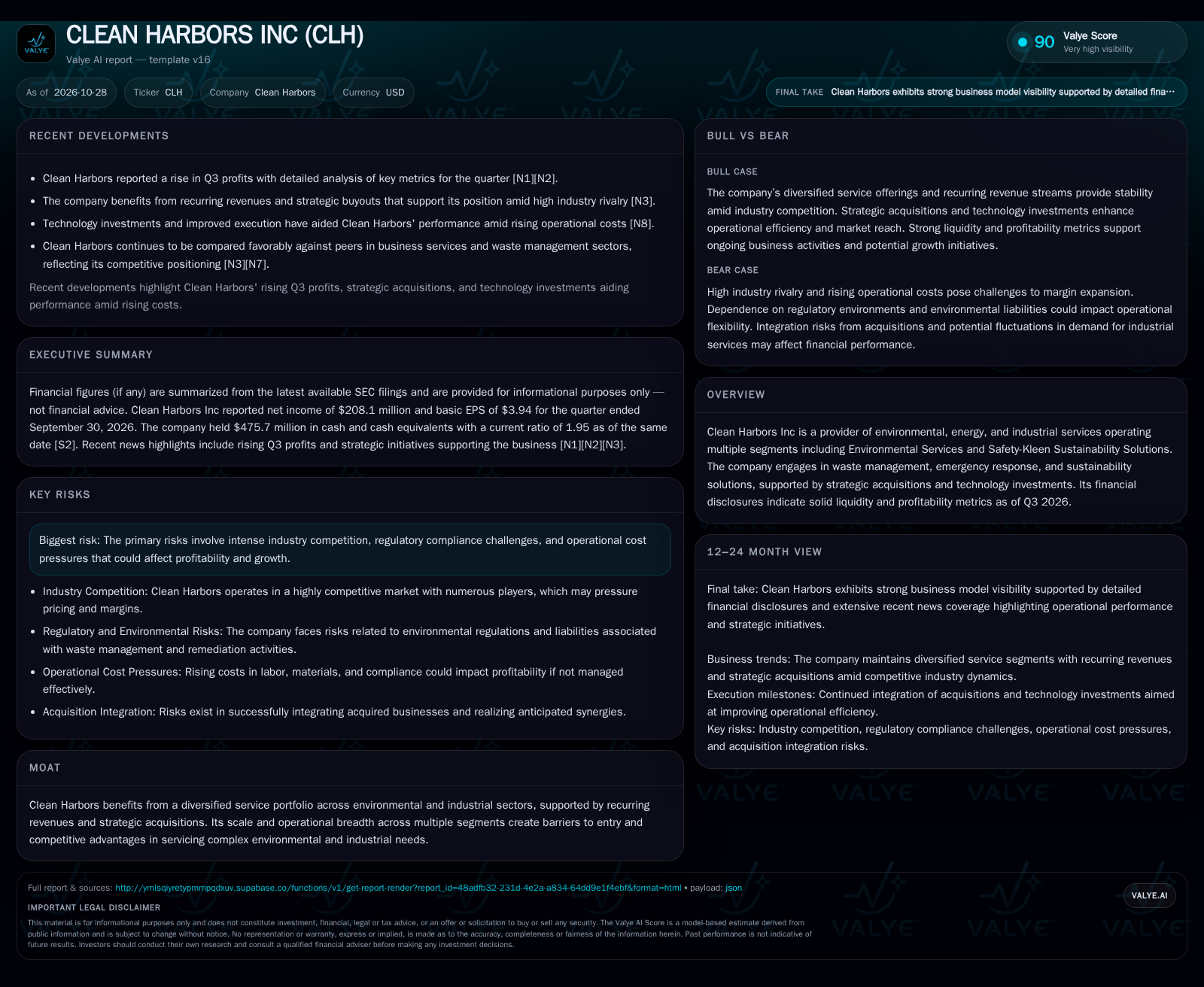
Clean Harbors reported $208.1 million in net income for Q3 2026, with reported liquidity position and a current ratio of 1.95. Recurring revenues and a history of strategic acquisitions anchor the company’s position in the highly competitive environmental services sector. Execution on technology upgrades and integration synergies will be central to margin resilience as operational costs rise and regulatory complexity persists. [S2] [N1] [N3]
Clean Harbors enters the final quarter of 2026 with a combination of strong profitability, reported liquidity position, and a diversified portfolio spanning environmental, industrial, and sustainability services. The company’s Q3 results show not only headline earnings strength but also underline the importance of recurring revenues and strategic acquisitions in a sector defined by regulatory complexity and high competitive pressure. As Clean Harbors continues to invest in technology and operational improvements, its ability to leverage scale and integration will likely determine how much of its current momentum can be converted into durable long-term advantage.
Profitability Trends, Liquidity Status, and Strategic Outlook
Clean Harbors reported net income of $208.1 million for Q3 2026, with basic earnings per share of $3.94 and a diluted EPS of $3.93 [S2]. [S2] These results come amid ongoing growth in recurring revenues and continued strategic acquisition activity, reinforcing Clean Harbors’ position as a scaled player in environmental and industrial services [N3]. The company’s focus on technology investments and improved execution has been cited as supporting factors for recent performance gains [N1] [N2].
Converting Scale and Operational Complexity into Cash Flow
Clean Harbors’ revenue model is anchored in recurring service contracts for waste management, emergency response, and sustainability solutions. These contracts, typically with industrial and government clients, provide a degree of revenue visibility and buffer the business against cyclical swings in individual end-markets. The company’s multi-segment structure—including Environmental Services, Safety-Kleen Sustainability Solutions, Technical Services, Industrial Services, and Field and Emergency Response—enables cross-selling and operational leverage, particularly as environmental compliance requirements drive demand for bundled, specialized solutions [S1].
Operating leverage can be achieved as fixed costs—such as facility maintenance, specialized equipment, and regulatory compliance—are spread over a larger revenue base. However, variable costs (labor, materials, disposal fees) remain significant, and rising operational costs can quickly erode margin gains if not offset by pricing power or efficiency improvements. The capital intensity of the business, especially for hazardous waste treatment facilities and collection infrastructure, requires disciplined reinvestment and prudent balance-sheet management. Strategic acquisitions have historically supplemented organic growth, but successful integration is essential to realize synergies and avoid value dilution.
Clean Harbors’ Market Position within Environmental Services
The environmental and industrial services sector is characterized by high regulatory barriers, substantial capital requirements, and intense rivalry among both large national players and regional specialists. Clean Harbors’ scale, multi-segment service offering, and history of recurring revenues provide meaningful differentiation, especially in servicing complex, multi-site industrial clients and government entities [N3].
However, competition from both diversified waste management companies and nimble regional operators remains fierce, often leading to pricing pressure and the need for ongoing innovation. Technology investments—such as digital tracking, process automation, and advanced treatment methods—may offer operational advantages if Clean Harbors can execute effectively. The company’s acquisition-driven growth strategy also positions it as a consolidator, but this brings integration risks and the need to maintain service reliability and regulatory compliance across an expanding geographic footprint.
Realizing Synergies and Driving Margin Gains Through Execution
A favorable outcome for Clean Harbors would be realized if the company can successfully integrate recent acquisitions, capture operational synergies, and maintain pricing discipline despite external cost pressures. If technology investments continue to yield process efficiencies—reducing variable costs or enabling premium pricing for advanced compliance services—Clean Harbors could expand margins even as competition intensifies.
Evidence confirming this scenario would include sustained or rising operating margins, a stable or improving cost structure relative to peers, and above-industry growth in recurring revenues. Announcements of successful integration milestones, new cross-segment service wins, or customer retention gains following technology rollouts would further support the upside thesis.
Pursuing Growth While Managing Acquisition Integration and Cost Pressures
The most plausible near-term trajectory for Clean Harbors is continued growth, tempered by the need to absorb ongoing operational cost inflation and the challenges of integrating acquired businesses. Recurring revenue streams and a diversified segment portfolio should provide a floor for earnings, but margin expansion will likely be incremental, dependent on the company’s ability to pass through costs and realize efficiency gains from technology upgrades.
This scenario would be confirmed by stable profitability metrics, modest improvements in cash flow conversion, and regular updates on acquisition integration progress. Conversely, any signs of margin compression, elevated integration costs, or loss of major contracts due to execution missteps would challenge the base thesis.
Potential Margin Challenges from Inflation, Integration Risks, or Regulatory Changes
Clean Harbors’ results could deteriorate if external cost pressures—such as labor, disposal, or compliance expenses—outpace the company’s ability to raise prices or drive internal efficiencies. Failure to integrate new acquisitions effectively could result in duplicate costs, operational disruptions, or loss of customer trust, further eroding profitability. Regulatory changes or environmental incidents could trigger unexpected liabilities, remediation costs, or reputational damage.
Downside evidence would include declining operating margins, negative cash flow trends, unexpected charges related to integration or compliance, or public disclosures of regulatory violations or major contract losses.
Factors Influencing the Success of Clean Harbors’ Acquisition and Margin Strategy
Reported operating margins and any commentary on drivers of margin expansion or contraction, especially in the context of cost inflation and technology investments.
Integration updates for recent acquisitions—qualitative or quantitative metrics on synergy capture, cost savings, or retention of acquired customer relationships, if disclosed.
Trends in recurring revenue as a percentage of total revenue—would help test the durability of Clean Harbors’ revenue base in the face of industry volatility.
Disclosures or news reports regarding major regulatory changes, enforcement actions, or environmental incidents that could impact compliance costs or operational flexibility.
Evidence of new multi-segment service contracts or cross-selling success, particularly following technology rollouts or acquisition integration.
Comparative analysis of cost structure and cash flow conversion versus sector peers—a useful metric would be peer-relative SG&A and capital intensity, if disclosed.
Customer retention rates or churn, especially in core industrial and government segments, would clarify the company’s competitive stickiness if Clean Harbors chooses to disclose these metrics.
Disclaimer: This is research-only, informational analysis and not investment advice. It may include AI-generated interpretation and general industry context. Always verify important details using primary sources.

Comments