
POOL CORP: Recurring Revenue Engine in a Fragmented Outdoor Living Supply Chain
POOL CORP leverages scale, breadth, and digital platforms to dominate pool supply distribution, but its fortunes remain tightly linked to discretionary spending and macro housing trends. With maintenance-driven sales providing ballast, the company’s push into proprietary brands and digital customer engagement will be tested by industry cyclicality, margin pressures, and evolving competitive threats.
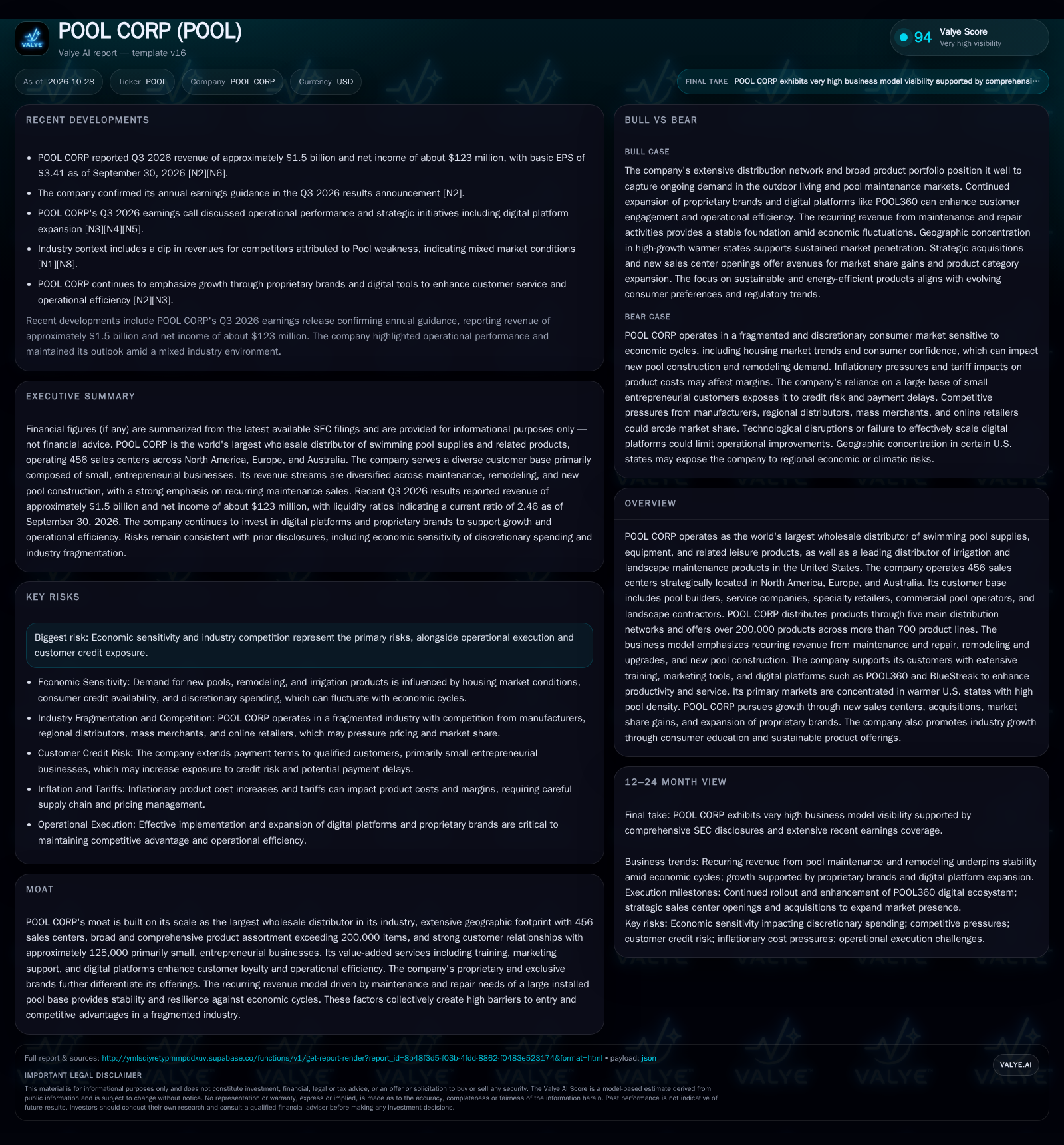
POOL CORP confirmed its annual earnings guidance for 2026, highlighting the resilience of its recurring maintenance-driven revenue base even as competitors report revenue dips tied to pool market softness. The company’s scale, broad assortment, and digital initiatives support its leading position, but its exposure to economic cycles, inflation, and credit risk among small business customers present ongoing challenges. Execution on digital enablement and proprietary product expansion will likely determine the next phase of margin and share gains. [N2] [N1]
POOL CORP sits at the crossroads of scale-driven distribution and the cyclical realities of the outdoor living market. As the world’s largest wholesale distributor of swimming pool supplies, it has built a formidable moat through geographic reach, a vast product portfolio, and deep relationships with a fragmented base of small business customers. The company’s 2026 performance, marked by confirmed earnings guidance amid sectoral headwinds, underscores the stabilizing power of maintenance-driven recurring revenue. Yet, its dependency on discretionary consumer spending, especially for new pool construction and remodeling, means macroeconomic currents could quickly alter its trajectory. The next chapter for POOL CORP will hinge on its ability to drive operational leverage from digital platforms and proprietary products while navigating economic and competitive crosswinds.
2026 Earnings Guidance Holds Amid Mixed Industry Signals
POOL CORP confirmed its annual earnings guidance in its Q3 2026 results, even as broader industry indicators reflected revenue softness at competitors due to pool market weakness. This resilience is notable given that 64% of POOL CORP’s 2025 sales came from recurring maintenance and minor repair, which tend to be less sensitive to short-term economic swings than construction or remodeling activity. The company’s ongoing investments in proprietary brands and digital platforms were highlighted as strategic priorities in recent communications. These facts suggest POOL CORP is leveraging its recurring revenue base and operational agility to sustain performance while peers face headwinds. [N2] [N1] [N3]
Recurring Revenue and Product Breadth Anchor the Economic Model
POOL CORP’s economics are anchored by a high share of recurring sales: about 64% of sales in 2025 were tied to regular pool maintenance and minor repairs, with only 14% from new pool construction and the rest from remodeling and upgrades. This mix insulates the business from the full volatility of housing market cycles, as existing pool owners must continue to purchase chemicals, replacement parts, and related supplies. The company’s scale enables efficient purchasing from a broad supplier base and rapid distribution through 456 sales centers, supporting both volume and margin.
Margins are likely supported by a combination of private-label product penetration (which can drive higher gross profit than third-party brands) and value-added services such as training and digital ordering platforms. The company reported cash and liquidity metrics for the period; these figures do not by themselves establish operating runway, investment capacity, financial flexibility, or financing capacity. [S2]
Operating leverage may be realized as digital platform adoption increases customer order frequency and reduces manual processing costs. However, inflationary pressures on product costs and the need to extend credit to small business customers could compress margins if not managed proactively.
Scale, Service, and Digital Integration Differentiate in a Crowded Field
POOL CORP’s prominent position is rooted in its scale, breadth of assortment (over 200,000 products), and ability to offer value-added services to its 125,000 customers, most of whom are small, entrepreneurial businesses. Its network of five distribution brands and geographic coverage—especially in high-pool-density states like California, Florida, Texas, and Arizona—creates high switching costs and logistical barriers for would-be entrants.
The company’s proprietary brands and digital platforms (POOL360, BlueStreak) add layers of differentiation by embedding POOL CORP deeper into customer workflows and offering tools that may be difficult for smaller rivals or less tech-enabled distributors to replicate. Nevertheless, the industry remains fragmented, and competitive pressure is mounting from regional distributors, mass merchants, and online retailers who could leverage scale or digital reach for price competition. Manufacturer-direct distribution also presents a potential disintermediation threat if larger suppliers seek to bypass intermediaries.
While POOL CORP’s moat is robust, it is not unassailable. Sustained investment in digital tools, exclusive products, and customer support will be necessary to defend margins and share.
Digital Ecosystem and Proprietary Brands Unlock Margin Expansion
The most favorable scenario for POOL CORP rests on continued penetration of proprietary brands and accelerated adoption of its digital platforms. If customers increasingly order through POOL360 and BlueStreak, POOL CORP could see higher order frequency, improved customer retention, and lower service costs. Expansion of exclusive and private-label product lines may further enhance gross margins, as these offerings can command higher profitability and increase customer dependency on POOL CORP’s ecosystem.
A supportive macro backdrop—such as stable or rising home values and robust consumer discretionary spending—would reinforce demand for remodeling and upgrades, amplifying the company’s recurring revenue engine. Confirmation of this scenario would come from rising gross margin percentages, increased digital order penetration (if disclosed), and continued outperformance relative to peers on sales center productivity and customer retention.
Maintenance Revenue Cushions Cyclicality, but Margin Pressures Persist
The most plausible trajectory is for POOL CORP to maintain steady performance anchored by its large installed base of pools and recurring maintenance sales, even as new construction and remodeling fluctuate with the economic cycle. Modest gains in proprietary brand penetration and digital adoption may offset some inflationary and competitive pressures, but overall margin expansion is likely incremental rather than dramatic.
Industry fragmentation persists, and while POOL CORP may continue to win share through acquisitions and new sales center openings, price competition and input cost volatility could weigh on profitability. Confirmation would be the maintenance of stable gross and operating margins year-over-year, sales growth roughly tracking the installed base expansion, and digital platform usage rising gradually. If proprietary brand sales or digital penetration stall, or if margin compression accelerates, it would challenge this base scenario.
Economic Downturn or Execution Missteps Expose Vulnerabilities
A sharp downturn in housing markets or discretionary consumer spending could trigger a drop in new pool construction and remodeling, eroding the 36% of revenue tied to non-recurring categories. If maintenance spending also comes under pressure—such as during a severe recession or weather-driven usage declines—POOL CORP’s top line could contract, especially given its concentration in a handful of climate-sensitive states.
Operationally, failure to execute on digital platform upgrades or expand proprietary brands could allow competitors to erode share, particularly if online retailers or mass merchants ramp up price competition. Additionally, credit risk from small business customers could materialize if defaults rise, pressuring working capital and cash flow. Evidence of this scenario would include declining sales center productivity, deteriorating receivables, margin compression, and digital or proprietary product initiatives missing adoption targets.
Milestones and Metrics That Will Shape POOL CORP’s Next Phase
Trends in gross and operating margin percentages, especially relative to proprietary brand penetration and inflationary input costs.
Sales center productivity and same-center sales growth, as indicators of market share gains or losses.
Adoption rates for digital platforms (POOL360, BlueStreak), such as percent of orders placed digitally, if disclosed.
Growth in proprietary and exclusive brand sales as a share of total revenue.
Receivables quality and days sales outstanding, particularly given the customer base’s credit risk profile.
Year-over-year changes in sales from new pool construction and remodeling, as a barometer of discretionary demand.
Geographic performance in primary states (California, Florida, Texas, Arizona) to assess regional economic or climatic impacts.
Acquisition activity and the pace of new sales center openings, which could signal continued market consolidation or expansion.
Disclaimer: This is research-only, informational analysis and not investment advice. It may include AI-generated interpretation and general industry context. Always verify important details using primary sources.

Comments