
Constellium SE: Specialty Aluminum Leverage, End-Market Cycles, and the Challenge of Margin Resilience
Constellium’s Q3 2026 results showcase robust revenue growth and raised guidance, but beneath headline expansion lies a margin balancing act amid volatile aluminum prices, cyclical demand, and evolving end-market requirements. The company’s ability to sustain high value-added positioning and operational discipline will determine how much of its recent momentum proves durable.
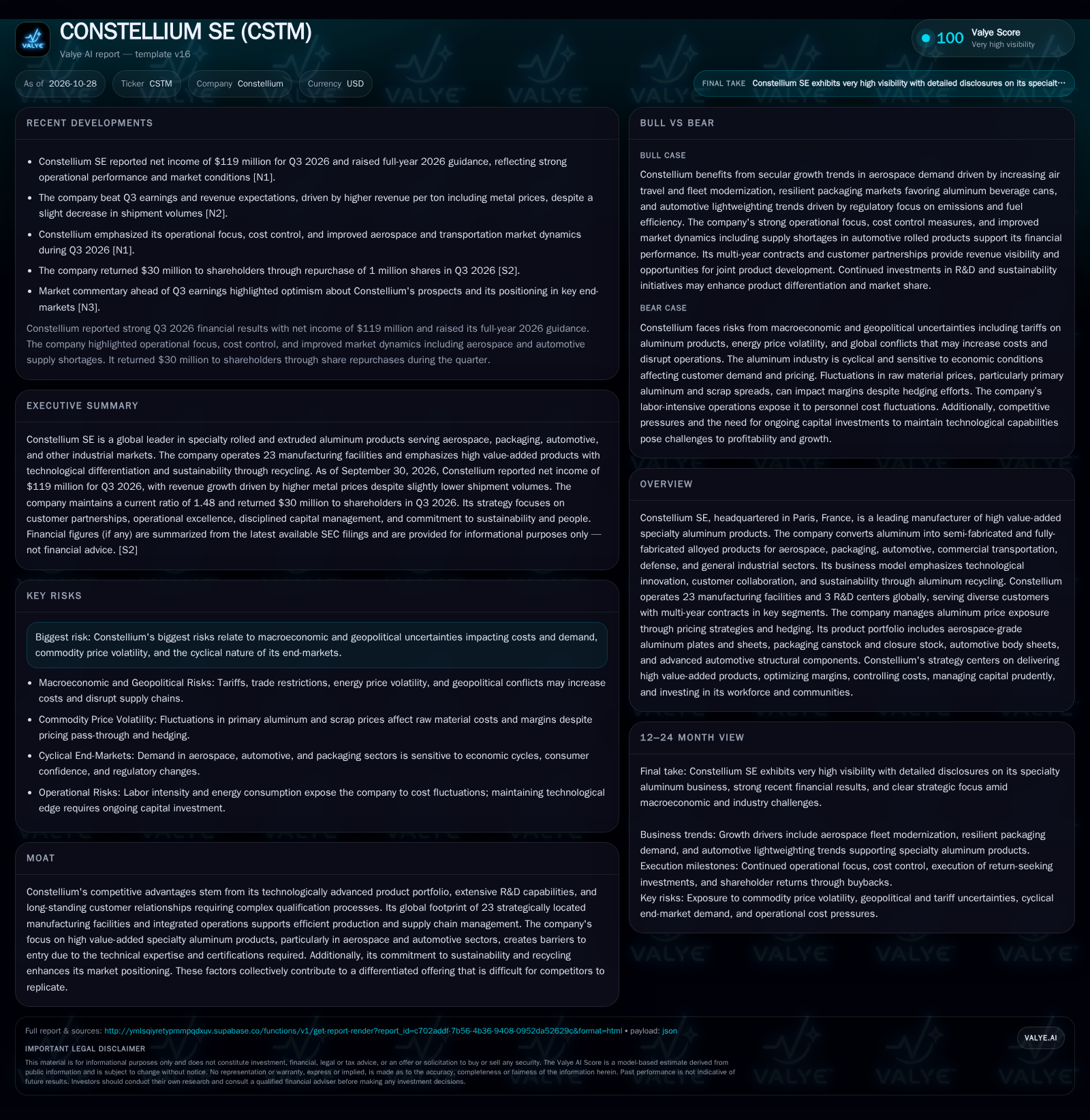
Constellium delivered strong Q3 2026 results, with 22% revenue growth driven by higher prices, offsetting a slight decline in shipments. Its focus on specialty aluminum products for aerospace, packaging, and automotive remains central, supported by multi-year contracts and R&D-driven differentiation. Yet the company faces persistent macro and commodity risks, and recent cost increases highlight the fragility of margin gains. The sustainability of Constellium’s outperformance depends on maintaining pricing discipline, operational efficiency, and end-market demand.
Constellium SE’s latest quarter highlights both the strengths and vulnerabilities of a specialty metals business operating at scale. While Q3 2026 saw a significant revenue boost and raised guidance—thanks in large part to higher aluminum prices and resilient demand in core segments—the company’s cost base also rose, narrowing the gap between pricing power and input inflation. With its business model anchored in high value-added aluminum solutions for aerospace, packaging, and automotive, Constellium’s long-term success depends on its ability to convert innovation and customer stickiness into durable margins, even as it faces energy volatility, tariffs, and cyclical headwinds.
Q3 2026: Pricing Power Offsets Volume Softness, but Cost Pressures Mount
Constellium reported Q3 2026 revenue of $2.639 billion, a 22% increase compared to the prior year, primarily attributable to higher revenue per ton driven by increased metal prices. However, shipment volumes declined by 1%, indicating that topline growth was not volume-led but price-driven [S2] [N1].
Net income for the quarter reached $119 million, with basic EPS of $0.87. The company returned $30 million to shareholders through the repurchase of 1 million shares, reflecting confidence in ongoing cash generation [S2].
Cost of sales rose 23% in the quarter, largely due to higher raw material and metal prices, highlighting Constellium’s ongoing exposure to commodity volatility despite hedging and pricing pass-through mechanisms [S2].
Segment mix reveals that Packaging & Automotive Rolled Products (P&ARP) remains the core engine, contributing 62% of revenue and 58% of adjusted EBITDA, while Aerospace & Transportation (A&T) and Automotive Structures & Industry (AS&I) provide diversification but less margin heft [S2].
How Constellium Earns: Value-Added Conversion, Pricing Pass-Throughs, and Margin Tension
Constellium’s business model is built on converting primary and recycled aluminum into semi-fabricated and fully-fabricated, high-specification products for customers in aerospace, packaging, automotive, and industrial sectors. Its ability to command premium pricing rests on technical requirements, stringent qualification processes, and integration with customer development cycles—especially for aerospace and automotive applications [S1].
Revenue is influenced by a mix of metal price pass-throughs, product mix, and contractual terms. The company aims to achieve aluminum price neutrality by embedding metal costs in product pricing and using hedging for any residual exposure [S1]. However, cost of sales remains sensitive to raw material price swings and energy inputs, as seen in the 23% year-over-year increase in Q3 2026 [S2].
High fixed costs from 23 manufacturing sites and significant R&D investments provide leverage in upcycles but can compress margins in downturns. Multi-year contracts, especially in aerospace and automotive, offer some revenue visibility but may include price adjustment clauses that lag input cost changes.
Capital needs are driven by asset maintenance, technology upgrades, and recycling infrastructure. The company reported cash and liquidity metrics for the period; these figures do not by themselves establish operating runway, investment capacity, financial flexibility, or financing capacity. [S2]
Technological Differentiation and Customer Integration: Defenses Against Commoditization
Constellium’s competitive position is anchored in its ability to deliver highly engineered aluminum products that meet demanding performance and regulatory standards. In aerospace, long qualification cycles and mission-critical applications create switching frictions and favor incumbents with proven track records [S1]. In automotive, the shift toward lightweighting and electrification increases demand for specialized alloys and structural components, but also attracts new entrants and puts pressure on pricing.
Packaging, particularly beverage canstock, is relatively resilient and less cyclical, but faces substitution risk from alternative materials and intense price competition. The company’s focus on recycling and sustainability supports its positioning with large beverage customers, who are increasingly sensitive to environmental credentials.
Global competitors include other specialty aluminum producers and vertically integrated metals companies, many of which have access to similar technology and global footprints. Barriers to entry are material in aerospace and advanced automotive, but less so in packaging and general industrial applications.
Constellium’s R&D investment and close customer collaboration are critical for maintaining differentiation, but the pace of innovation and adoption of alternative materials (such as composites or high-strength steels in automotive) could alter the competitive landscape.
Margin Expansion if Pricing Discipline and End-Market Growth Outpace Input Inflation
A favorable scenario for Constellium would involve sustained or accelerating demand in aerospace (driven by fleet renewals and air travel growth), continued resilience in packaging, and a broadening automotive recovery with an emphasis on lightweighting and EV adoption. In this environment, Constellium could leverage its high value-added mix to push through further price increases or maintain premium pricing, while benefiting from operating leverage as volumes recover.
Sustained cost discipline, successful hedging, and further adoption of recycled aluminum could mitigate input price pressures and expand margins. Evidence for this scenario would include stable or rising EBITDA margins, continued revenue growth outpacing cost inflation, and incremental share gains in key end-markets.
Additional confirmation would come from new multi-year contract wins in aerospace or automotive, higher R&D-driven product launches, and further shareholder returns via buybacks or dividends. A falsification would be a sharp deterioration in segment margins or inability to pass through rising costs, even as end-market demand remains firm.
Margin Maintenance Amid Cost Volatility and Mixed End-Market Signals
The most plausible near-term outcome is that Constellium maintains its margin structure by balancing pricing actions with ongoing cost pressures, against a backdrop of mixed end-market demand. Aerospace and packaging remain supportive, but automotive and general industrial segments may see uneven recovery or destocking.
The company is likely to continue managing aluminum price exposure through a combination of contractual pass-throughs and hedging, but may not be able to fully offset energy or labor cost increases. EBITDA and net income may remain stable, but with limited margin expansion unless revenue mix shifts further toward higher-margin segments.
Supporting evidence would be continued stability in segment EBITDA contributions, absence of major contract losses or customer churn, and disciplined capex or buyback activity. Falsification would be a material decline in segment profitability, elevated cost escalation outpacing pricing, or signs of demand softening in core segments.
Margin Compression if Cost Pressures Persist or End-Market Demand Falters
An adverse scenario would see cost inflation—especially for aluminum, scrap, and energy—outpacing Constellium’s ability to pass through increases, eroding gross margins. This could be compounded by weakening demand in one or more major end-markets due to macroeconomic slowdown, extended automotive inventory corrections, or a downturn in aerospace deliveries.
Tariff escalation, supply chain disruptions, or geopolitical events could further inflate costs or reduce export opportunities.
Confirmation would come from declining EBITDA margins, negative operating leverage, reduced buybacks or dividends, and possible liquidity management actions such as increased borrowing or working capital drawdowns. Falsification would be if the company managed to keep margins stable despite external shocks, signaling a more robust hedging and pricing framework than expected.
Signals That Will Determine the Durability of Constellium’s Margin Profile
Quarterly EBITDA margin trends by segment—especially whether P&ARP and A&T can sustain or expand their profitability as input costs fluctuate.
Volume trends in core end-markets, particularly aerospace shipments and automotive structural components, as indicators of demand resilience or softness.
Evidence of new or renewed multi-year contracts in aerospace and automotive, and whether pricing terms allow for timely pass-through of input cost increases.
Aluminum, scrap, and energy cost indices relative to Constellium’s realized pricing per ton—would help test the effectiveness of hedging and pricing strategies.
R&D and capital expenditure levels, if disclosed, as signals of ongoing innovation and asset competitiveness.
Shareholder returns (buybacks/dividends) versus reinvestment in operations, as a gauge of capital allocation discipline under differing market conditions.
Any operational disruptions, tariff/regulatory changes, or geopolitical developments impacting manufacturing costs or export volumes.
Disclaimer: This is research-only, informational analysis and not investment advice. It may include AI-generated interpretation and general industry context. Always verify important details using primary sources.

Comments