
Old National Bancorp: Profitability Momentum, Regional Banking Dynamics, and the Pursuit of Sustainable Advantage
Old National Bancorp’s record Q3 2026 results highlight both recent execution and the ongoing strategic balancing act of regional banking: defending margins and growth amid evolving credit, liquidity, and competitive pressures.
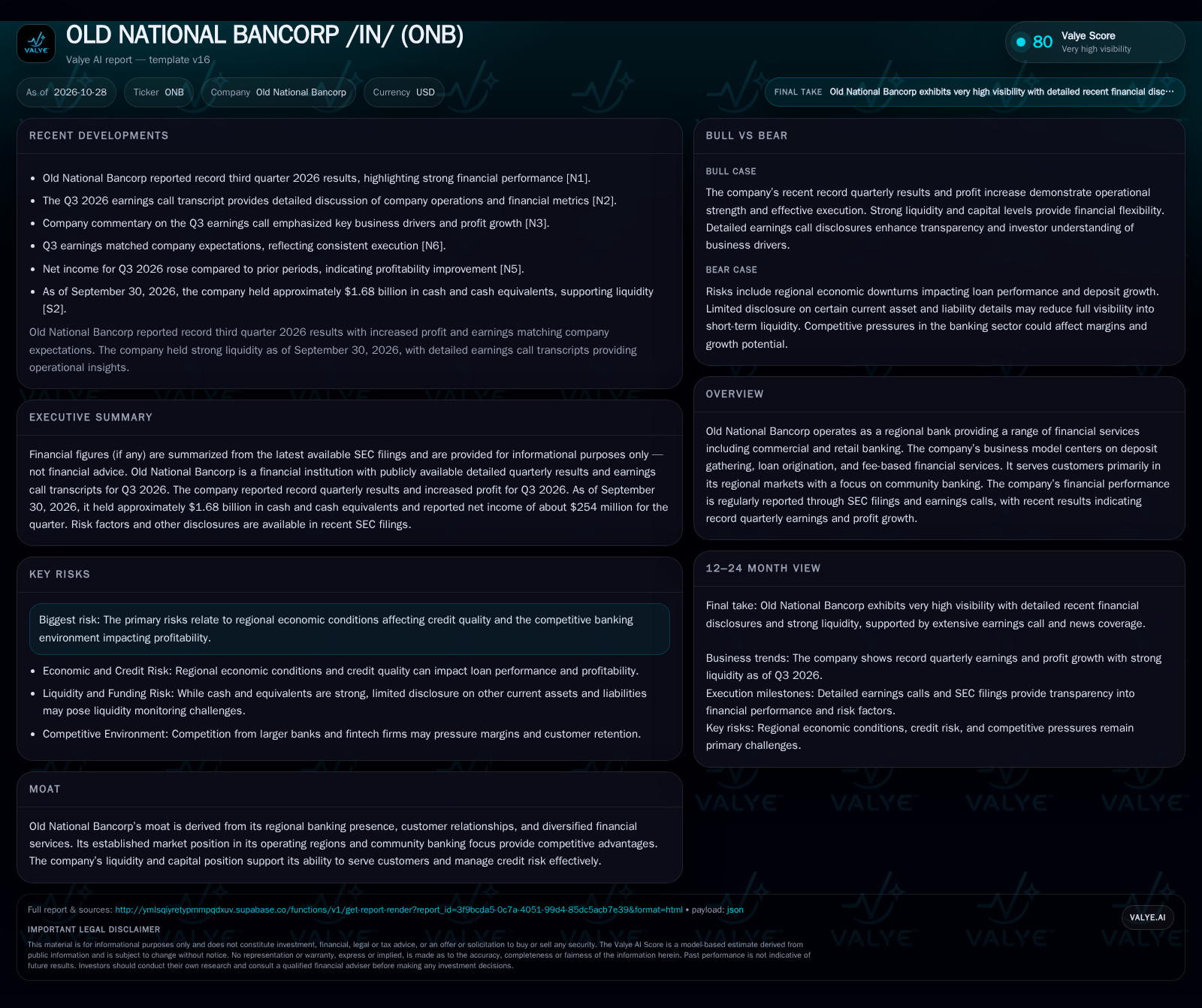
Old National Bancorp reported record Q3 2026 results, including net income of $254 million and cash holdings of $1.68 billion as of September 30, 2026. These results indicate improved profitability and strong cash reserves, but visibility into short-term reported liquidity position by partial asset and liability disclosure. The company’s outlook hinges on regional economic conditions, competitive responses, and its ability to sustain operational leverage.
Old National Bancorp’s third quarter 2026 results reflect both the strengths and the evolving challenges of a well-established regional bank. The next phase will test whether recent momentum can translate into durable advantage.
Recent Profit Surge and Cash Position Set the Stage for Strategic Decisions
Old National Bancorp reported net income of approximately $254 million for Q3 2026, a record for the company and an increase over prior periods [S2] [N5]. This profit performance matched management expectations and was highlighted as a sign of operational strength [N6]. The company reported cash and liquidity metrics for the period; these figures do not by themselves establish operating runway, investment capacity, financial flexibility, or financing capacity. [S2] These record results underscore improved profitability and cash generation, but also spotlight the importance of understanding the durability and sources of these gains in a competitive and potentially volatile regional banking environment.
How Old National Bancorp Makes Money: Core Banking Economics and Leverage Dynamics
Old National Bancorp’s core economics are driven by the spread between interest earned on loans and investments and interest paid on deposits—a classic banking model. The company’s fee-based financial services provide additional, often higher-margin, revenue streams but are typically smaller than interest income. In a favorable rate environment, net interest margins can expand, especially if the bank is able to reprice loans faster than deposits. However, deposit competition and rising funding costs can compress margins, especially as larger banks and digital challengers vie for customer deposits.
Operating leverage in banking arises when revenue growth outpaces the growth in expenses—either through loan growth, improved pricing, or efficiency gains. The record Q3 profit suggests that Old National is benefiting from at least one of these levers, but without detailed segment or margin disclosure, it is unclear how much is due to volume (loan growth), price (margin expansion), or mix (greater fee income). Capital requirements remain a constraint, as banks must maintain regulatory capital ratios that limit aggressive balance sheet expansion.
The interplay between interest rate cycles and loan portfolio composition is critical to understanding Old National Bancorp’s profitability trajectory. If the bank’s loan book is weighted towards adjustable-rate or shorter-duration loans, it can more rapidly benefit from rising rates, enhancing net interest income. Conversely, a higher proportion of fixed-rate loans or longer-duration assets could delay margin expansion or expose the bank to interest rate risk if funding costs increase faster than asset yields. Moreover, the composition of deposits—core versus transactional deposits versus time deposits—affects funding stability and cost. A shift towards more rate-sensitive or wholesale funding sources could increase expense volatility, challenging margin stability. Understanding these dynamics, even in the absence of detailed disclosures, is essential for assessing operational leverage and earnings sustainability.
Defending Regional Ground: Competitive Forces and the Threat of Disintermediation
Old National Bancorp’s competitive position is rooted in its regional footprint, community banking relationships, and diversified financial offerings. This provides some insulation from national banks and fintech disruptors, as local knowledge and relationship banking can drive customer loyalty and cross-sell opportunities. However, the competitive landscape is intensifying. Larger banks can leverage scale and technology to offer more attractive rates and digital experiences, while fintechs target profitable niches with lower cost structures and innovative services.
The question is whether Old National’s moat—built on relationships and regional scale—can withstand ongoing digital transformation and deposit competition. Switching costs for retail and small business customers are modest, especially as digital account opening and loan origination become commonplace. In commercial banking, relationship depth and local knowledge still matter, but are increasingly at risk as new entrants replicate core offerings. The durability of Old National’s advantage will depend on its ability to deliver both personalized service and competitive digital products, while maintaining credit discipline as underwriting cycles evolve.
Another dimension affecting Old National Bancorp’s competitive resilience is its technology adoption and innovation pace relative to peers. Regional banks often face challenges in scaling digital platforms due to limited resources compared to national banks or fintechs. If Old National can selectively invest in technology that enhances customer experience, reduces operational costs, or enables data-driven credit decisions, it could strengthen its differentiation. However, such investments require balancing short-term expense pressure against long-term strategic positioning. Failure to keep pace with digital transformation risks accelerating customer attrition and margin erosion. Conversely, leveraging partnerships or fintech integrations could provide a flexible path to innovation without disproportionate capital outlay, preserving the bank’s competitive moat.
Operational Leverage and Regional Tailwinds Could Drive Sustained Outperformance
If Old National Bancorp can leverage its reported liquidity position and recent profit momentum to grow loans and deepen customer relationships in its core markets, it could realize sustained earnings growth. A favorable regional economic environment—characterized by healthy business formation, low unemployment, and stable asset values—would support credit quality and deposit growth. If interest rates remain at levels that allow for attractive net interest margins, and if the bank successfully expands non-interest income through advisory or payment services, operating leverage could drive further profit expansion.
Confirmation of this scenario would include continued growth in net income and pre-provision earnings, stable or rising net interest margin, and positive trends in loan and deposit growth. Disclosure of improving efficiency ratios and non-interest income mix would further reinforce the thesis. Evidence that Old National is winning new business from competitors, or successfully defending share despite broader industry pressures, would be a strong positive indicator.
Profitability Holds, but Margin Compression and Competition Temper Growth Ambitions
The most plausible outcome is that Old National Bancorp sustains its current profitability but faces headwinds from margin compression and intensifying competition. As the rate cycle matures, funding costs are likely to rise, pressuring net interest margins. Loan growth may moderate if regional economic activity slows or if credit standards tighten. Fee income could provide some offset, but competitive pricing and customer churn may limit upside.
In this scenario, the bank continues to generate solid, if not record, profits—supported by its liquidity position and community relationships—but does not achieve transformative growth. Evidence for this path would be stable but flatlining net income, modest loan and deposit growth, and incremental rather than step-change improvements in efficiency or fee income. Rising non-performing assets or higher loan loss provisions could emerge if the regional economy weakens, but the bank remains fundamentally sound.
In this scenario, regulatory developments and compliance costs may also play a moderating role. Regional banks often face a disproportionate regulatory burden relative to their size, which can constrain capital deployment and increase fixed costs. If regulatory requirements tighten or compliance complexity grows, Old National may need to allocate more resources to risk management and reporting, limiting operating leverage gains. Additionally, competitive pressures could force the bank to accept lower spreads or higher incentives to retain deposits and loans, further compressing margins. The balance between maintaining prudent credit standards and pursuing growth will be delicate, with any missteps potentially amplifying downside risks in an environment of margin pressure and competitive intensity.
Regional Economic Weakness or Credit Deterioration Erodes Gains
A negative turn could occur if the regional economies Old National serves experience a downturn, leading to deteriorating loan performance and rising credit costs. Increased competition for deposits could force the bank to pay up for funding or lose market share, further squeezing net interest margins.
Warning signs would include a sharp rise in non-performing assets, higher loan loss provisions, declining net interest margins, and significant deposit outflows. If regulatory capital ratios come under pressure or the bank is forced to curtail lending, the downside scenario would be confirmed. Limited transparency into short-term liquidity and funding sources could amplify investor uncertainty if market conditions deteriorate.
Measuring Old National Bancorp’s Ability to Sustain Its Edge
Net interest margin trends—direction and magnitude—would clarify the balance between loan pricing and funding costs.
Loan growth and deposit growth rates, if disclosed, would indicate success in expanding the balance sheet and defending market share.
Non-performing asset ratios and loan loss provision trends would reveal underlying credit quality and risk exposure.
Breakdown of non-interest income (e.g., fees, advisory, payments) would help assess revenue diversification.
Efficiency ratio trends, if disclosed, would show whether operating leverage is being realized.
Deposit mix (core vs. time deposits), if available, would expose vulnerability to repricing and outflows.
Regulatory capital ratios and any commentary on capital management would signal resilience or constraints under stress.
Disclaimer: This is research-only, informational analysis and not investment advice. It may include AI-generated interpretation and general industry context. Always verify important details using primary sources.

Comments