
Littelfuse’s Strategic Evolution: Leveraging Diversification, Acquisitions, and Electrification Trends
Recent record sales and earnings highlight Littelfuse’s ability to capitalize on surging demand in data center and electrification markets. The company’s acquisition-driven portfolio expansion and global manufacturing footprint position it for further growth, but integration risks and exposure to cyclical end markets remain central to the long-term thesis.
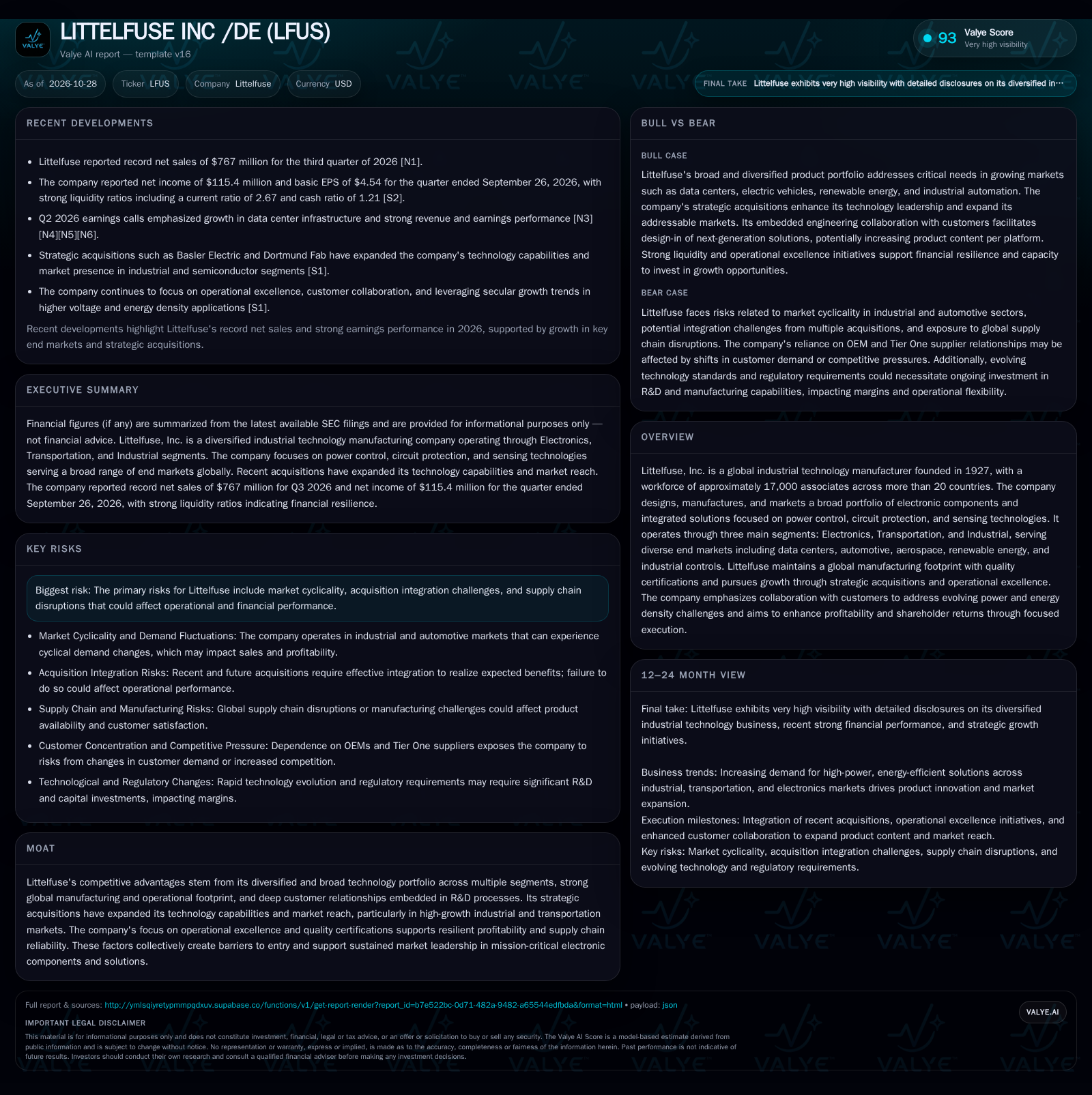
Littelfuse’s Q3 2026 record sales and strong earnings reflect its diversified industrial technology portfolio and success in high-growth markets like data centers and electrified transportation. Strategic acquisitions have broadened its technological capabilities and market reach, but ongoing integration, cyclical market exposure, and supply chain resilience will determine the sustainability of its recent momentum. Watch for continued execution on operational excellence and customer collaboration as leading indicators of future performance. [N1] [S2]
Littelfuse has emerged as a diversified leader in industrial technology, riding a wave of demand from data center electrification, automotive transformation, and industrial automation. The company’s Q3 2026 results set new sales and income records, reflecting disciplined execution on both organic and acquisition-driven growth. Yet, Littelfuse’s future hinges on its ability to integrate recent acquisitions, sustain innovation, and navigate the inherent volatility of its end markets. Investors must weigh the durability of current tailwinds against the risks of integration missteps, cyclical slowdowns, and intensifying global competition.
Record Sales, Expanded Capabilities, and End-Market Exposure Define Littelfuse’s Current Position
Littelfuse reported record net sales of $767 million for Q3 2026, alongside net income of $115.4 million and EPS of $4.54, marking a period of robust operating performance. [N1] [S2] This momentum reflects both organic growth and contributions from recent acquisitions, notably Basler Electric (Dec 2025) and Dortmund Fab (Dec 2024), which have strengthened the company’s presence in the industrial and semiconductor value chains. [S1]
The Electronics segment remains Littelfuse’s largest, with Transportation and Industrial also contributing meaningfully. In fiscal 2025, 65% of net sales were international, including 24% to China, highlighting significant global exposure and potential sensitivity to regional demand cycles. [S1]
How Littelfuse Converts Innovation and Scale into Operating Leverage
Littelfuse’s business model combines high-volume manufacturing of electronic components with value-added engineering and solution selling. The company’s economics hinge on a mix of mature, price-competitive products (e.g., circuit protection fuses) and higher-value, design-in components for data centers, EVs, and industrial automation. Pricing power is often limited for commodity components but can be stronger for specialized, safety-critical, or custom-engineered products that are embedded early in customer design cycles.
Variable costs dominate in component manufacturing, but scale and global footprint create opportunities for gross margin expansion when volumes rise—especially as higher-margin products (such as power semiconductors and integrated modules) outpace legacy items in the portfolio mix. Recent acquisitions have the potential to increase average content per customer platform, supporting both revenue growth and margin accretion if integration is successful.
Capital requirements are meaningful, particularly with ongoing investments in manufacturing capacity, quality certifications, and R&D to keep pace with evolving standards in electrification and energy density. The company’s operational excellence initiatives and Global Operations team aim to drive productivity improvements, supporting operating leverage as sales expand.
The interplay between product lifecycle dynamics and innovation cadence is critical in Littelfuse's ability to sustain operating leverage. Mature product lines, while offering stable cash flows, face margin erosion risks due to commoditization and competitive pricing pressures. Conversely, newer, higher-value products often require upfront R&D investment and longer qualification cycles with customers, delaying margin contributions. The balance between maintaining legacy product profitability and accelerating adoption of advanced solutions will influence overall margin trajectories. Additionally, the company's capacity to leverage digital manufacturing technologies and automation could reduce variable costs and improve throughput, further enhancing operating leverage if successfully scaled across global facilities.
Diversification, Customer Embedding, and Global Reach Shape Littelfuse’s Competitive Edge
Littelfuse’s core advantage lies in its diversified product offering across Electronics, Transportation, and Industrial segments, enabling it to serve a wide range of OEMs, Tier One suppliers, and industrial customers. Deep engineering collaboration and early-stage design-in relationships can create switching frictions, especially for mission-critical safety and power management components.
The company’s global manufacturing footprint and quality certifications (ISO 9001:2000, IATF 16949, ISO 14001) support reliable supply and compliance with stringent customer requirements, further reinforcing customer stickiness. However, the competitive landscape includes large diversified peers and specialized component makers, many of whom are also targeting growth in electrification and automation end markets.
Recent acquisitions have expanded Littelfuse’s technology base and market reach, but successful integration is essential to fully realize these advantages. The breadth of the portfolio could help buffer cyclical swings in any single end market, but also increases exposure to global demand and supply chain risks.
Accelerated Electrification and Seamless Integration Drive Margin and Revenue Outperformance
If secular trends in data centers, electric vehicles, and renewable energy accelerate, Littelfuse could see outsized demand for its power control and circuit protection solutions. Effective integration of recent acquisitions would increase cross-selling opportunities and enable the company to offer complete, higher-margin solutions to OEM customers, potentially raising average content per platform and deepening long-term relationships.
Operational excellence initiatives could unlock additional productivity gains, driving improved gross and operating margins as sales volumes rise. Successful expansion in high-growth international markets—especially China and other regions investing in electrification infrastructure—would further boost revenue diversity and growth.
Evidence supporting this scenario would include sustained above-market growth in Electronics and Transportation segments, expanding gross margins, increased disclosure of design wins in next-generation platforms, and smooth integration progress from acquired businesses.
Balanced Growth Amid Cyclicality and Integration Demands
The most plausible outcome is that Littelfuse continues to benefit from secular electrification trends, but faces intermittent headwinds from cyclical slowdowns in industrial and automotive markets. Recent acquisitions contribute to revenue and technology depth, but integration costs and operational complexity offset some margin gains.
The Electronics segment remains the primary driver, with Transportation and Industrial providing diversification but also exposing the company to regional and sector-specific volatility. Gross margins are stable to modestly improving, supported by operational initiatives but tempered by competitive pricing and input cost pressures.
Evidence for this scenario would be continued mid-single-digit sales growth, stable or gradually improving operating margins, and periodic updates on acquisition integration progress without major disruptions or write-downs.
Integration Setbacks and Demand Shocks Undermine Recent Gains
A less favorable trajectory could emerge if Littelfuse encounters significant challenges integrating its recent string of acquisitions—leading to operational disruptions, cost overruns, or customer attrition. Cyclical downturns in industrial or automotive end markets, potentially amplified by global supply chain shocks, could drive revenue declines and margin compression.
Competitive intensity could increase, especially if larger peers or low-cost entrants erode pricing or capture design wins in core segments. Regulatory changes or technology shifts could also require additional, unplanned investment, straining cash flows and limiting the company’s ability to capitalize on new opportunities.
Confirmation of this scenario would include sequential revenue declines, margin deterioration, integration-related charges or delays, or evidence of customer loss to competitors.
Testing Littelfuse’s Thesis: Execution, Integration, and Market Signals to Track
Track revenue growth and margin trends by segment—particularly Electronics and Transportation—as proxies for successful execution on secular demand drivers and portfolio mix improvement.
Monitor disclosure (if provided) of acquisition integration milestones, including cost synergies, cross-selling wins, and retention of key customers or talent.
Observe changes in geographic sales mix, especially exposure to China and emerging markets, as indicators of global demand resilience or vulnerability.
Assess R&D and capital expenditure trends—rising investments may signal both growth opportunity and competitive or regulatory pressure.
Watch for evidence of new design wins or expanded content in high-growth applications such as data centers, EVs, and renewable energy platforms.
Evaluate working capital and inventory turns (if disclosed) for signs of supply chain stress or overstocking risk.
Follow management commentary on operational excellence initiatives and progress toward productivity or quality targets.
Disclaimer: This is research-only, informational analysis and not investment advice. It may include AI-generated interpretation and general industry context. Always verify important details using primary sources.

Comments