
NOV Inc.: Backlog Strength, Global Footprint, and Technological Innovation in a Cyclical Industry
NOV Inc.'s $4.34 billion capital equipment backlog and recent earnings outperformance highlight operational resilience in a volatile oilfield equipment market. However, the company's fortunes remain tightly linked to the unpredictable dynamics of the global energy sector, contract execution risks, and the need for technological leadership.
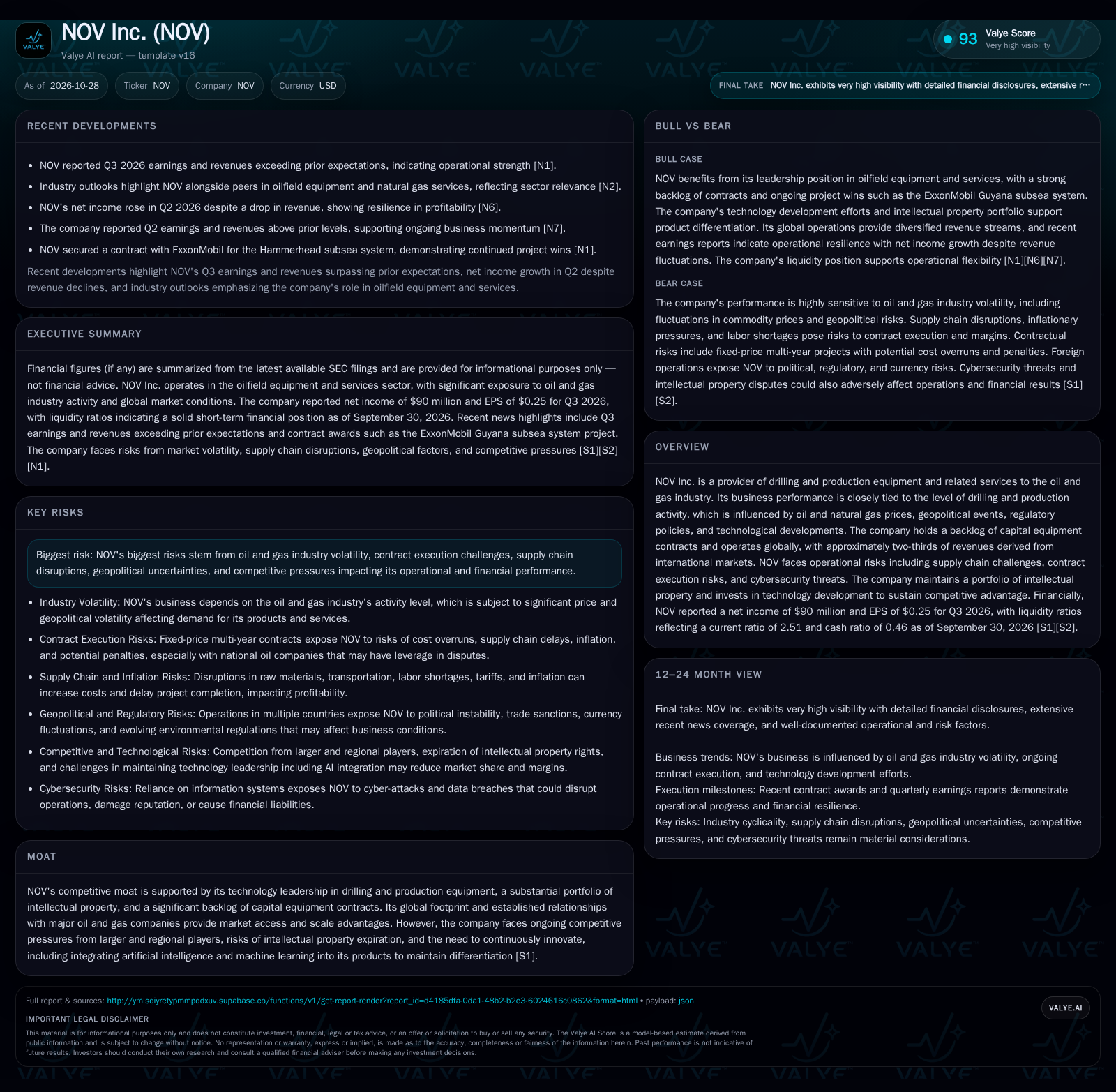
NOV Inc. operates at the intersection of oilfield equipment demand, global operational complexity, and technology-driven differentiation. Its strong backlog, international revenue mix, and recent earnings resilience are positives, but ongoing industry cyclicality, supply chain and contract risks, and the challenge of sustaining a technological edge frame both the upside and downside scenarios for investors. [S1] [S2] [N1]
NOV Inc. stands as a bellwether in the oilfield equipment and services sector, blending a large, visible contract backlog with a global revenue footprint. Its Q3 2026 earnings outperformance and resilient profitability, even amid revenue fluctuations, underscore management’s operational discipline and the partial insulation provided by progress-billed contracts. Yet, NOV’s fate remains tightly coupled to the cyclical swings of the energy industry, the successful execution of complex, fixed-price projects, and the ongoing challenge of defending its technology edge in an increasingly digital and competitive landscape.
Current Backlog, Earnings Trends, and International Exposure
As of December 31, 2025, NOV reported a capital equipment contract backlog of $4.34 billion, anchoring future revenue expectations but also introducing risks around contract execution, potential cost overruns, and customer-driven cancellations. This backlog is a critical buffer against short-term industry volatility, yet it is not immune to the operational and financial challenges that can arise in large, complex projects. [S1] [S2]
For the quarter ending September 30, 2026, NOV delivered net income of $90 million and basic and diluted EPS of $0.25, with Q3 earnings and revenues both exceeding prior expectations. Notably, the company demonstrated profitability resilience even in quarters of revenue decline, signaling some flexibility in cost structure or project mix. [S2] [N1] [N6]
The company's revenue base is highly international—approximately 66% of 2025 revenues were derived from outside the U.S.—which offers diversification but also heightens exposure to political instability, trade sanctions, currency volatility, and regulatory risks in foreign jurisdictions. [S1]
Revenue Drivers: Contract Types, Cost Challenges, and Financial Leverage
NOV’s revenues are primarily driven by the sale and servicing of drilling and production equipment, with revenue recognition often tied to long-term capital equipment contracts. These contracts typically involve significant down payments and progress billing, which can help smooth cash flows and mitigate working capital strain during project execution. However, fixed-price, multi-year contracts expose NOV to cost overrun risks, especially in inflationary or supply-constrained environments.
The business model is capital-intensive, reflecting the need for ongoing investment in R&D, manufacturing capacity, and global service infrastructure. Operating leverage is present—incremental revenue from higher industry activity can drive disproportionate profit gains due to high fixed costs—but this also amplifies downside risk in periods of underutilization.
NOV's profitability is sensitive to input costs (steel, specialized components), labor availability, and supply chain reliability. While technology and intellectual property can support differentiated pricing and margins, competitive bidding and customer bargaining power—especially among national oil companies—can compress margins in weaker markets.
Assessing NOV’s Market Position: Innovation, Scale Advantages, and Substitution Risks
NOV’s primary competitive assets are its technology portfolio—bolstered by patents, trademarks, and ongoing R&D—and its global customer relationships. The company's scale allows it to serve both major international oil companies and national oil companies, often on complex, multi-year projects that would be difficult for smaller players to execute.
However, the competitive landscape is intense. National, regional, and international rivals, some with greater resources, are constantly vying for contracts. The expiration of key patents in coming years could erode product differentiation, and the pace of technological change—including the integration of AI and machine learning into drilling systems—raises the bar for sustained leadership.
Substitution risk is present not only from direct competitors but also from broader industry shifts, such as digitalization, automation, and the potential for alternative energy investments to divert capital away from traditional oilfield infrastructure.
Positive Outcomes from Backlog Realization and Technological Advances
In a favorable scenario, NOV executes its $4.34 billion backlog without significant cost overruns or cancellations, translating into robust cash flows and margin expansion. Progress billing and down payments would continue to insulate the company from working capital shocks, while successful project delivery could reinforce customer trust and support new contract wins.
If NOV’s investments in technology—particularly in AI-driven automation and digital oilfield solutions—result in demonstrable performance or cost advantages for customers, the company could sustain premium pricing and defend (or expand) market share even as patents expire. Evidence of this scenario would include steady or rising margins, new project awards referencing technology leadership, and customer testimonials or renewals citing differentiated capabilities.
Confirmation would require disclosure of backlog conversion rates, margin trends on project execution, and explicit customer wins driven by new technology offerings.
Expected Performance Under Typical Industry Fluctuations
The most plausible scenario is that NOV continues to deliver lumpy, cycle-driven performance. The sizable backlog provides near-term revenue visibility, but periodic cost overruns, supply chain delays, or customer-driven renegotiations lead to volatile margin realization. The mix of international and domestic projects introduces both opportunity and risk, with some regions outperforming and others weighed down by regulatory or political disruptions.
Technology investments yield incremental, rather than transformative, differentiation—allowing NOV to maintain but not markedly expand its competitive position. Margins fluctuate with industry activity, input cost trends, and the company’s ability to manage contract risk. This scenario would be confirmed by ongoing but uneven EPS and revenue patterns, periodic contract win/loss announcements, and steady—but not sharply rising—technology licensing or product upgrade activity.
Risks from Market Volatility and Contractual Uncertainties
In an adverse scenario, a sharp downturn in oil and gas capital spending—driven by commodity price declines, regulatory shocks, or geopolitical disruptions—leads to project deferrals, contract cancellations, and reduced order inflows. Fixed-price contracts in the backlog become a liability if inflation or supply shortages drive costs well above bid levels, eroding margins or resulting in losses.
If key patents expire without adequate replacement through new technology, and competitors outpace NOV in digital or automation offerings, the company could lose share or be forced into price competition. Cybersecurity breaches or major supply chain failures could further disrupt operations and damage customer trust.
This scenario would be evidenced by a rising rate of contract cancellations or renegotiations, sustained negative margin trends, loss of major customers, or public disclosures of operational disruptions.
Factors Influencing NOV’s Strategic Momentum and Operational Stability
Backlog conversion rates and the incidence of contract cancellations or renegotiations—especially in international markets—will be critical to tracking revenue visibility and execution risk.
Gross and operating margin trends, particularly on large fixed-price projects, would help assess the impact of cost pressures and supply chain dynamics.
Disclosures around new technology-driven contract wins or explicit customer references to AI, automation, or digital differentiation would clarify the commercial value of NOV’s R&D investments.
The pace and geographic mix of new order intake, especially in regions exposed to political or regulatory volatility, would signal demand resilience or risk.
Updates on intellectual property expirations and the introduction of new proprietary technologies would help track the sustainability of NOV’s competitive moat.
Currency impacts and hedging disclosures—if provided—would illuminate the risks and management of NOV’s large international revenue base.
Any major cybersecurity incidents, system outages, or supply chain disruptions disclosed in filings or news releases would test the company’s operational resilience.
Disclaimer: This is research-only, informational analysis and not investment advice. It may include AI-generated interpretation and general industry context. Always verify important details using primary sources.

Comments