
Knight-Swift’s Diversification Push: Margin Recovery, Network Scale, and the Realities of Freight Market Cyclicality
Knight-Swift Transportation Holdings is leveraging a multi-modal freight platform—expanding beyond its legacy truckload core into LTL, logistics, and intermodal—to pursue margin stability and growth in a volatile, highly competitive industry.
Its scale, technology investments, and multi-segment approach provide defensive advantages, yet the company remains exposed to freight market swings, regulatory pressures, and rising costs. Margin resilience will hinge on execution in recently acquired LTL networks, continued efficiency gains, and disciplined capital management. [S1] [S2] [N1] [N7]
Knight-Swift Transportation Holdings stands at a pivotal juncture as it seeks to transform its scale advantage into sustainable margin leadership across the North American freight landscape. Recent quarterly results highlight profit gains driven by truckload pricing, but the company’s ambitions now depend on successful integration and expansion of its less-than-truckload (LTL) and logistics segments. [S1] [S2] [N1] [N7]
Profitability and Liquidity: Where Knight-Swift Stands After Q3 2026
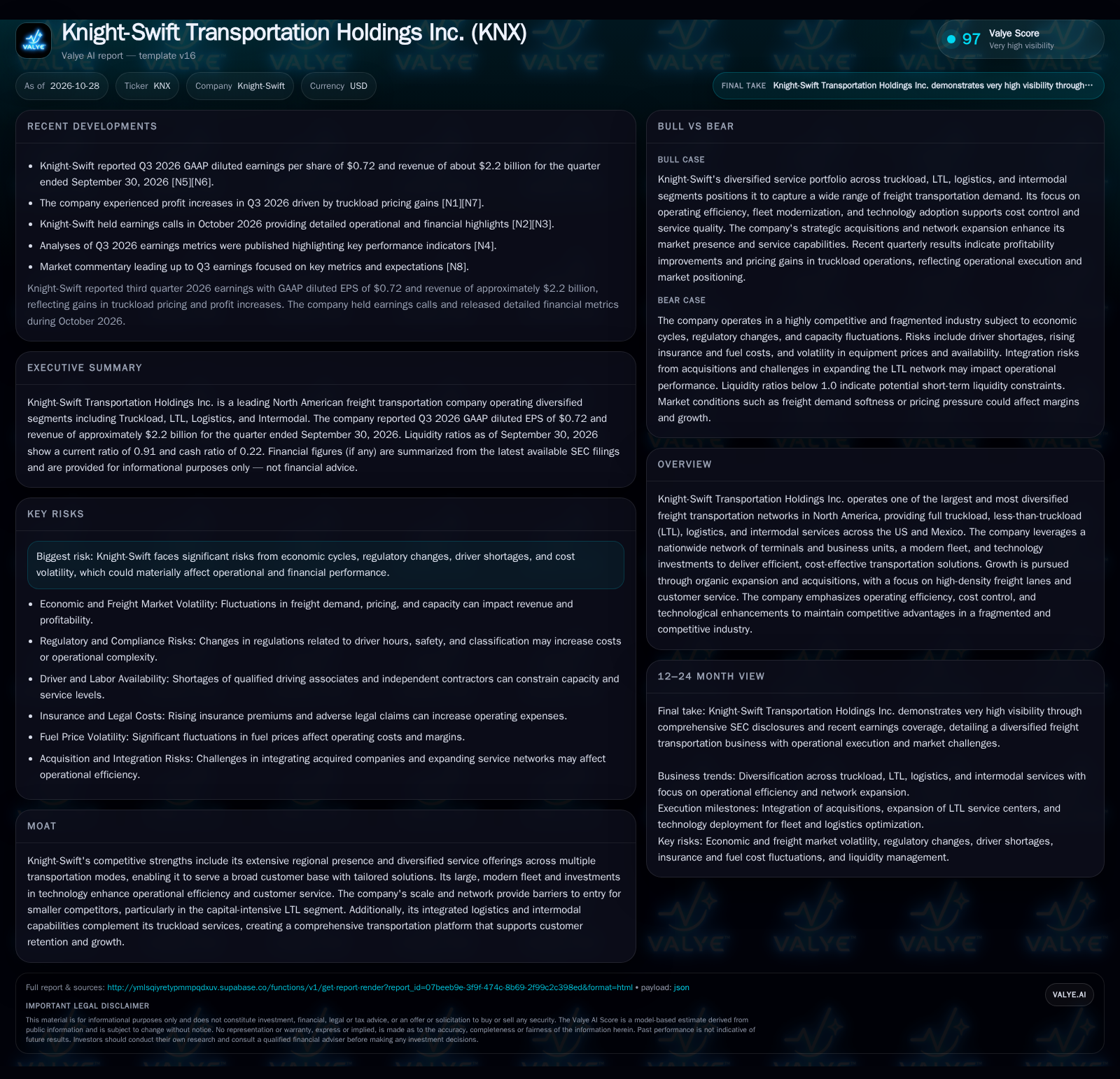
Knight-Swift reported Q3 2026 revenue of $2.2 billion and GAAP diluted EPS of $0.72, with profit increases driven by truckload pricing gains. This reflects operational execution in the company’s largest segment amid a period of industry-wide freight market volatility. [S2] [N1] [N5] [N6] [N7]
As of September 30, 2026, the company held $254.2 million in cash and equivalents, with a current ratio of 0.91 and a cash ratio of 0.22. The company reported cash and liquidity metrics for the period; these figures do not by themselves establish operating runway, investment capacity, financial flexibility, or financing capacity. [S2]
The company’s operating structure now spans four segments: Truckload, LTL, Logistics, and Intermodal, reflecting a deliberate shift toward diversification and national network scale. The LTL segment, created through acquisitions since 2021, continues to expand its service center footprint for national coverage. [S1]
How Knight-Swift’s Multi-Segment Model Could Shape Future Earnings Power
Knight-Swift’s revenue mix is increasingly diversified, with Truckload remaining the core profit engine but LTL and Logistics targeted as growth areas. Truckload is a high fixed-cost business, with operating leverage driven by asset utilization, dense freight lanes, and disciplined cost control. The LTL segment, while capital-intensive due to terminal infrastructure and fleet needs, can deliver more stable margins if scale and network density are achieved.
Logistics provides a variable-cost, higher-margin opportunity by matching customer freight with third-party capacity, reducing asset risk but exposing the company to brokerage competition. Intermodal leverages existing rail partnerships and fixed assets to extend reach on longer-haul lanes, potentially lowering per-mile costs but requiring volume to justify infrastructure commitments.
Across all segments, technology investments—in telematics, ELDs, trailer tracking, and logistics optimization—aim to improve asset productivity, reduce empty miles, and automate back-office functions. If these investments translate into lower operating ratios and improved customer service, margin expansion could follow. However, ongoing capital requirements for fleet renewal, service center expansion, and technology upgrades necessitate disciplined capital allocation and robust cash flow management.
The interplay between fixed and variable costs across Knight-Swift’s segments further nuances margin dynamics. Truckload’s fixed cost base means that volume fluctuations can disproportionately impact profitability; thus, sustained asset utilization is critical to absorbing overhead and optimizing returns. Conversely, the LTL segment’s capital intensity, while substantial, benefits from densification effects—higher shipment volumes per terminal can reduce average costs and improve pricing power. However, achieving this density requires careful network planning and demand forecasting to avoid underutilized assets or service gaps. Logistics, with its asset-light model, offers flexibility but is more exposed to market pricing volatility and competitive pressures, necessitating agile capacity sourcing and customer relationship management to protect margins.
Defensive Scale and the Limits of Moat in a Fragmented Freight Market
Knight-Swift’s scale—spanning over 21,000 tractors and 84,000 trailers in Truckload alone—offers purchasing leverage (fuel, equipment), network density, and the ability to serve complex national accounts. In LTL, national coverage is still maturing, but the expanded service center footprint increases relevance to shippers seeking single-source solutions.
Despite these advantages, the North American trucking and logistics industry remains highly fragmented, with thousands of regional and local carriers, as well as formidable national LTL players and third-party logistics providers. Competitive dynamics are driven by price, service reliability, geographic reach, and technology integration, with customer switching costs relatively low outside of deeply integrated, multi-modal contracts.
Barriers to entry are highest in LTL, given the capital and operational complexity of building a dense terminal network, but remain modest in brokerage and even in asset-light intermodal. Knight-Swift’s moat is thus more about execution—operational efficiency, technology-enabled service, and integration discipline—than structural barriers alone.
If LTL Integration and Tech Investments Deliver, Margin Expansion Could Outpace the Cycle
The bullish scenario hinges on Knight-Swift successfully integrating its LTL acquisitions, achieving national network density, and leveraging shared technology platforms to drive operating ratio improvement. If the company can translate Truckload discipline to LTL—optimizing linehaul, terminal operations, and pricing—margin stability and growth could follow even in choppy freight markets.
Further, if logistics and intermodal segments capture incremental share from shippers seeking end-to-end solutions, Knight-Swift could move up the value chain and diversify away from pure spot-market risk. Evidence for this scenario would include sustained improvement in LTL operating ratios, rising logistics margins, and positive free cash flow after capital expenditures, even as the company expands its asset base.
Confirmation would come from disclosure of LTL segment profit growth, customer retention rates in integrated contracts, and visible progress on technology-driven efficiency metrics.
Segment Diversification Offsets Cyclical Headwinds—But Margins Remain Sensitive to Cost Pressures
The most probable course is that Knight-Swift’s diversified platform provides partial insulation from freight demand volatility, but margin swings persist due to driver costs, insurance, equipment prices, and integration friction. Truckload remains the primary profit contributor, while LTL and logistics gradually expand but do not fully offset cyclical weakness or cost inflation in the near term.
Incremental gains come from operational discipline—improved asset utilization, selective contract repricing, and ongoing cost control—rather than dramatic margin expansion. Evidence supporting this scenario would be continued, but moderate, profit growth, stable (though not surging) LTL margins, and maintenance of technology investment pace without overstretching the balance sheet.
Integration Missteps or Freight Downturn Could Expose Financial and Strategic Vulnerability
In a negative scenario, LTL network integration fails to deliver expected synergies—due to operational misalignment, labor disruptions, or IT challenges—resulting in cost overruns and lost customers. Simultaneously, a broad-based freight downturn or prolonged period of weak demand could drive down asset utilization, pressure rates, and erode Truckload segment profitability.
Rising insurance and fuel costs would exacerbate margin compression, and the company might be forced to slow or halt network investments. Evidence confirming this scenario would include declining operating income, negative free cash flow, operational disruption headlines, or disclosure of restructuring or asset sales.
Tests for Knight-Swift’s Margin Ambitions and Network Integration in the Cyclical Freight Environment
LTL segment operating ratio trends—if disclosed—would clarify whether integration and network expansion are translating into improved segment-level profitability.
Truckload segment asset utilization metrics, such as loaded miles per tractor or average revenue per mile, to gauge operational efficiency.
Customer retention and contract renewal rates, especially for national or multi-modal service agreements, as a signal of competitive stickiness.
Quarterly progress updates on service center openings and LTL network expansion milestones.
Technology adoption rates (e.g., percentage of fleet with advanced telematics or automation) and resulting efficiency gains—if reported.
Disclosure of material legal, insurance, or regulatory cost increases that could pressure margins.
Disclaimer: This is research-only, informational analysis and not investment advice. It may include AI-generated interpretation and general industry context. Always verify important details using primary sources.

Comments