
JLL’s 2026 Momentum: Operational Leverage, Service Diversification, and the Real Estate Cycle
Jones Lang LaSalle’s strong Q3 2026 results highlight the power of operational leverage and a diversified global platform, but the company’s earnings remain highly sensitive to macroeconomic swings, compensation variability, and the pace of technology integration. The next chapter will hinge on JLL’s ability to sustain outsourcing and tech-driven growth amid cyclical and competitive headwinds.
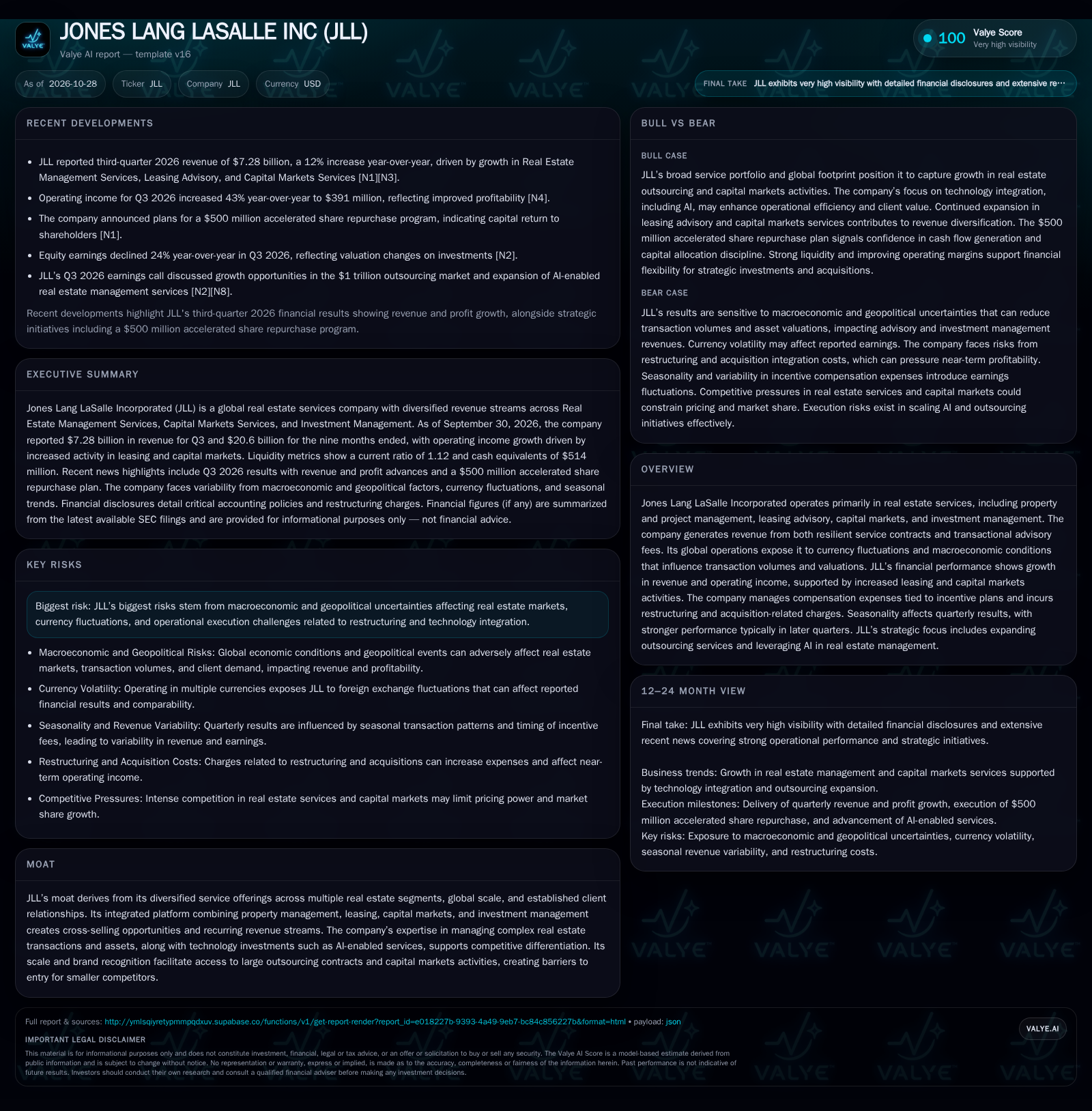
JLL posted a 12% year-over-year revenue increase and a 43% jump in Q3 2026 operating income, led by growth in real estate management, leasing advisory, and capital markets. The company’s $500 million accelerated share repurchase signals capital allocation confidence, but results are still exposed to macroeconomic and currency risks, compensation volatility, and the success of AI and outsourcing initiatives. Investors should focus on sustained margin expansion, resilience of recurring revenue streams, and execution on technology integration.
Jones Lang LaSalle (JLL) enters late 2026 with clear operational momentum, as Q3 results show double-digit revenue growth and a sharp surge in profitability. The company’s diversified service base—spanning real estate management, capital markets, and investment management—has delivered resilience and leverage in a complex market. However, JLL’s fortunes remain closely tied to global real estate cycles, compensation structures, and the effectiveness of its technology and outsourcing push. The coming quarters will test whether JLL can convert cyclical tailwinds and strategic initiatives into durable earnings power.
2026 Snapshot Marked by Profit Growth and Capital Returns
JLL’s Q3 2026 revenue increased 12% year-over-year to $7.28 billion, with Real Estate Management Services rising 9%, Leasing Advisory up 27%, and Capital Markets Services climbing 20% [S2]. Operating income for the quarter grew 43% year-over-year to $391 million, highlighting both topline momentum and expanding margins [S2] [N4]. The company announced a $500 million accelerated share repurchase, signaling management’s willingness to deploy capital for shareholder returns in the current environment [N1]. Liquidity at quarter-end included $514 million in cash and a current ratio of 1.12 [S2]. These facts establish that JLL is emerging from a period of margin compression into one of renewed operational leverage and active capital management.
JLL’s Revenue Composition and Cost Dynamics Underpin Earnings Potential
JLL’s business model relies on a blend of recurring service revenues (property, workplace, and project management) and more cyclical, transaction-driven advisory and capital markets fees. Recurring streams offer greater visibility, often tied to multi-year outsourcing contracts, while advisory and capital markets revenue is highly sensitive to transaction volumes and asset valuations, which fluctuate with macroeconomic conditions. The Q3 surge in Leasing Advisory and Capital Markets suggests cyclical upside, but also highlights volatility risk.
Operating leverage is evident—fixed costs in technology, staff, and infrastructure mean that incremental revenue growth can drive disproportionate profit gains, as seen in the 43% year-over-year operating income increase on 12% revenue growth [S2] [N4]. However, compensation and benefits (up 13% for the first nine months) are a major variable cost, reflecting incentive-based pay structures that can swing with performance [S2]. Restructuring and acquisition charges, which rose 65% in Q3, are a recurring drag that can offset operational gains if not carefully managed [S2].
Capital needs are moderate by real estate standards, as JLL typically operates with asset-light service contracts rather than owning real estate. However, cash management is still crucial given the company’s global footprint, currency exposures, and periodic restructuring outlays. Technology investment, especially in AI and digital platforms, represents a growing capital allocation priority with uncertain near-term returns.
Competitive Landscape: Strengths and Risks in Global Real Estate
JLL’s competitive moat stems from its global scale, broad service portfolio, and established client relationships. These attributes enable the company to win large outsourcing mandates and offer integrated solutions that smaller, region-specific firms cannot match. Brand recognition and track record in managing complex real estate transactions further support its ability to attract institutional clients.
However, the global real estate services sector is intensely competitive, with peer groups that include other multinational firms and technology-driven entrants. Pricing power in commoditized brokerage or advisory services is limited, especially during market downturns or when clients pursue aggressive cost reductions. The push into AI-enabled services and software solutions is a potential differentiator, but also attracts new competitors and raises execution risk.
Technology substitution is a growing threat: Proptech firms, data analytics specialists, and digital platforms are targeting segments such as leasing, property management, and transaction advisory. JLL’s ability to integrate technology without eroding its service margins or cannibalizing existing revenue streams will be a key battleground.
Margin Gains Fueled by Outsourcing and AI-Enhanced Services
A favorable scenario for JLL centers on sustained growth in outsourcing and technology-enabled services, which could increase the share of recurring, higher-margin revenue. If the company’s investments in AI and digital platforms lead to measurable productivity gains, improved client retention, and the ability to command premium pricing for bundled solutions, operating margins could expand further.
Evidence confirming this trajectory would include continued double-digit growth in Real Estate Management and Technology Solutions, stable or improving margins despite compensation pressures, and an increasing mix of multi-year outsourcing contracts. Successful execution would also be reflected in higher renewal rates, growing wallet share among large clients, and positive client case studies on technology-driven value creation.
A key falsification point would be stagnation or decline in recurring revenue streams, margin erosion due to technology investment overruns, or loss of major outsourcing mandates to tech-first competitors.
Market Cycles Provide Offset to Volatility in Core Operations
The most plausible path is that JLL continues to benefit from cyclical recovery in transaction volumes and capital markets, while its recurring revenue base provides a buffer against sharp downturns. Earnings growth may be lumpy, reflecting seasonality and incentive compensation swings, but operating leverage remains a tailwind whenever revenue growth is positive.
In this scenario, the company’s technology and outsourcing initiatives generate incremental—not transformative—margin improvement, with competitive threats and restructuring costs limiting upside. Currency volatility and geopolitical risks continue to introduce noise into quarterly results, but do not fundamentally derail the business model.
Plausible confirming evidence includes mid-to-high single-digit annual revenue growth, modest margin expansion, periodic restructuring charges, and a stable or slowly rising share of recurring revenue. Falsifying evidence would be a sharp reversal in transaction-driven revenue, persistent margin compression, or an inability to demonstrate any operating leverage during upswings.
Earnings Pressure from Macroeconomic and Execution Challenges
An adverse scenario for JLL involves a sharp deterioration in global real estate markets—triggered by recession, geopolitical events, or credit market stress—that slashes transaction volumes and asset valuations. Advisory and capital markets revenues could drop precipitously, with operating leverage turning against the company as fixed costs outpace revenue.
Simultaneously, if technology investments fail to deliver promised efficiencies, or if large outsourcing clients defect to digital-first competitors, the recurring revenue base could erode. Rising compensation and restructuring costs would further compress margins.
Evidence supporting the downside would be revenue declines in both advisory and recurring streams, increasing restructuring charges, negative operating leverage, and loss of major clients or contracts. Inability to control compensation or integration costs would amplify the impact.
Factors Influencing JLL’s Strategic Durability and Performance
The growth rate and margin profile of Real Estate Management Services and Technology Solutions, if disclosed, as proxies for recurring revenue momentum and operating leverage.
Trends in compensation and benefits expense as a percentage of revenue, highlighting the effectiveness of cost controls and incentive alignment.
Progress on AI and digital platform adoption, such as client wins, productivity benchmarks, or specific efficiency gains attributed to technology investments.
Magnitude and frequency of restructuring and acquisition charges, which would indicate the cost and complexity of ongoing transformation.
Revenue and margin volatility attributable to currency fluctuations, especially in major non-USD markets.
Retention and renewal rates for large outsourcing contracts, if disclosed, to gauge client stickiness and competitive positioning.
Quarterly updates on share repurchase activity and capital allocation, clarifying management’s confidence and priorities.
Advisory and capital markets revenue trends relative to macroeconomic indicators, providing early warning of cyclical shifts.
Disclaimer: This is research-only, informational analysis and not investment advice. It may include AI-generated interpretation and general industry context. Always verify important details using primary sources.

Comments