
Hamco Ventures Ltd: Franchise Consulting Ambitions Confront Funding and Execution Reality
Hamco Ventures Ltd, operating via its Hong Kong subsidiary in the franchise consulting and QSR brand development space, faces a fundamental crossroads: its early-stage revenue and reported current ratio contrast sharply with zero cash on hand and ongoing net losses. The company’s future hinges on its ability to secure fresh capital and prove out its business model in a competitive, capital-intensive sector.
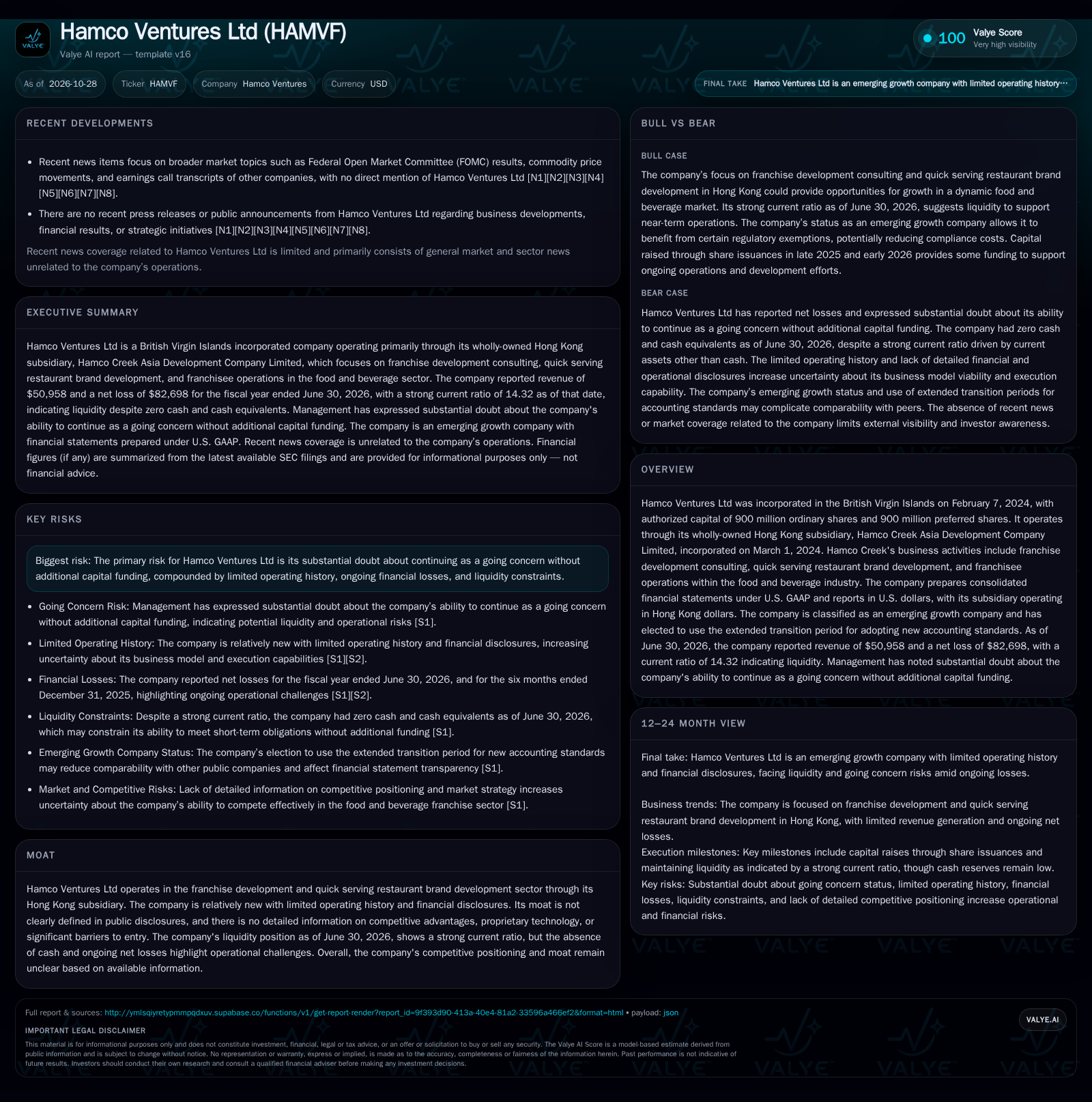
Hamco Ventures Ltd is an emerging growth company focused on franchise development and quick serving restaurant (QSR) brand consulting in Hong Kong. Despite reporting modest revenue, the company faces substantial going concern risk due to persistent operating losses and a complete absence of cash as of June 2026. Its ability to survive and scale depends on raising further capital and demonstrating operational traction in a crowded and competitive market. [S1] [S2]
Hamco Ventures Ltd presents a textbook case of early-stage ambition and execution risk in the franchise development and quick serving restaurant (QSR) consulting sector. This analysis explores the core economic mechanisms at play, the competitive context, and the scenarios that could define Hamco’s future.
Liquidity Paradox and Going Concern Risk Define the Near-Term Outlook
Hamco Ventures Ltd reported $50,958 in revenue and a net loss of $82,698 for the fiscal year ended June 30, 2026, confirming that the company is generating some commercial activity but remains significantly unprofitable. The company reported cash and liquidity metrics for the period; these figures do not by themselves establish operating runway, investment capacity, financial flexibility, or financing capacity. [S1] [S1] This disconnect—substantial current assets but no cash—raises immediate operational concerns, especially as management has openly stated substantial doubt about the company’s ability to continue as a going concern without additional capital. [S1] The company’s recent capital raise of $150,000 from ordinary share issuance in late 2025 was not sufficient to reverse its negative cash trajectory. [S2] In sum, Hamco’s survival is now tied to its capacity to secure new funding and rapidly improve cash conversion from operations.
Franchise Consulting and QSR Development: Pathways to Scale and Profitability
Hamco’s business model, centered on franchise development consulting and QSR brand creation, is theoretically attractive for its potential to generate recurring advisory fees and capture a share of growing food and beverage (F&B) market activity in Asia. In a successful model, franchise consultants earn revenue through upfront development fees, ongoing royalties, and support contracts, while QSR brand development can yield equity-like returns if a brand scales across multiple locations. However, translating these theoretical economics into practice typically requires both a robust pipeline of franchisees and significant investment in brand-building, operational support, and compliance.
The fixed cost base for such businesses—comprising staff, marketing, and legal/regulatory infrastructure—can be substantial relative to early-stage revenue. Hamco’s reported general and administrative expenses of $38,428 for the six months ended December 31, 2025, illustrate this dynamic. [S2] If the company cannot rapidly scale its client base or establish proprietary QSR brands with strong unit economics, losses are likely to persist and potentially widen.
Capital needs in this sector are often underestimated, especially when working capital is tied up in receivables or pre-opening costs.
Fragmented Market, Low Barriers: Competitive Pressure in Franchise Consulting
The franchise consulting and QSR brand development space is characterized by low barriers to entry and significant fragmentation, especially in Asia’s dynamic F&B sector. Hamco faces competition from both established international franchise consultants and local boutique firms, many of whom have deeper networks, proven track records, and more robust operational infrastructure. In the QSR segment, the challenge is even greater: established global brands and well-funded regional chains already compete aggressively for franchisees, real estate, and consumer attention.
Without evidence of proprietary IP, unique technology, or a differentiated value proposition, Hamco’s ability to attract and retain clients will likely hinge on pricing, speed of execution, and the perceived success of early projects. If Hamco can demonstrate successful brand launches or secure exclusive development deals, it could carve out a niche. However, at present, there is no disclosure of such differentiators or anchor clients. The company’s lack of detailed commercial disclosures further clouds any assessment of its competitive moat or ability to defend margins against larger, better-capitalized players.
Securing Capital and Proving Operational Traction Could Catalyze a Turnaround
The most favorable scenario for Hamco involves raising sufficient new capital to stabilize operations and invest in business development. With a fresh cash infusion, the company could accelerate client acquisition, invest in marketing to build a distinctive QSR brand, and develop proprietary tools or processes to enhance its consulting value proposition. Successful execution could unlock operating leverage, as incremental revenues would outpace fixed costs, moving the company toward breakeven.
Confirmation of this upside would require evidence of a completed capital raise, a significant increase in paying clients or franchise development mandates, and improved cash conversion—specifically, a material rise in cash and cash equivalents on the balance sheet. Additional proof points would include publicly announced franchise agreements, QSR brand launches, or strategic partnerships with established players in the F&B ecosystem.
Continued Losses and Cash Constraints Force a Strategic Pivot or External Rescue
The most plausible near-term outcome is that Hamco remains loss-making, with operational progress hampered by insufficient cash resources. Unless the company can rapidly monetize its current assets or secure new funding, it may be forced to scale back development activity, delay project launches, or seek a strategic partner or acquirer.
Confirmation of this middle-path scenario would include continued reporting of net losses, little or no growth in cash balances, and limited or no disclosure of major client wins or brand launches. Any bridge financing, asset sale, or evidence of a pivot toward a lower-cost advisory model would reinforce this case. Conversely, a sudden improvement in operational metrics, cash position, or external validation could falsify the base scenario.
Funding Shortfall Triggers Business Interruption or Wind-Down
In the most adverse scenario, Hamco is unable to secure additional capital and cannot convert current assets into operational liquidity. This could force the company to suspend operations, default on obligations, or initiate a formal restructuring or wind-down. The lack of cash and persistent net losses are clear warning signs—especially since management has already signaled substantial doubt about the company’s ability to continue as a going concern. [S1]
Evidence confirming this downside would include a further deterioration in financial disclosures (e.g., rising payables, inability to meet obligations), explicit filings announcing a halt in operations or liquidation, or disclosures of missed payroll or regulatory non-compliance. Failure to close a new financing round or attract a strategic partner would also support the downside scenario.
Milestones That Will Define Whether Hamco Ventures Can Survive and Scale
Evidence of a completed capital raise or other external funding event—timing, amount, and terms would be critical to assessing runway and negotiating leverage.
Cash and cash equivalents reported quarterly; a material increase would indicate improved liquidity and operational breathing room.
Signed franchise development or QSR brand creation mandates, if disclosed, would help test whether the company is gaining commercial traction.
Recurring revenue growth, client retention rates, or backlog disclosures—any of these would indicate whether the consulting model is gaining predictable scale.
Gross margin or operating margin improvements, if reported, would provide insight into the scalability and profitability of the business model.
Evidence of proprietary offerings, technology, or exclusive partnerships would support arguments for a defensible competitive position.
Management commentary on client pipeline, project launches, or strategic pivots would clarify execution strategy and near-term priorities.
Disclaimer: This is research-only, informational analysis and not investment advice. It may include AI-generated interpretation and general industry context. Always verify important details using primary sources.

Comments