
Chubb Ltd in 2026: Navigating Diversification, Underwriting Discipline, and Catastrophe Exposure
Chubb enters late 2026 as a global insurance leader with a diversified portfolio and disciplined underwriting, but faces heightened catastrophe losses and competitive pressures. Investment income and consumer insurance growth support earnings, yet volatility in weather events and regulatory shifts remain key watchpoints.
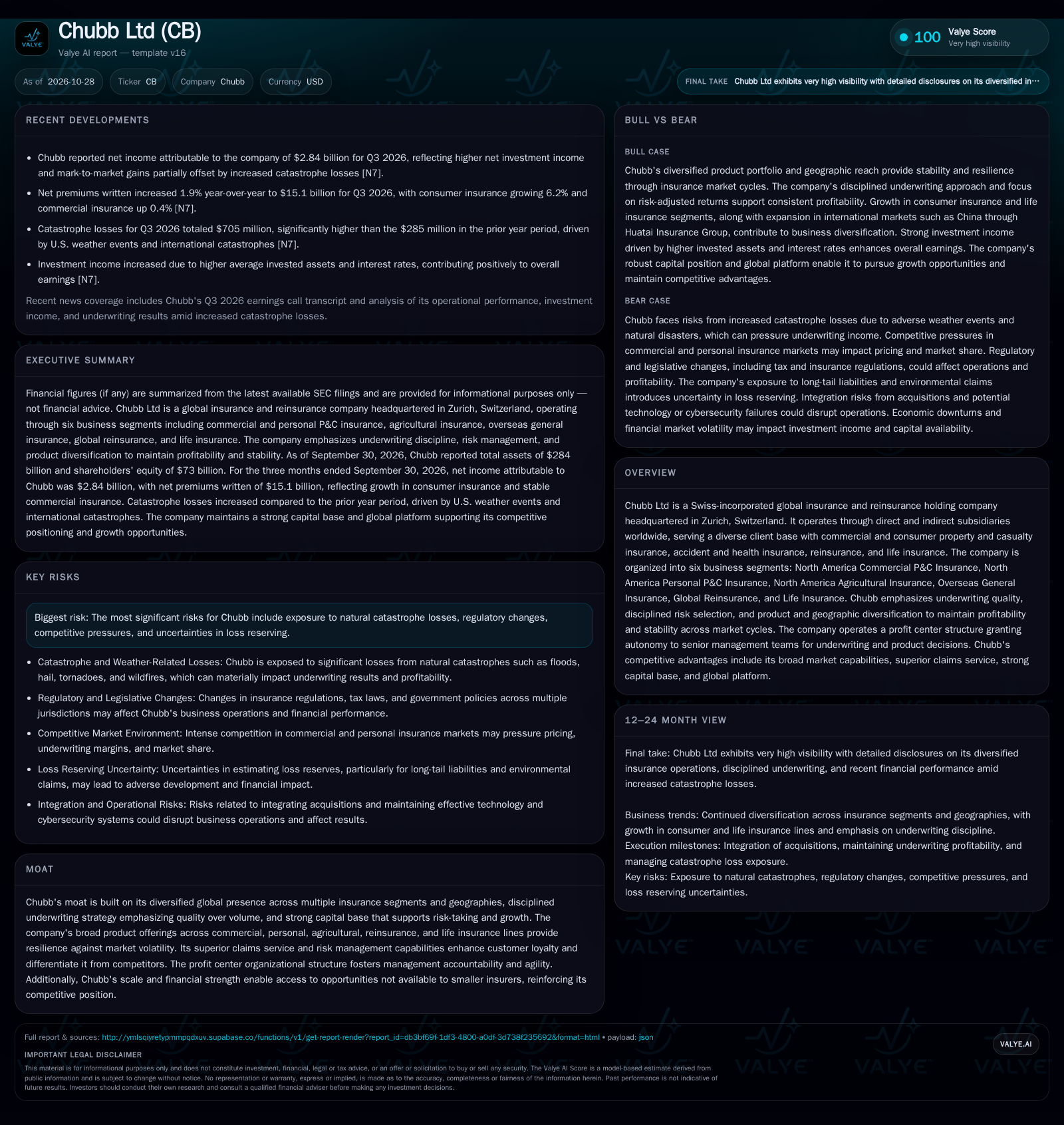
Chubb Ltd reported $2.84 billion in Q3 2026 net income, driven by higher investment income and mark-to-market gains, but offset by a sharp rise in catastrophe losses. Net premiums written grew 1.9% year-over-year, led by 6.2% growth in consumer insurance. The company’s capital base and global reach underpin resilience, but increased weather-related claims and market competition test underwriting profitability and future growth [S2] [N7].
Chubb Ltd stands at a pivotal juncture in late 2026, balancing the benefits of global diversification and disciplined underwriting against the mounting challenge of catastrophe-driven losses. With $284 billion in assets and a broad presence across 54 countries, Chubb’s ability to generate stable earnings hinges on its mix of property & casualty, consumer, and life insurance businesses. Yet, a surge in catastrophe claims and competitive market dynamics test the limits of its risk management and pricing power. As investment income grows amid higher rates, the company’s future resilience will depend on how effectively it adapts underwriting, pricing, and capital allocation to a more volatile risk environment [S2] [N7].
Recent Results Underscore the Tradeoff Between Investment Gains and Catastrophe Costs
For the third quarter of 2026, Chubb reported net income attributable to the company of $2.84 billion, reflecting higher net investment income and mark-to-market gains offset by a significant increase in catastrophe losses. Net premiums written reached $15.1 billion, a 1.9% year-over-year increase, with consumer insurance driving most of the growth at 6.2% and commercial insurance remaining nearly flat at 0.4%. Catastrophe losses surged to $705 million from $285 million in the prior year period, mainly due to U.S. weather events and international catastrophes. Chubb’s total assets rose to $284 billion, with shareholders’ equity of $73 billion as of September 30, 2026 [S2] [N7].
The company reported cash and liquidity metrics for the period; these figures do not by themselves establish operating runway, investment capacity, financial flexibility, or financing capacity. The modest growth in net premiums—especially the outpacing of consumer over commercial lines—suggests evolving demand dynamics and competitive pressures within its core segments.
How Chubb’s Diversified Model and Underwriting Discipline Shape Profitability
Chubb generates earnings primarily through three levers: P&C underwriting income, investment income from its large portfolio of invested assets, and contributions from its life segment [S1]. The company’s profit center structure—granting autonomy to business segment leaders—enables tailored underwriting and pricing strategies by geography and product line. This approach is designed to optimize risk-adjusted returns and reduce vulnerability to single-market disruptions.
The economics of Chubb’s model are deeply cyclical and sensitive to both claims experience and capital market conditions. When underwriting discipline is effective, the company can achieve favorable combined ratios and generate underwriting profits. However, the fixed costs associated with claims management and regulatory compliance are high, making operating leverage primarily a function of premium growth and loss ratio control. In periods of elevated catastrophe activity, as seen in Q3 2026, underwriting profitability can deteriorate quickly, leaving investment income as the stabilizing force.
Investment income has become a more prominent driver of earnings as interest rates and invested asset balances have increased. This provides a cushion against volatility in underwriting results, but also exposes Chubb to market risk and reinvestment challenges. Capital requirements remain significant, as regulatory and rating agency standards demand robust reserves and solvency margins to support underwriting risk and growth ambitions.
Why Scale, Global Reach, and Claims Service Matter in a Crowded Insurance Market
Chubb’s competitive position rests on several pillars: its global scale, broad product suite, underwriting expertise, and reputation for claims service [S1]. The company operates in 54 countries and leverages geographic and product diversification to smooth earnings across market cycles. This breadth allows Chubb to shift focus toward faster-growing or more profitable regions and segments, such as the consumer insurance business and international markets like China (via Huatai Insurance Group).
However, the global P&C insurance landscape is intensely competitive, featuring multinational carriers, regional insurers, and insurtech entrants. Pricing pressure is acute in both commercial and personal lines, and loss cost trends—especially for catastrophes and liability exposures—can erode margins. Chubb’s scale enables it to absorb large losses and invest in risk analytics, but it must continually balance growth and profitability, particularly as weather volatility and regulatory scrutiny intensify.
Switching costs for clients are typically modest, especially in commoditized segments, but Chubb’s high-net-worth personal lines and specialty commercial products may carry higher retention due to bespoke service and expertise. The company’s claims-handling reputation and risk management capabilities are potential differentiators, though these advantages can be diluted if competitors close the service gap or underprice risk to gain share.
If Chubb Converts Diversification and Rate Discipline Into Consistent Profits
The most favorable outcome for Chubb would see the company’s underwriting discipline and diversified product/geographic mix offsetting volatility from catastrophe events. If commercial and consumer insurance pricing hardens in response to industry-wide loss experience, Chubb could benefit from improved premium rates and better loss ratios, especially if competitors struggle to match its risk selection standards.
Continued growth in consumer and life insurance, particularly in overseas markets, may further insulate earnings from U.S. weather volatility. If investment income remains robust—supported by high interest rates and prudent asset allocation—Chubb’s overall returns could exceed industry averages.
Evidence confirming this scenario would include a multi-quarter trend of improving combined ratios (excluding catastrophes), sustained premium growth outpacing peers in targeted segments, and stable or rising investment yields. Additionally, visible expansion in international markets and high-net-worth personal lines would support the thesis of resilient, diversified profit streams.
Earnings Stability Hinges on Catastrophe Management and Investment Trends
The most plausible near-term outcome is that Chubb continues to deliver steady, if uneven, earnings as it balances underwriting profits with the variable impact of catastrophe losses and capital market swings. Premium growth may remain modest in mature markets, offset by higher growth in select consumer and overseas segments.
Periodic spikes in catastrophe claims are likely to persist, pressuring quarterly underwriting results. However, Chubb’s capital strength and investment income can help dampen the earnings volatility. The company’s ability to maintain or improve underwriting profitability will depend on its responsiveness to loss cost trends, effectiveness in risk selection, and agility in repricing business where necessary.
Confirmation of this scenario would involve quarterly results showing moderate premium growth, combined ratios hovering near industry averages, and investment returns that continue to contribute materially to net income. Signs of market share stability in core segments and disciplined reserve development would also support the base case.
Heightened Catastrophe Frequency or Investment Setbacks Could Disrupt Profit Cycle
Adverse outcomes for Chubb could arise if catastrophe losses escalate further—whether due to climate-driven weather volatility, geographic concentration of exposures, or loss cost inflation. If premium growth stalls or softens due to competitive pricing or economic headwinds, the company’s ability to offset large claims would be compromised.
A simultaneous downturn in investment markets—reducing both investment income and the value of the asset portfolio—would magnify the impact of underwriting losses. Regulatory changes or adverse reserve developments could further erode capital and constrain growth or shareholder return.
Downside evidence would include a sustained increase in catastrophe losses as a percentage of premiums, deteriorating combined ratios, negative reserve development, or a marked decline in investment yields. Any regulatory or ratings-related capital action could also signal structural headwinds.
What Will Distinguish Chubb’s Performance in an Uncertain Insurance Environment?
Quarterly and annual combined ratios, both including and excluding catastrophe losses, as these directly reflect underwriting profitability and discipline.
Net premium growth rates by segment—particularly in consumer, commercial, and international lines—to assess demand, pricing power, and competitive standing.
Trends in catastrophe-related claims and losses, by geography and peril, to gauge risk exposure and the effectiveness of risk mitigation strategies.
Pre-tax net investment income and portfolio asset allocation, as interest rate changes and market volatility impact this earnings stream.
Reserve development over time, especially for long-tail and environmental liabilities, to test the accuracy of risk selection and loss estimation.
Market share shifts in core and emerging segments, if disclosed, which would indicate competitive strength or vulnerability.
Evidence of successful integration and expansion in overseas markets such as China (e.g., Huatai Insurance Group performance), to validate international growth strategy.
Any changes in regulatory capital requirements or ratings agency outlooks, which could affect Chubb’s ability to deploy capital for growth or shareholder returns.
Disclaimer: This is research-only, informational analysis and not investment advice. It may include AI-generated interpretation and general industry context. Always verify important details using primary sources.

Comments