
Central Pacific Financial: Hawaii’s Community Bank Navigates Local Strengths and Unique Regional Vulnerabilities
Recent earnings outperformance and improved credit metrics highlight Central Pacific Financial’s core strengths in Hawaii’s banking market, but the bank’s fortunes remain tightly bound to the state’s economic and environmental cycles. Efficiency gains, capital returns, and selective expansion provide levers for value creation—yet geographic concentration and shifting competition define the risk-reward balance.
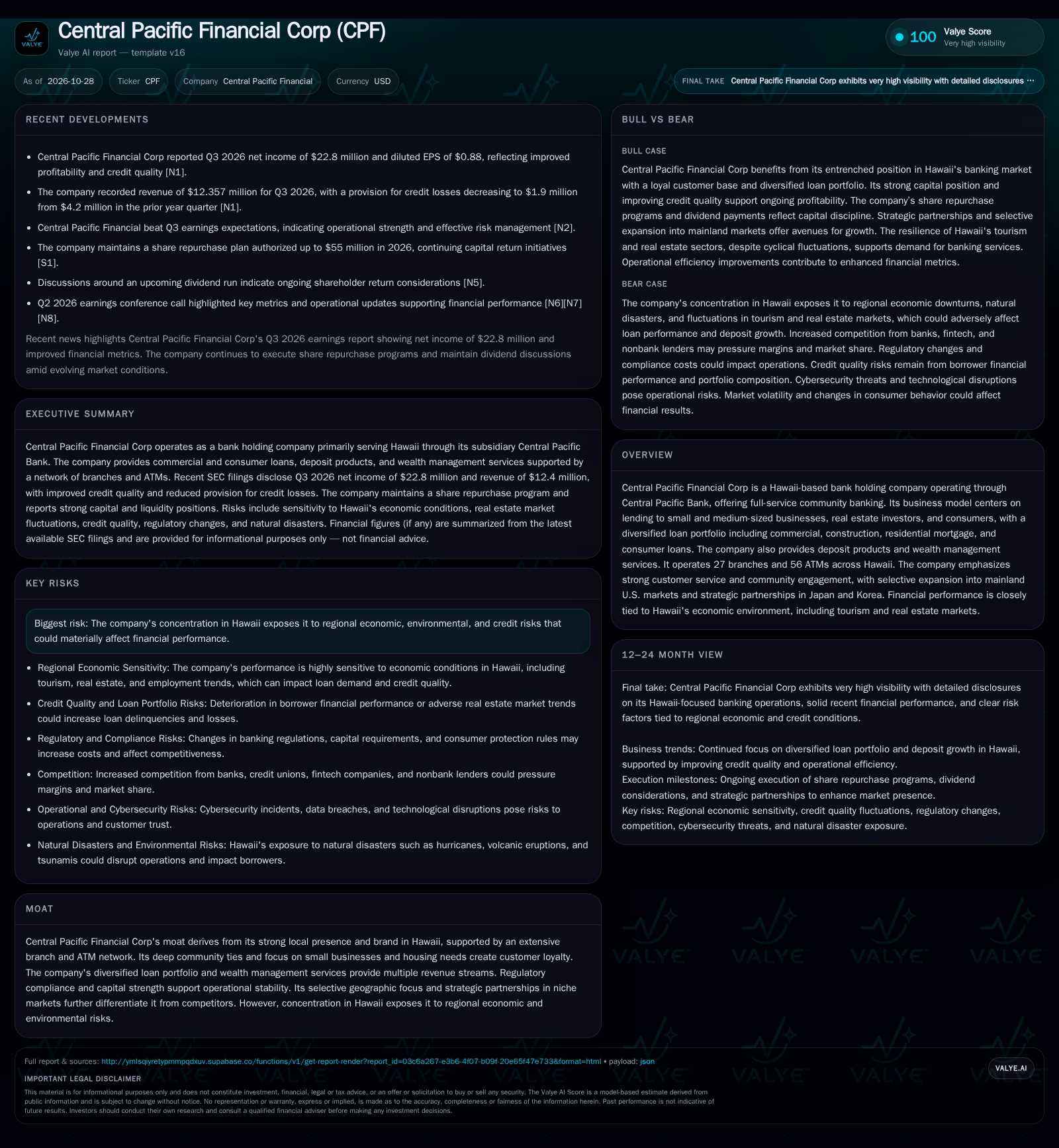
Central Pacific Financial Corp (CPF) delivered robust Q3 2026 results, marked by improved credit quality and an efficiency ratio improvement to 58.27%. The cited source reports dividend-related activity; that disclosure alone does not establish dividend-policy continuity, management confidence, or a material constraint on capital flexibility. However, CPF’s heavy exposure to Hawaii’s tourism and real estate cycles, along with rising competition and disaster risk, remain central to its long-term outlook. Strategic expansion and operational efficiency are key levers to watch going forward. [S2] [N2] [N5]
Central Pacific Financial Corp’s latest results showcase a well-run, regionally focused bank leveraging its entrenched position in Hawaii’s community banking landscape. With earnings ahead of expectations, a declining provision for credit losses, and a renewed capital return program, CPF is demonstrating operational resilience. Yet, its fortunes are tightly intertwined with Hawaii’s unique economic drivers—most notably tourism, real estate, and natural disaster exposure. As the bank eyes selective expansion and digital initiatives, the core question is whether efficiency gains and balance sheet strength can offset the inherent risks of geographic concentration and rising competition.
Recent Performance Highlights Strong Core and Capital Return Focus
Central Pacific Financial delivered net income of $64.3 million for the first nine months of 2026, translating to $2.46 per diluted share and a return on average assets of 1.22%. The return on average equity stood at a robust 15.28% for Q3, signaling strong underlying profitability. The provision for credit losses fell to $1.9 million in Q3 2026 from $4.2 million a year prior, reflecting tangible improvements in credit quality and portfolio composition. Operational efficiency also improved, with the non-GAAP efficiency ratio declining to 58.27% from 62.84% in Q3 2025. On the capital front, CPF authorized a new $55 million share repurchase plan for 2026, following the completion of its prior buyback program. These developments collectively underscore effective risk management, operational discipline, and a continued commitment to shareholder returns. [S2] [S1] [N2]
How CPF Monetizes Community Banking in a Unique Island Economy
CPF’s core business economics are shaped by its lending and deposit franchise, with a diversified loan book spanning commercial, construction, residential mortgage, and consumer segments. In Hawaii, the bank’s ability to price loans is influenced by limited local competition and deep customer relationships, though this also means its loan growth and credit performance are acutely tied to the state’s cyclical tourism and real estate sectors. Deposit funding is largely relationship-driven, with relatively low-cost core deposits supporting net interest margins—though deposit beta could rise if competition intensifies or rates shift.
Revenue mix is supplemented by fee-based wealth management, trust, and advisory services, providing some insulation from net interest margin volatility. Operating leverage is achievable through continued cost discipline and digitalization, as reflected in recent efficiency gains. However, fixed costs from a physical branch network and technology investments are persistent, and new capital requirements or regulatory compliance costs could pressure margins. Share repurchases and dividends remain important uses of capital, but future buybacks may be tempered if loan growth accelerates or credit quality deteriorates.
Defending Local Franchise Strengths as Competition and Disruption Loom
CPF’s competitive edge is rooted in its entrenched local presence, with 27 branches and 56 ATMs serving the Hawaiian islands—a network that supports brand loyalty, especially among small businesses and long-term residents. Its reputation for community engagement and personalized service could increase switching friction, while longstanding relationships with real estate investors and hospitality businesses anchor its commercial lending book.
However, the bank’s geographic concentration is a double-edged sword: while it limits direct competition from national banks and fintechs, it also exposes CPF to regional shocks and constrains its addressable market. Competitors in Hawaii include other local banks, credit unions, and increasingly, digital-first entrants and nonbank lenders targeting niche loan segments or payment services. The real threat to CPF’s margins and growth prospects arises if fintech adoption accelerates among consumers or if larger banks intensify efforts to capture high-value clients through digital channels and remote advisory services.
Leveraging Core Strengths and Economic Tailwinds to Drive Outperformance
CPF could outperform if Hawaii’s economy remains resilient, tourism rebounds further, and real estate loan demand stays robust. Continued improvement in credit quality—evidenced by sustained low provisions for credit losses—would bolster earnings visibility. Further operational efficiency, such as branch consolidation or digital channel expansion, could unlock additional margin expansion. If deposit growth remains strong and stable despite competitive pressure, CPF’s funding costs could remain below those of mainland peers, supporting net interest margin resilience.
Confirmation of this scenario would come from ongoing improvements in the efficiency ratio, steady or rising loan growth (particularly in higher-yielding segments), and further reductions in non-performing assets. New strategic partnerships, successful expansion into select mainland markets, or above-peer deposit retention would also signal CPF’s ability to leverage its franchise for sustainable growth.
Balancing Local Resilience with Structural Constraints in the Near Term
The most plausible outcome is that CPF sustains moderate profitability and operational efficiency, but growth remains largely in line with Hawaii’s economic trajectory. Credit quality stabilizes at improved levels, and provision expenses remain manageable, but loan growth is constrained by the mature, slow-growing nature of the local economy. Deposit competition may gradually increase, especially if fintech adoption or mainland bank incursion accelerates, putting mild pressure on net interest margins.
The efficiency ratio is likely to see incremental improvement from ongoing process optimization, but major gains may be limited unless digital adoption materially reduces legacy branch costs. Share repurchases and dividends continue, but are sized to reflect modest organic growth and the need to maintain capital for unforeseen shocks. Evidence for this scenario includes steady returns on assets and equity, low volatility in credit metrics, and a stable but unspectacular pace of loan and deposit growth.
Regional Shocks and Competitive Pressures Erode Financial Resilience
CPF’s biggest risks stem from its geographic concentration. A sharp downturn in Hawaii’s tourism or real estate markets—triggered by global macro weakness, a natural disaster, or a pandemic-like event—could drive up loan delinquencies, increase credit loss provisions, and impair earnings. Rising competition from fintechs or aggressive pricing by larger banks could force CPF to raise deposit rates or loosen lending standards, compressing margins and increasing risk.
If regulatory costs rise or the bank suffers a major cybersecurity incident, operational expenses could spike, eroding the recent efficiency gains. In this scenario, the efficiency ratio would deteriorate, non-performing loans would rise, and capital return programs could be paused to preserve balance sheet strength. Confirmation would come from a spike in credit loss provisions, a marked increase in non-performing assets, or evidence of deposit outflows to competitors.
Testing the CPF Thesis: Metrics and External Factors That Will Shape the Outlook
Sustained performance in the efficiency ratio, especially if it continues to improve toward or below 58%, would indicate successful cost discipline and digital transformation.
Quarterly trends in provision for credit losses and non-performing asset ratios are critical for gauging credit risk exposure to Hawaii’s cyclical sectors.
Loan growth rates by segment (commercial, residential mortgage, consumer) would help assess whether CPF is capturing new business or facing demand headwinds—if disclosed.
Deposit growth and stability, especially core deposits versus time deposits, will signal customer loyalty and competitive pressure.
Progress or setbacks in strategic partnerships or selective mainland expansion would provide evidence of CPF’s ability to diversify beyond Hawaii.
Any major regulatory, cybersecurity, or natural disaster event impacting operations or credit quality would serve as a real-time stress test for CPF’s risk management.
A useful metric would be digital adoption rates among CPF’s customer base, as this would illuminate competitive positioning versus fintechs and national banks.
Disclaimer: This is research-only, informational analysis and not investment advice. It may include AI-generated interpretation and general industry context. Always verify important details using primary sources.

Comments