
OrthoPediatrics at a Crossroads: Expanding Product Portfolio Meets Ongoing Profitability Challenge
Record Q3 revenue and nationwide product launches highlight OrthoPediatrics' growth momentum, but persistent net losses and niche market constraints test the sustainability of its pediatric orthopedic focus.
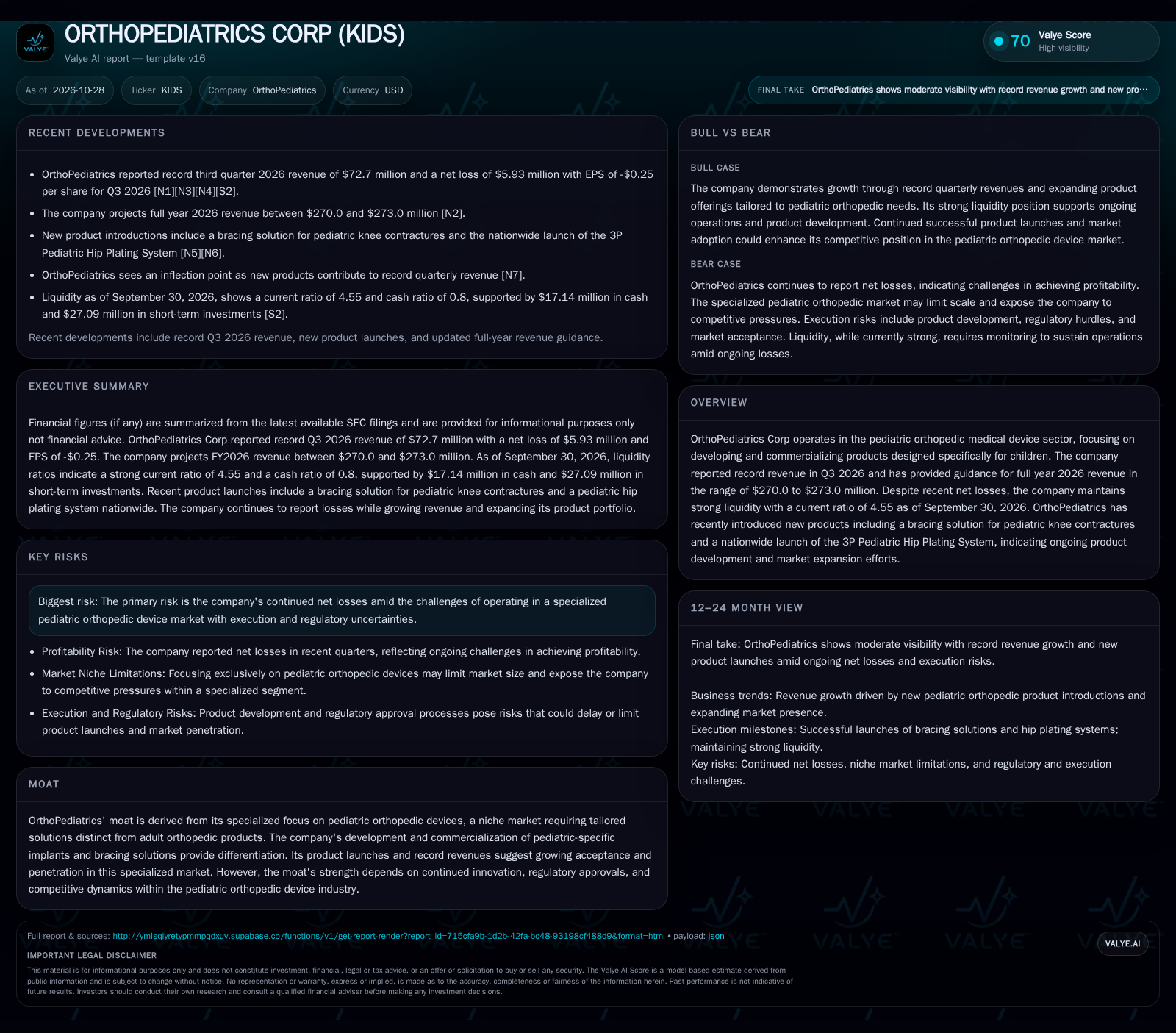
OrthoPediatrics delivered record Q3 2026 revenue of $72.7 million and introduced new bracing and hip plating solutions, signaling commercial traction in pediatric orthopedics. Despite this, the company remains unprofitable, posting a net loss of $5.93 million for the quarter. With a current ratio of 4.55 and cash/short-term investments totaling $44.23 million, liquidity is not an immediate concern. The central question is whether continued product innovation and market expansion can eventually drive scale and margin improvement within a specialized, inherently limited market segment. [N1] [N2] [N3] [N4] [N5] [N6] [S2]
OrthoPediatrics Corp’s latest quarter underscores the company’s duality: robust top-line growth from new pediatric orthopedic product launches, but persistent net losses that highlight the challenge of scaling profitability in a highly specialized market. With record Q3 revenue and a strengthened product lineup, the company is gaining commercial traction, yet the economics of pediatric orthopedics—a field defined by small patient pools and high regulatory hurdles—mean that sustainable margins remain elusive. The next phase hinges on whether innovation and market expansion can convert revenue momentum into lasting financial strength. [N1] [N2] [N3] [N4] [N5] [N6] [S2]
Recent Performance: Revenue Records Amid Ongoing Net Losses
OrthoPediatrics reported record quarterly revenue of $72.7 million in Q3 2026, reflecting momentum from new product launches, including a pediatric knee bracing solution and the 3P Pediatric Hip Plating System. However, the company posted a net loss of $5.93 million for the quarter, continuing a pattern of quarterly unprofitability. Management projects full-year 2026 revenue between $270.0 and $273.0 million, suggesting confidence in continued commercial traction. The company reported a current ratio of 4.55 for the period. These facts frame a business at a pivotal stage: growing sales and product breadth, but still searching for a route to sustained profitability. [N1] [N2] [N3] [N4] [N5] [N6] [S2]
Profit Model Constraints in Pediatric Orthopedics
OrthoPediatrics operates in a niche segment of the medical device industry, focusing on pediatric orthopedic implants and bracing solutions. Revenue is primarily generated from the sale of specialized hardware to hospitals and surgical centers, where purchasing decisions are influenced by clinical efficacy, regulatory clearance, and surgeon preference. In this market, pricing typically reflects high fixed R&D and regulatory costs relative to a small addressable patient population, leading to structurally higher per-unit prices but limited scale benefits.
The company’s cost structure is characterized by significant ongoing investment in product development, clinical studies, and regulatory compliance, with relatively low variable costs per unit. This dynamic can delay operating leverage, as incremental revenue may be absorbed by continued R&D and commercial expansion rather than dropping quickly to the bottom line. Additionally, capital needs for inventory, surgeon education, and clinical support are non-trivial, further pressuring margins. Until the product portfolio reaches a scale where fixed costs are covered and gross margins expand meaningfully, profitability is likely to remain a challenge.
The pediatric orthopedic market's inherent scale constraints impose a natural ceiling on revenue potential, making operational efficiency and cost management critical. Given the relatively small patient population, the company must optimize its sales and marketing efforts to avoid disproportionate spending that could erode margins further. Additionally, the long sales cycles typical in medical device procurement, especially in pediatric specialties, can delay revenue recognition and complicate cash flow management. Strategic partnerships or licensing agreements might offer pathways to leverage broader distribution networks without incurring commensurate fixed costs, thus partially mitigating the scale limitations inherent in the business model.
Specialization as Differentiation—But Not Immunity
OrthoPediatrics’ competitive position is rooted in its exclusive focus on pediatric orthopedics—a segment underserved by larger, generalist orthopedic device companies. This specialization enables tailored product development and closer clinical relationships with pediatric surgeons. The recent launches of the 3P Pediatric Hip Plating System and knee bracing solution underscore this commitment.
However, the company’s moat is not absolute. Large orthopedic multinationals possess the resources to enter pediatric sub-segments if market growth or reimbursement trends justify it, potentially eroding OrthoPediatrics’ share or compressing pricing. Additionally, substitute therapies (such as non-surgical interventions or biologics) and the relatively small size of the pediatric patient pool limit the upside. Regulatory barriers provide some protection, but also slow the pace of product cycles and market adoption. The company’s ability to maintain its differentiation will depend on continuous innovation and deepening clinical trust—advantages that are real but not insurmountable by better-funded competitors.
OrthoPediatrics’ specialization also necessitates a nuanced approach to clinical engagement, as pediatric orthopedic surgeons represent a concentrated and influential user base. Building and maintaining strong relationships with key opinion leaders can accelerate adoption and foster loyalty, which is essential given the competitive threat from larger firms with deeper pockets. However, this reliance on a limited clinical community also introduces vulnerability; shifts in surgeon preferences or the emergence of alternative treatment paradigms could disproportionately impact market share. Therefore, continuous investment in clinical education and evidence generation is not just a differentiation tactic but a defensive necessity in preserving the company’s niche.
When New Product Momentum Converts to Margin Expansion
The constructive scenario for OrthoPediatrics centers on successful commercialization of recent and future product launches, leading to accelerated revenue growth and improved gross margins. If the bracing solution for knee contractures and the 3P Hip Plating System achieve wide clinical adoption, this could drive higher sales volumes, better utilization of manufacturing assets, and increased operating leverage.
Confirmation would come from sequential revenue growth outpacing operating expense increases, expansion in gross margin percentage, and a narrowing of quarterly net losses. New distribution agreements, expanded reimbursement, or evidence of market share gains from generalist competitors would further validate the thesis. Conversely, if new product launches stall or fail to gain traction, or if pricing comes under pressure, the upside scenario would be undermined.
If OrthoPediatrics successfully leverages its product innovation to achieve higher utilization rates and repeat purchases, it could unlock incremental operating leverage beyond simply growing revenue. For instance, improvements in manufacturing efficiency or supply chain optimization could reduce cost of goods sold per unit, enhancing gross margins. Moreover, expanding reimbursement coverage for pediatric orthopedic devices would lower barriers to adoption, potentially accelerating volume growth. In this scenario, the company might also benefit from cross-selling opportunities within its expanded product portfolio, increasing average revenue per customer. These dynamics combined could create a virtuous cycle, where scale and margin improvements reinforce each other, moving the company closer to sustainable profitability.
Growth Continues, but Profitability Remains Distant
The most plausible near-term outcome is continued top-line growth driven by incremental product launches and deeper penetration with existing solutions, but with operating losses persisting due to high fixed costs and the limited scale inherent in pediatric orthopedics. Revenue is likely to track in line with guidance, as new products add volume and potentially improve the mix, but margin improvement may be slow as R&D and market development investments continue.
Evidence confirming this scenario would include steady increases in revenue and product introductions, but ongoing net losses and stagnant or only modestly improving gross margins. Falsification would require either a step-change in profitability—suggesting a meaningful shift in operating leverage—or a sharp revenue slowdown, indicating that the growth engine is faltering.
Execution Risks and Market Limits Pressure Liquidity
The adverse scenario emerges if new product launches underperform, regulatory or reimbursement setbacks occur, or competitive encroachment from larger device makers accelerates. In this case, revenue growth would decelerate, while fixed costs and ongoing R&D spend remain high, leading to widening losses.
If commercial momentum stalls and cash burn accelerates, the company could be forced to raise additional capital or curtail R&D investment, potentially eroding its differentiation. Evidence supporting this downside would include sequential revenue declines, deteriorating gross or operating margins, and a rapid drawdown of cash and short-term investments. Any regulatory or product recall issues would further exacerbate the situation.
Milestones That Will Test OrthoPediatrics’ Path to Sustainable Growth
Quarterly gross margin trends: Sustained expansion would suggest operating leverage; stagnation or contraction would point to persistent scale challenges, especially if revenue grows.
Sequential revenue growth by product family: Disaggregated performance, if disclosed, would clarify the adoption rates and commercial impact of recent launches.
Operating expense as a percentage of revenue: Improvement would indicate progress toward breakeven; continued elevation would signal ongoing scale limitations.
Product development pipeline and regulatory milestones: Announcements of new approvals, launches, or clinical results would provide evidence of continued innovation.
Competitive activity in pediatric orthopedics: Any major entry or expansion by larger device makers could threaten pricing or share.
Reimbursement environment changes: Shifts in payer policies or coverage for pediatric orthopedic procedures could directly impact demand.
Disclaimer: This is research-only, informational analysis and not investment advice. It may include AI-generated interpretation and general industry context. Always verify important details using primary sources.

Comments