
Phillips 66: Earnings Power, Refining Scale, and the Realities of Energy Transition
Record Q3 2026 earnings for Phillips 66 highlight the enduring importance of refining margins and operational scale, but also frame the company’s exposure to commodity swings, regulatory shifts, and the capital intensity of transformation in an evolving energy landscape.
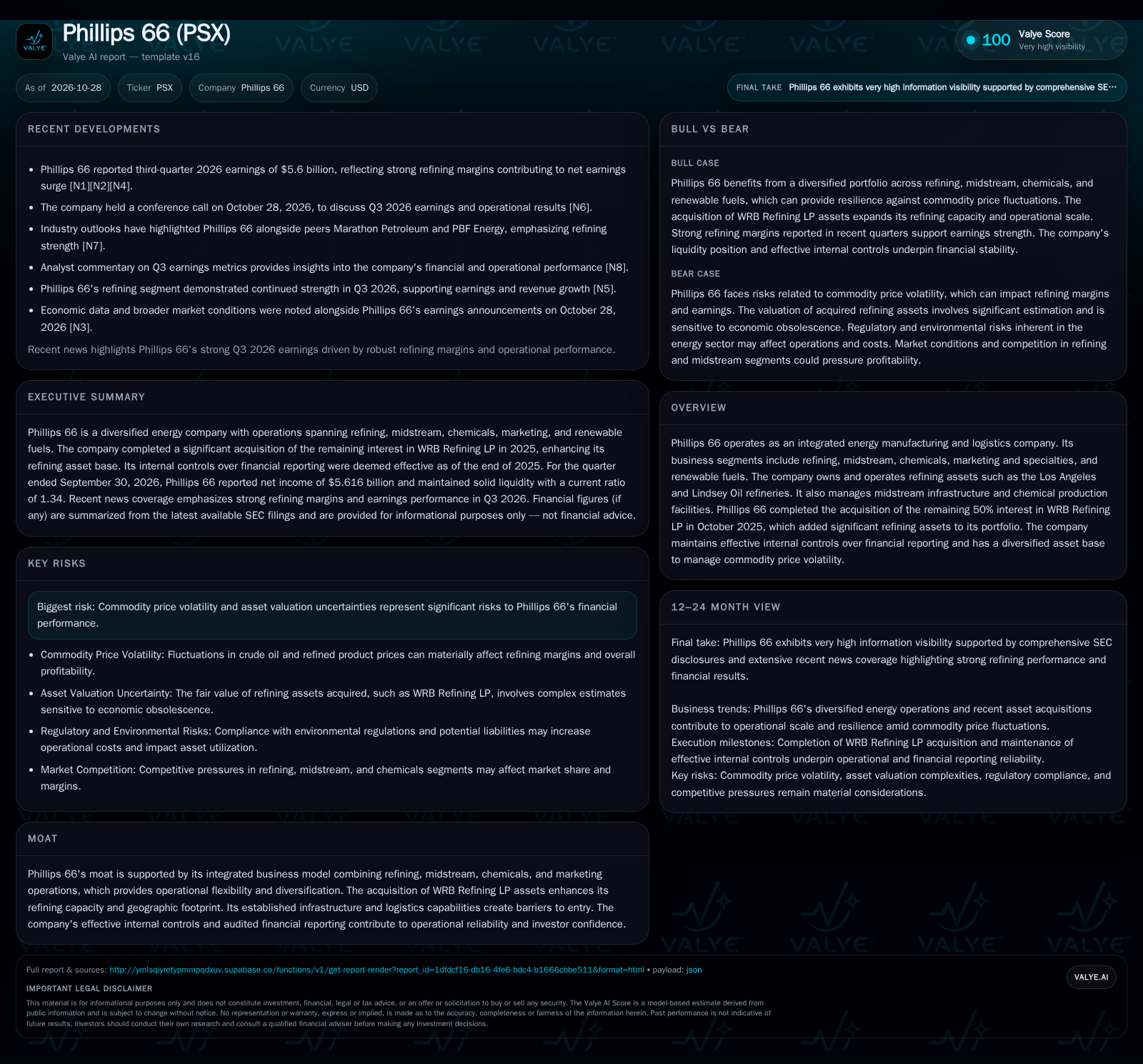
Phillips 66 posted $5.6 billion in Q3 2026 net income, driven by strong refining margins and the consolidation of WRB Refining LP. Recent results underscore the company’s scale advantages and asset diversification, but also surface risks from commodity volatility, evolving regulation, and the uncertain pace of energy transition. Monitoring margin sustainability, capital allocation, and regulatory adaptation will be central to the investment thesis as the company navigates changing energy demand and policy.
Phillips 66’s record third-quarter 2026 earnings underscore the company’s continued ability to extract value from large-scale refining and integrated energy operations. The recent consolidation of WRB Refining LP has bolstered its asset base, just as industry-wide refining margins remain robust. The company reported profitability for the period. The coming quarters will test whether today’s earnings power can translate into durable advantage.
Refining Margins and Asset Expansion Drive 2026 Results
Phillips 66 reported net income of $5.616 billion for Q3 2026, reflecting a substantial earnings surge attributed mainly to strong refining margins [S2] [N1] [N2] [N4] [N5]. The company completed the acquisition of the remaining 50% interest in WRB Refining LP from Cenovus Energy in October 2025, recognizing $2.8 billion in additional refining assets [S1]. This consolidation expands both operational scale and earnings potential, positioning Phillips 66 to leverage favorable market conditions. The company reported cash and liquidity metrics for the period; these figures do not by themselves establish operating runway, investment capacity, financial flexibility, or financing capacity. [S2] These developments collectively frame a business at the intersection of operational momentum and the need for ongoing adaptation.
The Economics of Scale: Margin Leverage and Capital Intensity
Phillips 66 generates revenue through a diversified portfolio: refining, midstream, chemicals, marketing, and renewable fuels. The company’s refining segment remains the core earnings engine, with profitability closely tied to the spread between crude input costs and refined product prices. High refining margins in Q3 2026 demonstrate the profit potential when crack spreads are wide, but these margins are inherently cyclical and vulnerable to shifts in supply-demand balance or regulatory shocks. The acquisition of WRB Refining LP increases throughput and fixed-cost leverage, amplifying both upside and downside in margin cycles.
Midstream and chemicals segments provide some buffer against crude price volatility, as fee-based logistics and specialty chemicals earnings are less directly exposed to commodity swings. However, the capital intensity of maintaining and upgrading refineries, pipelines, and renewable facilities remains high, demanding disciplined capital allocation and continuous investment. As the energy transition advances, Phillips 66’s renewable fuels and chemical investments may support long-term diversification, but near-term returns depend heavily on legacy hydrocarbon assets and the pace of regulatory change.
Integrated Operations and Barriers—But Margin Compression Looms
Phillips 66’s competitive position is anchored in its integrated business model, which combines refining, midstream logistics, chemicals, and marketing. This integration provides operational flexibility—crude sourcing, product blending, and logistics optimization—that can help mitigate adverse movements in any single segment. The company’s recent asset consolidation further strengthens its scale advantage, particularly in the U.S. and select international markets.
However, the refining sector remains structurally competitive, with peers such as Marathon Petroleum and PBF Energy also enjoying scale and integration benefits [N7]. Over time, margin compression could arise from new capacity additions, demand shifts (especially if electric vehicle adoption accelerates), and tightening environmental regulations. While Phillips 66’s infrastructure and established customer relationships create switching frictions, these advantages may erode if regulatory requirements force costly retrofits or if lower-carbon alternatives gain ground more rapidly than expected.
Sustained Margin Strength and Successful Energy Diversification
The most favorable outcome for Phillips 66 would see refining margins remain elevated due to continued supply discipline, robust end-market demand, and limited capacity additions in North America. The expanded refining base from the WRB acquisition could then deliver disproportionate earnings growth and operating leverage. Simultaneously, the company could successfully ramp up its renewable fuels and specialty chemicals businesses, capturing regulatory credits and premium pricing in low-carbon markets.
Evidence confirming this scenario would include: persistent high crack spreads; growing contributions from renewable fuels and chemicals to total EBITDA; visible progress on major capital projects (such as refinery conversions or renewable expansions) coming in on time and on budget; and regulatory clarity that allows for effective long-term capital planning. Falsification would occur if margin strength proves fleeting, renewable investments underperform, or regulatory costs escalate unexpectedly.
Earnings Volatility Amid Cyclical and Structural Change
The most plausible near-term course is one of continued earnings volatility, with refining margins gradually reverting toward mid-cycle levels as market supply and demand rebalance. Phillips 66’s diversified business mix will likely buffer, but not eliminate, swings in profitability. The WRB acquisition should enhance operating scale, but integration risks and asset valuation uncertainties may temper its impact.
Incremental growth in renewable fuels and chemicals segments may offset some pressure from traditional refining, yet these businesses will likely remain subscale relative to hydrocarbons for several years. Regulatory and environmental compliance costs are likely to rise, but not so abruptly as to trigger immediate existential threats. Confirmation would come from stable—if variable—quarterly earnings, measured capital deployment, and steady progress on renewables and compliance milestones. This scenario would be undermined by a sudden collapse in refining margins, major cost overruns, or regulatory shocks.
Margin Compression and Regulatory Headwinds Challenge Profitability
A negative scenario would be triggered by a sharp decline in global refining margins—whether due to demand destruction, new capacity additions, or a rapid increase in regulatory costs. Under such conditions, Phillips 66’s expanded refining footprint could amplify downside, as fixed costs and depreciation remain high even as throughput and pricing weaken.
Simultaneously, if regulatory changes—such as more aggressive carbon pricing, accelerated fuel economy standards, or changing renewable fuel mandates—materially increase compliance costs or capex needs, cash flow could be squeezed. Underperformance or delays in renewable projects would further erode the company’s ability to pivot away from hydrocarbons. Confirmation would include consecutive quarters of margin compression, negative free cash flow, rising debt, or asset impairments. This scenario could be partially mitigated if the company rapidly adjusts its cost structure or divests non-core assets.
Testing the Phillips 66 Thesis: Margin Durability, Capital Discipline, and Transition Milestones
Track the refining segment’s reported gross margin per barrel and overall segment EBITDA, as these figures directly reflect the health of the company’s core earnings engine.
Monitor the pace and cost of integration for the acquired WRB Refining LP assets, including any updates on synergy capture or unexpected operational challenges.
Assess contributions from renewable fuels and chemicals as a share of total EBITDA or operating income—growth here would signal progress in diversification.
Watch for major capital expenditure announcements, particularly regarding refinery upgrades, renewable conversions, or regulatory compliance investments.
Scrutinize any regulatory or policy changes affecting refining economics—such as shifts in fuel standards, carbon pricing, or renewable fuel mandates—that could alter cost structure or demand.
Examine quarterly cash flow from operations versus capital expenditures to gauge whether the company is maintaining capital discipline.
Monitor peer margin trends and competitive actions, particularly among integrated refiners and large-cap midstream players, to contextualize Phillips 66’s performance.
Disclaimer: This is research-only, informational analysis and not investment advice. It may include AI-generated interpretation and general industry context. Always verify important details using primary sources.

Comments