
Crown Holdings in 2026: Global Scale, Raw Material Volatility, and the Resilience Test in Packaging Economics
Crown Holdings’ dominance in global beverage cans drives scale and customer access, but exposes the company to raw material price swings and customer concentration. The next phase depends on sustaining margin discipline, translating sustainability investments into competitive benefit, and managing the tightrope between scale-driven efficiencies and concentrated risk.
Crown Holdings generates nearly three-quarters of its $12.4B sales from beverage cans, with major multinationals as anchor customers and 61% of revenue from outside the U.S. [S1]. [S2] The company’s future hinges on passing through input costs, leveraging global scale, and translating ESG leadership into durable contracts.
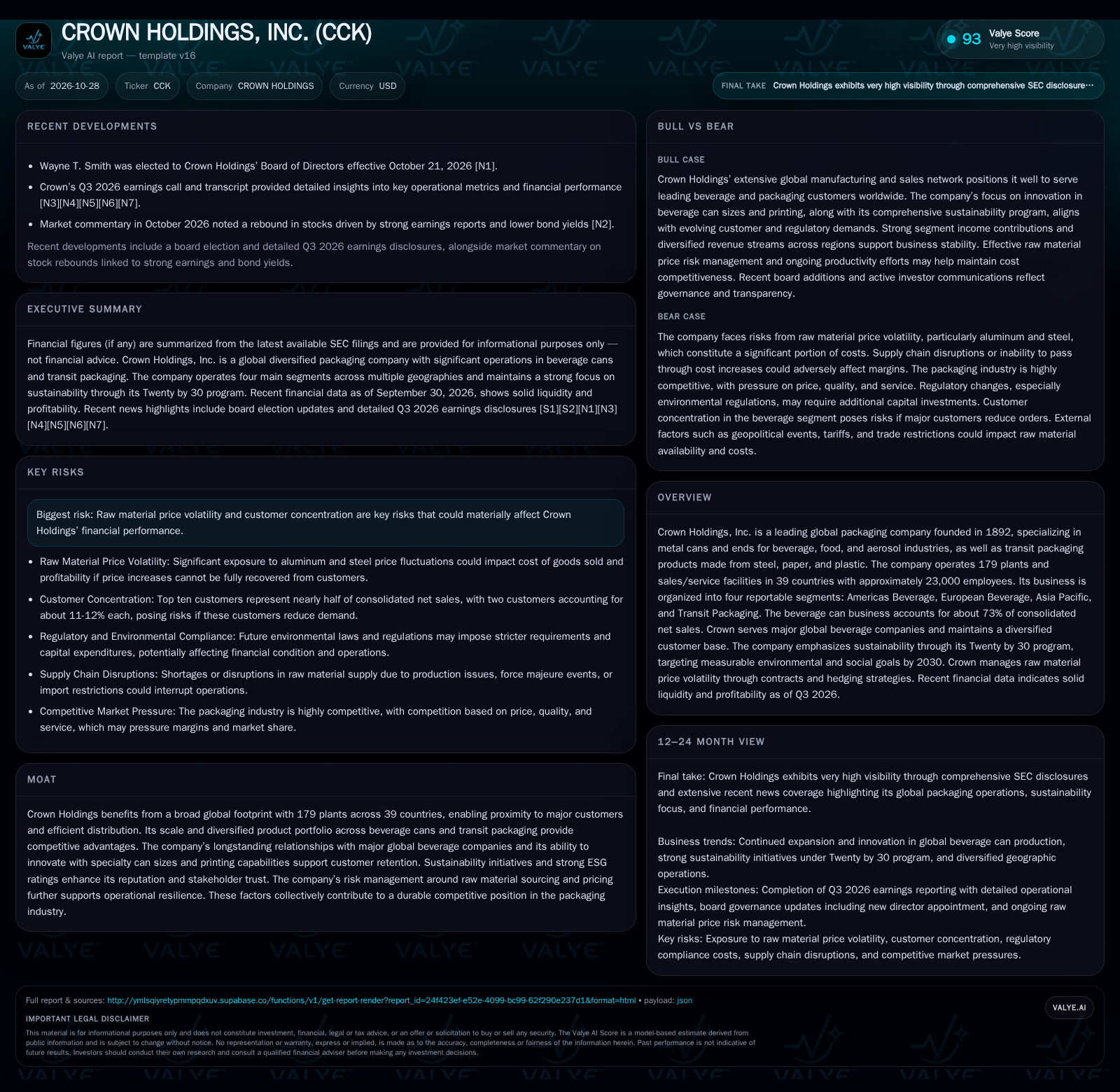
Crown Holdings enters late 2026 as one of the world’s largest packaging manufacturers, with 179 plants across 39 countries and a business model anchored in beverage cans for multinational customers [S1]. The company’s scale and global reach provide efficiency advantages, but also create exposure to volatile aluminum and steel prices, and to the strategic decisions of a concentrated customer base. As the company pursues ambitious sustainability goals and navigates shifting regulatory and input cost landscapes, the central question is whether its global platform and innovation pipeline can consistently translate into pricing power and margin stability—or whether cyclical and structural pressures will erode the company’s economic resilience.
Recent Earnings, Customer Mix, and the Raw Material Cost Equation
As of Q3 2026, Crown Holdings reported net income of $225 million and basic EPS of $2.09, with a current ratio of 1.14 and cash and equivalents totaling $629 million [S2]. The company generated $12.4 billion in 2025 net sales, with 73% from beverage cans and 61% from non-U.S. operations [S1]. Two customers each accounted for about 11-12% of consolidated net sales, and the top ten together represented nearly half, highlighting significant customer concentration [S1]. Raw materials—primarily aluminum (47% of cost of goods sold) and steel (8%)—remain a central cost variable, with price risk only partially hedged through contracts and forwards [S1]. These facts frame the company’s near-term thesis: solid profitability and global reach, but persistent exposure to input volatility and customer power.
How Crown’s Packaging Model Turns Scale into Margin—And Where the Leverage Bites Back
Crown’s economics are fundamentally scale-driven, with high fixed costs in plant, equipment, and logistics, but variable costs dominated by raw materials—particularly aluminum. The beverage can business is characterized by long production runs, tight integration with customer supply chains, and a product that is at once a commodity (in material terms) and a substrate for brand differentiation (through specialty sizes and printing). Pricing for cans is typically linked to input costs via pass-through mechanisms, but these are rarely perfect: timing lags, contract variations, and competitive intensity can leave the company exposed to margin squeeze when aluminum prices spike.
The company’s large global footprint allows for proximity to customers, which can reduce shipping costs and enable just-in-time delivery, important for large beverage multinationals. However, this also means significant ongoing capital expenditure is required to maintain and upgrade facilities, especially as sustainability and regulatory demands rise. Crown’s transit packaging segment offers higher value-added solutions and some margin diversification, but remains a minority of total profit and revenue [S1].
Operating leverage cuts both ways: when volumes are strong and cost pass-throughs are effective, margins expand; when volumes soften or input costs cannot be passed on, profitability can deteriorate rapidly. Sustainability investments (such as the Twenty by 30™ program) may drive longer-term efficiency and reputational benefits, but require upfront capital and may pressure near-term returns if not offset by pricing or contract gains.
Competitive Edges and Counterforces in Global Packaging
Crown’s moat is rooted in its global manufacturing scale, customer proximity, and long-term relationships with major beverage companies. Its ability to innovate in can sizing, printing, and specialty formats helps embed it in customer supply chains and supports switching frictions—multinational beverage companies are unlikely to swap suppliers lightly due to the complexity and capital intensity of qualifying new plants.
However, the industry remains structurally competitive. Other global packaging firms—particularly those specializing in metal cans or transit packaging—compete on price, reliability, and service. The commoditized nature of the base product limits pricing power, especially outside of specialty formats. Furthermore, customer concentration increases counterparty bargaining power: if a major beverage multinational shifts volume, Crown’s plant utilization and margins could suffer disproportionately.
Sustainability credentials and ESG ratings increasingly matter in bidding for large contracts, particularly in Europe and with global consumer-goods firms. Crown’s validated net-zero targets and strong ESG scores may enhance its competitive position, but these advantages are contingent on customers’ willingness to pay a premium or allocate volume based on sustainability performance.
When Scale, Innovation, and Sustainability Drive Margin Expansion
The most favorable scenario for Crown sees global beverage demand rising or holding steady, enabling high plant utilization and strong volumes. If aluminum prices stabilize or decrease, and the company’s hedging and pass-through mechanisms remain effective, gross margins could expand. Sustainability investments could pay off by differentiating Crown in contract tenders, especially as beverage customers seek to burnish their own ESG credentials and lock in low-carbon supply chains.
Further upside could come from specialty can innovation—formats, printing, or closures that command premium pricing—or from increased transit packaging penetration in higher-margin, less commodity-like segments.
Confirmation would come from reported gross margin expansion, contract wins explicitly tied to sustainability or specialty capability, and evidence of customer volume growth or new major customer additions. Falsification would be signaled by margin compression despite stable input costs, or by customer loss/volume declines that offset any sustainability-driven gains.
Volume Stability, Input Cost Churn, and the Ongoing Margin Balancing Act
The most plausible path is one where global beverage can demand remains steady, but input costs—especially aluminum—continue to fluctuate. Crown manages to pass through most, but not all, cost increases, resulting in margins that are relatively stable but not expanding. Customer relationships remain intact, but competition for volume and periodic renegotiations keep pricing pressure in play.
Sustainability investments are necessary to maintain access to major tenders and avoid regulatory penalty, but do not yet translate into discernible pricing power or volume gains. The transit packaging segment provides some diversification, but its growth and margin profile remain secondary to the beverage can core.
This scenario is confirmed by stable revenue and segment income, with gross margin oscillating within a narrow band around historical averages. Falsification would come from either a sharp, sustained margin decline (indicating pass-through failure or volume loss) or a meaningful upward shift in margins, signaling stronger pricing power or cost control.
How Input Shocks and Customer Shifts Could Erode Crown’s Resilience
In an adverse scenario, a combination of aluminum price spikes and an inability to fully pass through costs compresses margins, particularly if contracts lag or competitors undercut on price. If one or both of Crown’s largest customers reduce orders—whether due to internal supply shifts, volume declines, or strategic sourcing changes—the company could face underutilization in key plants, amplifying fixed-cost drag and eroding profitability.
Regulatory changes that require accelerated capital investments could further strain free cash flow, especially if not matched by customer willingness to pay for sustainability features. Supply chain disruptions, geopolitical factors, or trade restrictions could exacerbate input cost volatility or limit raw material availability.
Downside confirmation would be evident in declining segment income, plant closures or restructuring costs, and negative free cash flow. Falsification would require demonstrated resilience in margins and customer retention even during periods of input price volatility or regulatory change.
Testing Crown’s Thesis: Operational, Customer, and Margin Milestones to Track
Quarterly gross margin trends in the beverage can segment—if disclosed—would indicate the effectiveness of cost pass-throughs and the impact of input price volatility.
New contract wins or extensions, especially those explicitly citing sustainability or specialty can innovation, would help test whether ESG investments are translating into commercial advantage.
Volume trends with top ten customers, particularly the two largest, would provide early warning of concentration risks materializing.
Capital expenditure levels and geographic allocation would shed light on the pace and focus of sustainability and growth investments.
Segment income and growth rates in Transit Packaging would clarify the extent of diversification and margin contribution outside the beverage core.
Disclosure of hedging effectiveness and the degree of input cost recovery in customer contracts would help gauge risk management success.
Developments in regulatory or environmental compliance costs—if broken out—would signal whether sustainability requirements are pressuring near-term margins or cash flow.
Plant utilization rates and any announced plant closures or expansions would offer insight into volume health and strategic response to demand shifts.
Disclaimer: This is research-only, informational analysis and not investment advice. It may include AI-generated interpretation and general industry context. Always verify important details using primary sources.

Comments