
TTM Technologies in 2026: Navigating Global Complexity, Customer Concentration, and Margin Pressures
TTM Technologies posts strong quarterly results, but its fortunes remain closely tied to global supply chains, volatile raw material prices, and a concentrated customer base. As the PCB industry endures rapid product cycles and intense competition, TTM’s ability to sustain high utilization and adapt to shifting demand will be critical for future margin resilience.
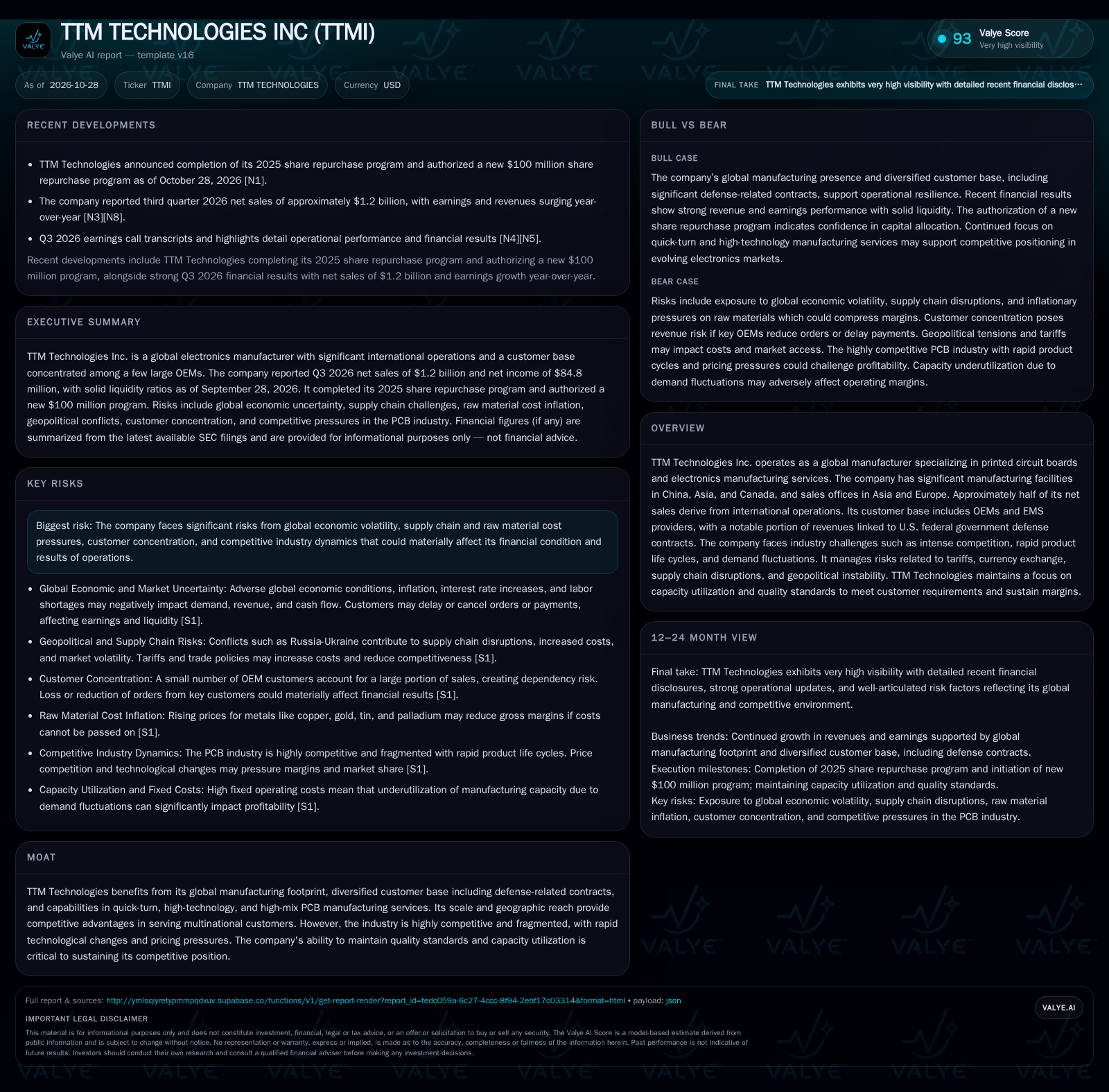
TTM Technologies delivered robust Q3 2026 results, with net sales of $1.2 billion and net income of $84.8 million, but faces pronounced risks from customer concentration, raw material cost inflation, and global economic volatility. The company’s high fixed cost base means capacity utilization will remain a key driver of profitability in a cyclical, fragmented PCB market.
TTM Technologies, a global force in printed circuit board (PCB) and electronics manufacturing services, has reported a strong third quarter for 2026, with net sales of $1.2 billion and net income of $84.8 million. However, beneath these headline numbers lies a business model exposed to acute cyclical and structural risks: nearly half of sales come from outside the U.S., customer concentration remains high, and cost structure is heavily leveraged to factory utilization. As the electronics supply chain faces persistent disruptions, inflationary input costs, and geopolitical uncertainties, TTM’s near-term success may hinge on its ability to maintain high utilization rates and defend share with demanding OEM customers.
Recent Performance Highlights Structural Exposure
TTM Technologies reported Q3 2026 net sales of approximately $1.2 billion, with net income of $84.8 million and diluted EPS of $0.79 [S2] [N8]. This represents a year-over-year surge in both revenue and earnings [N3] [N4] [N5] [N8]. International operations accounted for about 50% of 2025 net sales, underlining both the breadth of TTM’s global footprint and its vulnerability to cross-border risks [S1]. The company’s balance sheet shows cash and equivalents of $876 million as of September 28, 2026, with a current ratio of 1.67 and cash ratio of 0.49 [S2]. More strategically, TTM’s customer base is highly concentrated: the top five customers contributed 44% of 2025 net sales [S1]. These facts frame a business with substantial operational momentum, but also pronounced sensitivity to macro, customer, and supply chain shocks.
Profitability Hinges on Utilization and Input Costs
TTM’s core economics are shaped by high fixed manufacturing costs and significant exposure to raw material price volatility—especially metals like copper, gold, tin, and palladium [S1]. Gross margin expansion is heavily dependent on maintaining high factory utilization; periods of underutilization can rapidly erode margins. In the PCB business, pricing is often dictated by customer bargaining power and the commoditized nature of standard boards, though TTM’s focus on high-mix, high-tech, and quick-turn services may allow for some premium pricing—particularly in defense and advanced electronics segments. However, these pockets of pricing power are counterbalanced by the need to absorb rising input costs and potential labor inflation, which may not be fully pass-through if customers resist price increases. Capital needs are ongoing as the company must invest to keep pace with rapid product cycles and evolving customer requirements, especially for quick-turn and high-complexity orders. The company reported cash and liquidity metrics for the period; these figures do not by themselves establish operating runway, investment capacity, financial flexibility, or financing capacity.
Global Footprint Offers Scale, But Competition Is Relentless
TTM’s global manufacturing network, spanning China, Asia, and Canada, is a double-edged sword: it enables service to multinational OEMs and defense primes, but exposes the company to tariffs, currency swings (notably RMB and MYR), and geopolitical disruptions [S1]. The PCB and EMS industry is highly fragmented, with many domestic and Asian competitors able to undercut on price, especially in standard product categories. TTM’s partial insulation comes from its capabilities in high-mix, quick-turn, and high-reliability manufacturing—attributes valued by aerospace, defense, and advanced electronics customers. However, switching costs are generally low for most commercial PCB applications, and technological differentiation can be fleeting as process innovations diffuse rapidly. The company’s dependence on a few large customers further limits its negotiating leverage, making it vulnerable to volume shifts or price concessions demanded by these OEMs. In sum, while TTM’s scale and technical breadth are assets, sustainable competitive advantage is difficult to maintain in this dynamic, price-sensitive landscape.
If Utilization Remains High and Defense Demand Grows, Margin Expansion Is Plausible
The most favorable scenario for TTM would involve sustained high capacity utilization, supported by robust demand from both commercial and defense electronics customers. If the company can leverage its global footprint to win incremental business in quick-turn, high-complexity PCBs—particularly from defense primes and advanced technology sectors—margin expansion could follow. Evidence that would confirm this upside includes: sequential improvement in gross margins, rising revenue share from high-reliability/defense contracts, and stable or declining SG&A as a percentage of sales. Further, if TTM can successfully pass along raw material cost increases to customers, or lock in long-term supply contracts at favorable rates, input cost headwinds could abate. Strategic wins in emerging end-markets (e.g., automotive ADAS, aerospace, or IoT) would also signal an ability to capture higher-margin growth opportunities.
Sustained Volatility, But Core Profitability Persists
The most plausible near-term outcome is that TTM continues to deliver solid revenues and modest profitability, but with ongoing earnings volatility tied to swings in demand, customer order timing, and raw material costs. The company’s high fixed cost structure means that even mild fluctuations in utilization can have outsized impact on margins. Customer concentration remains a persistent risk: any reduction in orders from a top OEM or defense prime could quickly translate into a revenue and margin dip. At the same time, the company’s global reach and partial specialization in high-mix, high-reliability PCBs provide some buffer against pure commodity price wars. Confirmation of this scenario would include steady (but not accelerating) revenue growth, flattish gross margins, and continued concentration of sales among the top five customers. Falsification would come from either a sharp drop in utilization (evidenced by falling sales and margin compression) or a surge in higher-value contract wins that dilute the impact of customer concentration.
Demand Shocks or Input Cost Surges Could Trigger Margin Compression
A negative scenario could unfold if TTM faces a simultaneous downturn in demand from key OEMs—whether due to macroeconomic shocks, OEM inventory corrections, or loss of a major customer—and a spike in input costs that cannot be passed through. Because 44% of sales are tied to the top five customers, even a single large customer’s retrenchment could materially impact revenue [S1]. Meanwhile, a surge in copper, gold, or other key metal prices would erode gross margins, especially if end-market conditions prevent timely price increases. Capacity underutilization would exacerbate fixed-cost absorption challenges, driving operating leverage in the wrong direction. Confirmation of this downside would be seen in sequential drops in revenue and gross margin, rising inventory, or working capital build-ups, and any commentary or disclosure of lost business with a major customer.
Pivotal Developments That Could Shift TTM’s Outlook
Gross margin trends: Sequential quarterly changes would help indicate the company’s ability to manage input cost pressures and utilization swings.
Capacity utilization rates: If disclosed, these would provide direct insight into fixed-cost absorption and margin resilience.
Customer concentration metrics: Any reduction in the share of sales from the top five customers would suggest progress on diversification.
Revenue mix by end-market: An increasing share from defense, aerospace, or high-complexity electronics would support a margin expansion thesis.
Raw material cost pass-through: Evidence of the company’s ability to pass on metal price increases to customers would be crucial in inflationary periods.
Inventory and working capital trends: Rapid build-ups could signal slowing demand or supply chain disruptions.
Foreign exchange impacts: Disclosures on RMB and MYR currency swings would help assess the risk posed by international operations.
Major contract wins, extensions, or losses: Announcements of new multi-year deals or the loss of a major OEM would materially affect forward-looking expectations.
Disclaimer: This is research-only, informational analysis and not investment advice. It may include AI-generated interpretation and general industry context. Always verify important details using primary sources.

Comments