
HF Sinclair in Late 2026: Managing Commodity Exposure, Renewables Transition, and Leadership Change
HF Sinclair delivered robust Q3 2026 results, but the real test lies in its ability to balance refining economics, regulatory headwinds, and execution under new leadership.
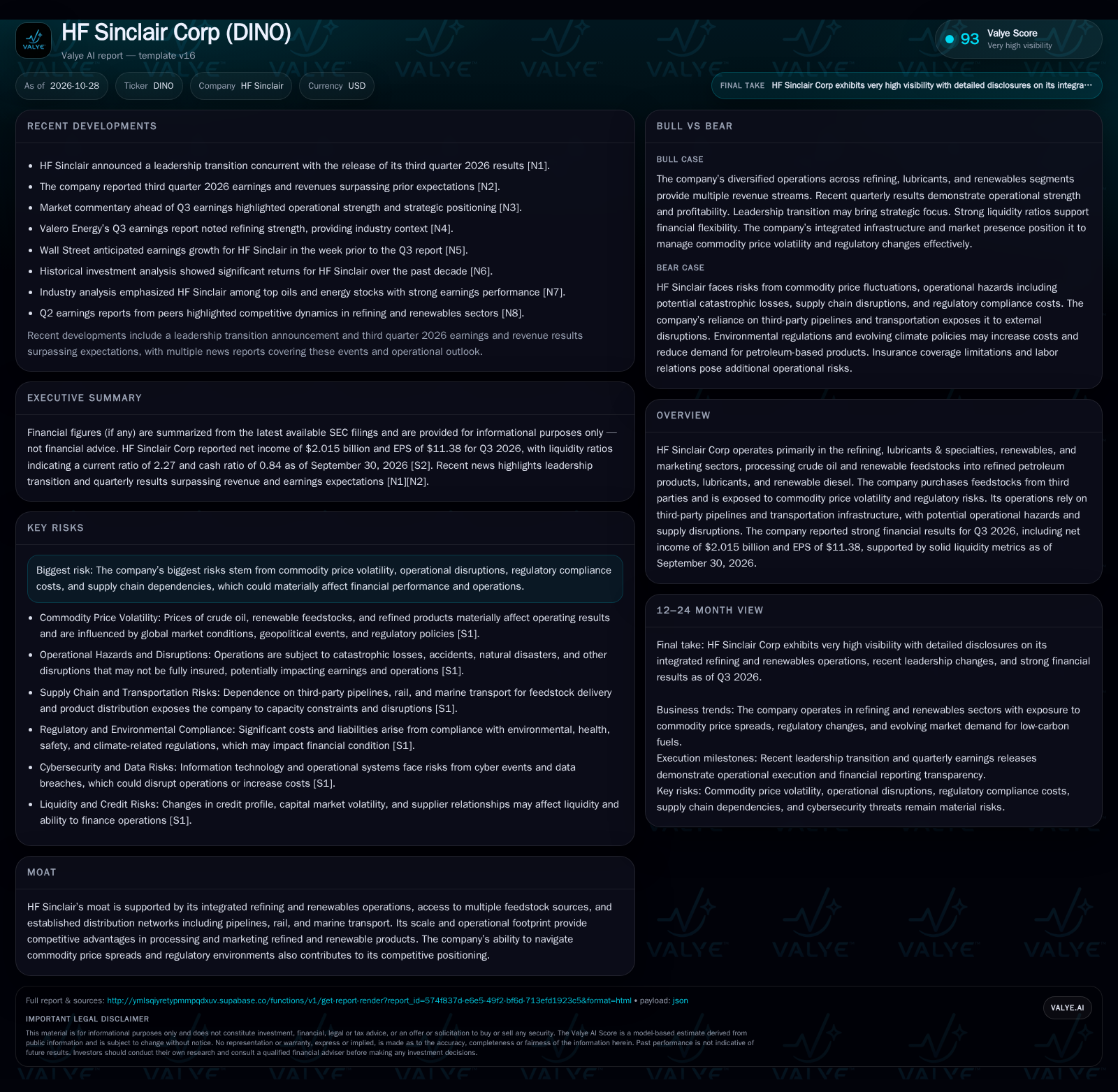
HF Sinclair posted $2.015 billion in net income for Q3 2026, exceeding expectations and highlighting operational strength and a conservative liquidity position. The company's business model—spanning refining, lubricants, renewables, and marketing—remains fundamentally exposed to commodity price volatility, regulatory changes, and supply chain risk. A recent leadership transition introduces both execution risk and the potential for strategic recalibration as the company navigates the evolving energy landscape. Key watchpoints include margin resilience, renewables integration, and the ability to manage regulatory and operational shocks. [S2] [N1] [N2]
HF Sinclair enters the final quarter of 2026 with momentum, reporting higher-than-expected profits and maintaining a sizable liquidity buffer. However, the company’s fundamental exposure to commodity price cycles, regulatory uncertainty, and operational complexity remains. With a recent leadership change, HF Sinclair faces a pivotal period: Can it sustain margin strength and strategic clarity as the energy sector undergoes rapid transformation? The company’s next moves—especially in renewables integration and risk management—will likely determine its resilience and future value.
Recent Performance and Shifting Leadership Set the Stage
HF Sinclair reported net income of $2.015 billion and EPS of $11.38 for the quarter ended September 30, 2026, significantly surpassing consensus expectations. The company reported cash and liquidity metrics for the period; these figures do not by themselves establish operating runway, investment capacity, financial flexibility, or financing capacity. The company announced a leadership transition concurrent with these results, introducing both execution risk and the opportunity for strategic change. These developments matter because they amplify the stakes around execution in a volatile sector, where capital allocation, operational discipline, and adaptability to regulatory and market shifts are paramount. [S2] [N1] [N2]
How the Business Makes—and Risks—Money: Spreads, Scale, and Cycles
HF Sinclair’s core economics are dictated by the margin between purchased feedstocks (crude oil, renewable oils) and the market prices for its output—refined fuels, lubricants, and renewable diesel. The company does not produce its own feedstocks, relying instead on third-party procurement, which means it is a price taker on input costs and must manage spread volatility. Profitability is highly sensitive to crack spreads (the difference between crude oil prices and refined product prices) for traditional operations, as well as the spread between renewable diesel prices (plus incentives) and renewable feedstock costs for its renewables segment. [S1]
Fixed costs are substantial, given the capital-intensive nature of refining and renewables facilities, but once operational, incremental throughput can contribute meaningfully to margins—offering some operating leverage in favorable markets. Variable costs include feedstock, utilities, and compliance expenses. Regulatory costs—especially for renewables blending, emissions, and safety—are material and rising. Capital needs remain significant, both for maintenance and for compliance/adaptation as the regulatory environment evolves. The use of the LIFO inventory method can introduce earnings volatility during periods of sharp commodity price swings, resulting in non-cash charges or reversals that obscure underlying cash generation. [S1]
In sum, HF Sinclair’s cash generation potential is robust in strong margin environments but can deteriorate rapidly if spreads compress, regulatory costs escalate, or if operational disruptions occur.
The interplay between commodity price volatility and regulatory costs creates a complex risk-return profile for HF Sinclair. For instance, while elevated crack spreads can boost margins, they also tend to increase feedstock costs, requiring agile procurement strategies and hedging approaches to preserve profitability. Moreover, regulatory compliance costs are not static; they often increase in stepwise fashion with new mandates, which can abruptly shift cost structures and capital allocation priorities. This dynamic necessitates continuous scenario planning and stress testing to anticipate margin impacts and adjust operational tactics accordingly. The company's ability to flex throughput rates and optimize product slates in response to these factors is critical to maintaining resilient cash flows over commodity cycles.
Competitive Edge and Its Erosion: Integration, Scale, and Structural Headwinds
HF Sinclair’s competitive position is anchored in its integrated refining and renewables infrastructure, access to multiple feedstock sources, and established distribution networks (pipelines, rail, marine). These factors provide some scale benefits and logistical flexibility, allowing the company to optimize product mix and market access. However, reliance on third-party feedstock and infrastructure means it cannot fully insulate itself from supply disruptions or input price shocks. [S1]
The company’s diversified product slate—spanning traditional fuels, lubricants, and renewables—offers resilience against demand shifts, but also exposes it to increased complexity and regulatory scrutiny. In renewables, HF Sinclair competes with both established refiners pivoting to low-carbon fuels and pure-play biofuel producers; success here will depend on execution, cost control, and the ability to capture regulatory incentives. Traditional refining peers and integrated energy majors remain primary competitors, but substitutes from electrification and alternative fuels are a growing long-term threat, particularly as policy and consumer preferences shift.
Scale and integration confer competitive advantages but also impose certain inflexibilities. For example, large, complex facilities may have limited ability to rapidly pivot feedstock inputs or product outputs in response to market signals, compared to smaller or more specialized competitors. This can constrain responsiveness during periods of rapid demand shifts or regulatory change. Additionally, the need to comply with diverse regulatory regimes across multiple jurisdictions adds complexity and cost, potentially eroding scale benefits. Competitors with vertically integrated feedstock supplies or proprietary technologies in renewables may achieve cost advantages or differentiation that HF Sinclair must mitigate through operational excellence and strategic partnerships.
Margin Upside if Spreads Hold and Renewables Integration Accelerates
A favorable scenario would see crack spreads remain wide due to resilient fuel demand and/or constrained global refining capacity, while renewable diesel margins benefit from supportive regulatory incentives and manageable feedstock costs. If the new leadership sustains operational discipline, invests prudently in renewables integration, and leverages the company’s liquidity for opportunistic growth or efficiency projects, HF Sinclair could deliver above-peer returns and cash flow.
Evidence supporting this scenario would include persistently strong product margins relative to feedstock costs, volume growth in renewables and specialty products, and disciplined capital allocation—reflected in rising returns on invested capital, stable or growing dividends, and continued outperformance versus industry benchmarks. Successful navigation of regulatory changes and maintenance of high utilization rates would further confirm the upside case.
Balanced Results Amid Commodity Cycles and Regulatory Pressure
The most plausible path is one where HF Sinclair delivers solid but volatile earnings, with refining and renewables margins fluctuating in response to global commodity cycles and policy changes.
Confirmation would come from continued positive net income (albeit with quarter-to-quarter swings), maintenance of a conservative balance sheet, and incremental progress in renewables volumes and compliance. Falsification would be signaled by sustained margin compression, significant regulatory penalties, or a material operational disruption that erodes cash flow or necessitates asset sales.
Margin Compression and Execution Slippage Under Multiple Pressures
A negative scenario could unfold if crack spreads narrow due to falling product demand, rising input costs, or excess industry capacity. If regulatory costs increase faster than anticipated—especially around emissions or renewable blending—and HF Sinclair struggles to pass these through to customers, margins could erode quickly. Operational incidents, supply chain disruptions, or labor unrest could further amplify downside risk.
Downside evidence would include sharp declines in gross margin per barrel, negative free cash flow, breach of credit covenants, or the need for asset sales or external capital raises. Leadership missteps or execution failures in renewables integration, resulting in cost overruns or compliance failures, would further corroborate this scenario.
What Will Reveal HF Sinclair’s Resilience in a Shifting Energy Landscape?
Quarterly trends in crack spreads and renewable diesel margins—if disclosed—will directly impact earnings sensitivity and should be monitored closely.
Utilization rates across refining and renewables facilities, as these signal both operational discipline and demand resilience.
Progress on renewables volume ramp-up and the proportion of revenue attributable to low-carbon fuels, which would indicate successful strategic diversification.
Capital expenditure allocation between maintenance, compliance, and growth projects, helping to track management’s strategic priorities and discipline.
Regulatory compliance costs, fines, or new environmental mandates that may materially alter cost structure or capital requirements.
Labor relations developments, including union negotiations or disruptions, given the company’s unionized workforce.
Leadership team communications and early strategic initiatives following the transition, which may signal the new direction or commitment to existing plans.
Any material operational disruptions—such as unplanned outages, supply chain interruptions, or catastrophic incidents—that could test the company’s financial and operational resilience.
Disclaimer: This is research-only, informational analysis and not investment advice. It may include AI-generated interpretation and general industry context. Always verify important details using primary sources.

Comments