
Coca-Cola’s Revenue Resilience: Pricing Power, Global Diversification, and Emerging Competitive Dynamics
Despite flat North American volumes, Coca-Cola delivered 7% organic revenue growth and raised its outlook for 2026, highlighting the company’s ability to leverage pricing and mix while navigating regulatory and operational risks. The core question is whether these levers can continue to offset shifting consumer trends, regulatory costs, and intensifying competition in a slow-growth global beverage market.
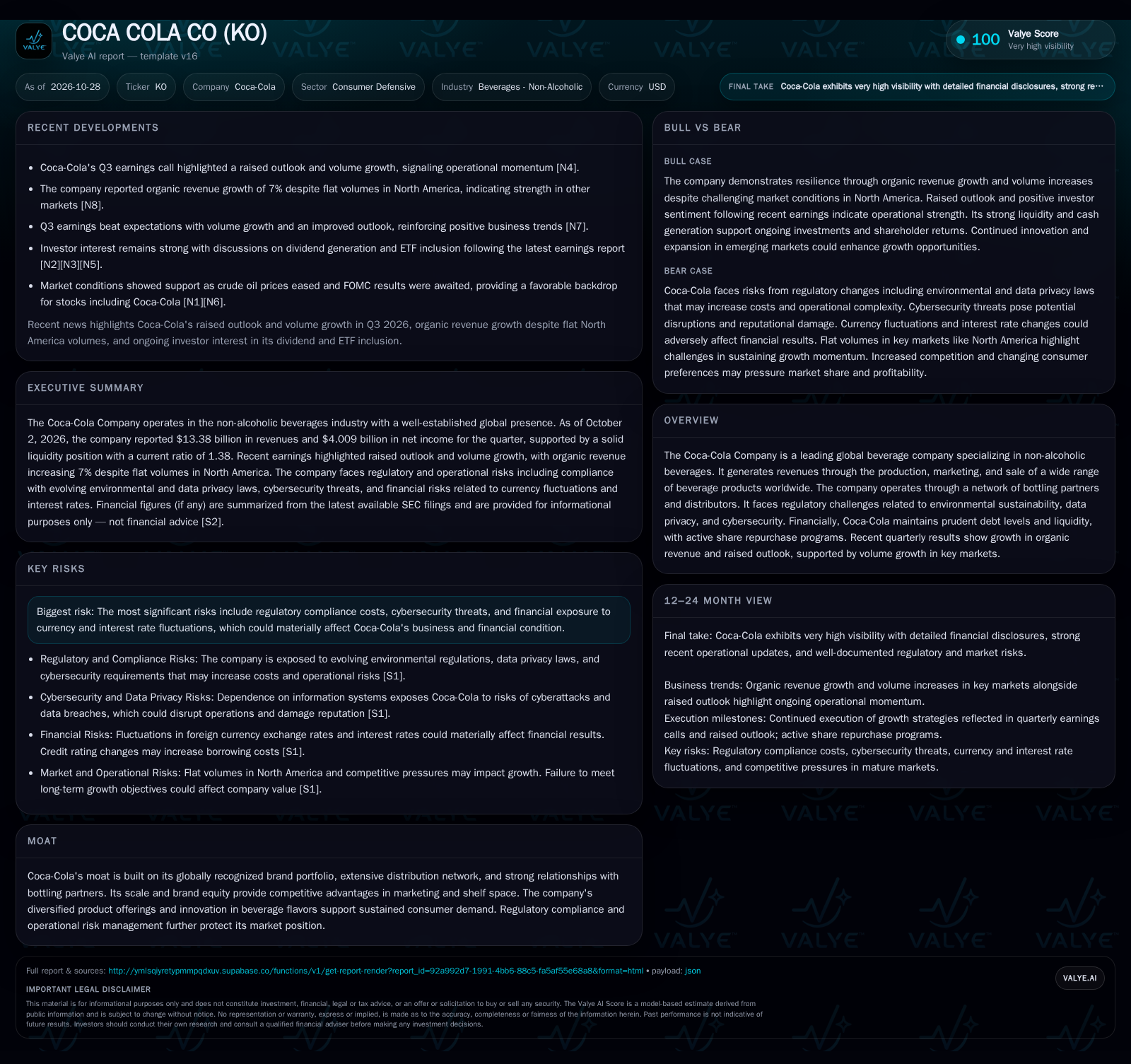
Coca-Cola’s Q3 2026 results showcased 7% organic revenue growth and a raised outlook, even as North America volumes remained flat. This performance underscores the company’s pricing and product-mix flexibility, but long-term growth will depend on success in emerging markets, regulatory adaptation, and competitive dynamics. Key watchpoints include sustained volume growth outside North America, the impact of regulatory costs, and the company’s ability to innovate against new entrants and shifting consumer preferences. [S2] [N4] [N7] [N8]
Coca-Cola’s Q3 2026 performance reaffirmed its status as a global beverage powerhouse, delivering $13.38 billion in revenue and $4.009 billion in net income, with organic revenue up 7% despite ongoing volume stagnation in North America. The company’s ability to raise its outlook in the face of these headwinds reflects a blend of pricing power, geographic diversification, and disciplined capital management. However, as regulatory costs mount and consumer preferences evolve, the durability of these advantages will be tested by both legacy competitors and new market entrants.
Organic Growth and Outlook: Financial Strength Amid Regional Variations
Coca-Cola reported $13.38 billion in revenue and $4.009 billion in net income for the quarter ended October 2, 2026. Organic revenue grew 7%, a figure made more notable by the flat volume performance in North America—a market that historically drives both margin and visibility for the company [S2] [N7] [N8]. The company raised its outlook on the back of positive volume growth in other geographies, underscoring the importance of international markets for incremental expansion. The company reported cash and liquidity metrics for the period; these figures do not by themselves establish operating runway, investment capacity, financial flexibility, or financing capacity. [S2] The announced repurchase of 2.7 million shares further signals ongoing capital return discipline [S2]. These core facts set the stage for analysis of whether pricing and mix can continue to drive growth in a maturing global beverage landscape.
Beyond headline revenue and income figures, a deeper understanding of regional performance nuances is essential. For instance, the flat volume in North America may mask shifts within subcategories or channels, such as declines in carbonated soft drinks offset by growth in bottled water or ready-to-drink teas. The company’s ability to reallocate marketing and distribution resources to capitalize on these micro-trends within mature markets could be a critical factor in sustaining overall revenue resilience. Additionally, currency fluctuations and geopolitical risks in international markets could materially influence reported results and operational flexibility, underscoring the importance of robust hedging and local market adaptation strategies.
Understanding the Economics Behind Pricing, Product Mix, and Fixed Costs
Coca-Cola’s business model relies on a blend of direct sales, concentrate sales to bottlers, and marketing-driven value capture. The company’s ability to generate organic revenue growth despite flat volumes in mature markets suggests that pricing and product mix—such as premiumization, smaller pack sizes, and innovation in low/no-sugar offerings—are compensating for stagnation in core categories. This dynamic is typical for established consumer brands facing demographic and consumption headwinds in developed markets.
Operating leverage is structurally high: fixed marketing, brand investment, and distribution costs are amortized over massive global volumes, allowing incremental revenue—especially via price/mix—to drop disproportionately to the bottom line. However, this leverage cuts both ways. Should volumes decline meaningfully, the cost base becomes less flexible. Capital needs are generally modest outside of supply chain and bottler investment, supporting steady free cash flow and capital returns, but regulatory and compliance costs (environmental, privacy, cybersecurity) may introduce new structural expenses that erode margins if not offset by further top-line expansion or efficiency gains [S1] [S2].
The interplay between pricing power and consumer price sensitivity is a delicate balance that warrants further examination. While premiumization supports higher price points, there is a threshold beyond which consumer resistance could erode volume or brand loyalty, especially in price-competitive or economically challenged markets. Moreover, the fixed cost structure, while providing operating leverage at scale, may limit the company’s agility to quickly adjust to rapid shifts in demand or supply chain disruptions. The incremental regulatory and compliance expenses introduce a semi-fixed cost element that could diminish the scalability advantage unless offset by targeted efficiency programs or technological innovation in production and logistics.
Brand Strength Meets Changing Consumer Preferences in the Beverage Market
Coca-Cola’s core competitive advantages—global brand equity, unrivaled distribution, and deep bottling relationships—have historically insulated it from both regional upstarts and global peers. These moats translate into superior shelf presence, marketing muscle, and the ability to shape retailer and consumer choice. However, the beverage market is fragmenting as health-consciousness rises and niche brands gain traction, particularly in premium and functional beverage categories.
The company’s diversified product portfolio and ongoing innovation help defend market share, but they also require constant investment and carry execution risk. Regulatory scrutiny around sugar, packaging, and environmental impact is intensifying, potentially leveling the playing field for smaller, more agile competitors who can pivot faster. Large regional rivals and new entrants—especially those focused on health, sustainability, or direct-to-consumer models—pose credible substitution threats, especially among younger demographics. The question is whether Coca-Cola’s scale and brand can keep pace with these evolving competitive dynamics.
Coca-Cola’s entrenched distribution network remains a formidable barrier to entry; however, the rise of digital commerce and direct-to-consumer platforms is reshaping how beverages reach end consumers. The company’s capacity to integrate e-commerce and leverage data analytics for personalized marketing could become pivotal in maintaining relevance among digitally native consumers. Furthermore, the growing consumer emphasis on sustainability and corporate social responsibility may require Coca-Cola to accelerate investments in environmentally friendly packaging and transparent supply chain practices. Failure to meet these evolving expectations could erode brand equity and invite regulatory scrutiny, potentially leveling the competitive landscape in favor of more nimble or niche players.
Growth Opportunities Through Global Expansion and Premium Product Focus
The favorable scenario for Coca-Cola is one where emerging market volume growth and continued premiumization offset mature market stagnation. If the company can sustain or accelerate volume gains in Asia, Africa, and Latin America—where per-capita consumption and brand penetration have room to rise—its fixed cost base would yield further operating leverage. Pricing power, supported by ongoing innovation (e.g., healthier beverages, new flavors, functional drinks), could help protect margins even as regulatory costs rise.
Evidence supporting this scenario would include accelerating international volume growth, strong uptake of new product lines, and expanding gross margins despite higher compliance costs. Further, if reported organic revenue growth remains robust even as developed-market volumes stay flat, it would indicate that mix and emerging-market momentum are more than offsetting headwinds.
Maintaining Market Position: Pricing and Mix Counteract Mature Market Pressures
The most plausible trajectory is a continuation of the current pattern: Coca-Cola leverages pricing and product mix to drive modest top-line growth, while volume remains flat or grows slowly in developed markets. Emerging market expansion provides incremental volume upside, but is partially offset by regulatory costs, currency headwinds, and the need for ongoing innovation investment.
In this scenario, margins remain stable or expand slightly, supported by tight cost controls and efficiency initiatives. Evidence would include sustained organic revenue growth in the mid-single digits, stable or slightly improving operating margins, and a continuation of the current capital return policy. Signs that would falsify this path include a sharp decline in developed-market volumes, margin compression due to regulatory or competitive pressures, or a material slowdown in emerging-market performance.
Profitability Risks from Regulatory Expenses and Consumer Behavior Changes
The adverse scenario involves a combination of regulatory cost inflation, consumer migration away from traditional soft drinks, and intensifying price competition eroding Coca-Cola’s margin structure. If environmental, data privacy, and sugar-related regulations significantly increase operating costs, and these cannot be passed through to consumers, profitability could come under pressure [S1].
Simultaneously, if younger consumers accelerate their shift toward alternative beverages—such as plant-based, low-sugar, or direct-to-consumer brands—the company could face both volume and mix pressures. Evidence for this scenario would include declining volumes or negative mix in key regions, persistent margin contraction, and either a suspension or reduction of share repurchases/dividends. Early-warning signs would be negative operating leverage, regulatory fines, or material loss of shelf space to new entrants.
Factors Shaping Coca-Cola’s Upcoming Growth Trajectory
Sustained volume growth in emerging markets, particularly Asia and Africa, would indicate successful geographic diversification and potential for operating leverage.
Organic revenue growth outpacing volume growth—if disclosed—would confirm the effectiveness of pricing and product mix strategies.
Gross margin trends, especially in the face of rising regulatory and compliance costs, will help assess whether pricing power offsets new expense headwinds.
The pace and scale of innovation launches (e.g., low/no-sugar, functional beverages), if disclosed, would clarify Coca-Cola’s ability to adapt to shifting consumer preferences.
Share of shelf and retail channel penetration data—where available—would indicate competitive resilience against new entrants and private-label brands.
Actual regulatory cost disclosures, such as environmental compliance or data privacy expenditures, would test the long-term margin thesis.
Disclaimer: This is research-only, informational analysis and not investment advice. It may include AI-generated interpretation and general industry context. Always verify important details using primary sources.

Comments