
Ameritek Ventures: Diversification Ambitions Meet Financial and Execution Headwinds
Ameritek Ventures has pivoted from software to a multi-sector holding company with stakes in solid-state batteries, adaptive manufacturing, aerospace, and luxury real estate.
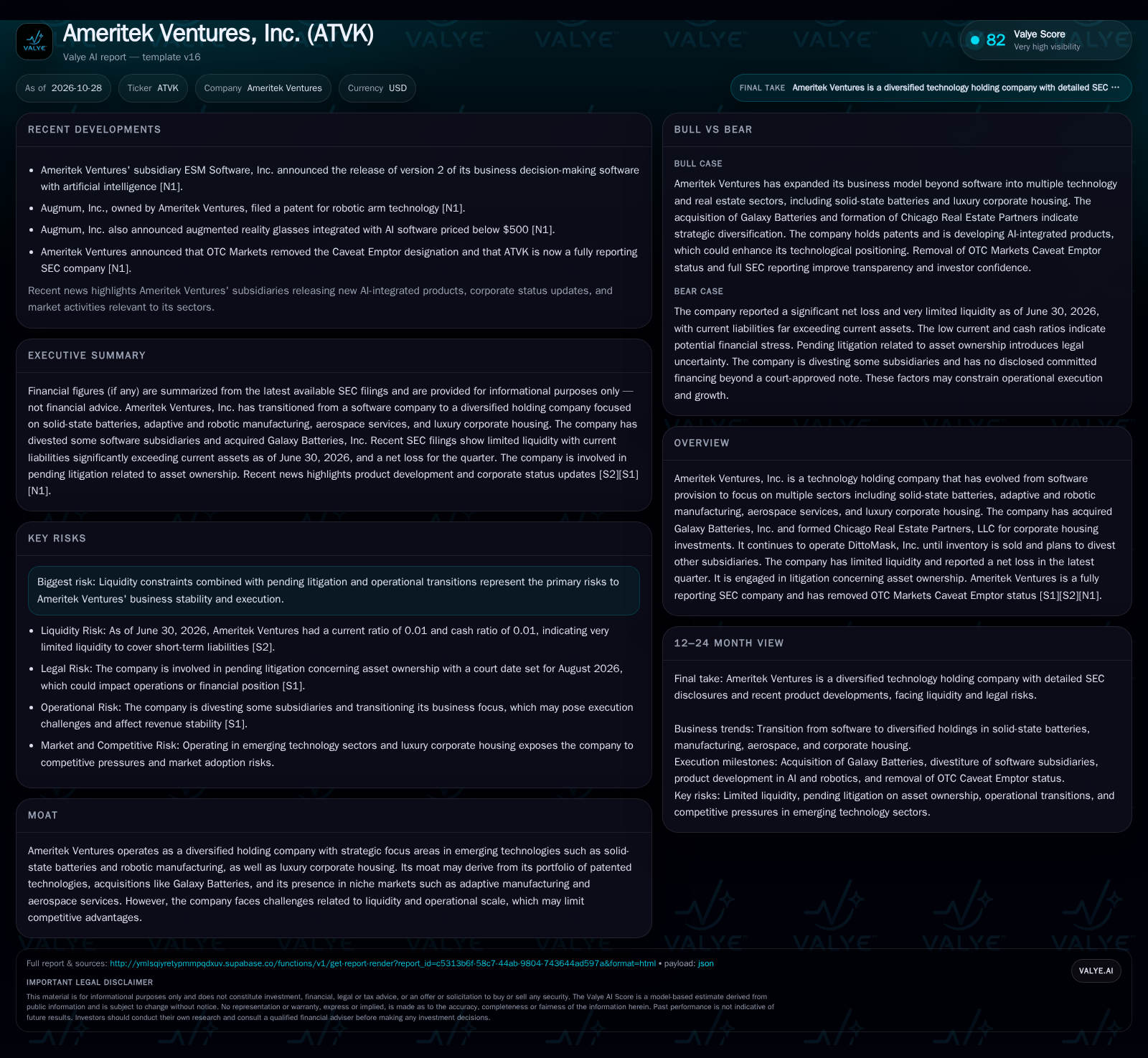
Ameritek Ventures’ transformation into a diversified tech and real estate holding company is marked by the acquisition of Galaxy Batteries and a push into luxury corporate housing. Strategic successes will depend on resolving legal issues, securing funding, and demonstrating traction in target markets. [S1] [S2]
Ameritek Ventures, Inc. has undergone a dramatic shift from its roots as a software business to a diversified holding company with interests spanning solid-state batteries, adaptive and robotic manufacturing, aerospace services, and luxury corporate housing. This pivot, underlined by the acquisition of Galaxy Batteries and the launch of a corporate housing initiative, signals ambitious repositioning. Strategic execution, legal clarity, and capital access will determine whether this transformation can succeed or unravel under financial and operational strain. [S1] [S2]
New Strategic Direction Collides with Financial Constraints and Legal Uncertainty
Ameritek Ventures’ recent period has been defined by a fundamental business model transformation: the company sold off its software assets (notably Ecker Capital, LLC) in late 2024 and acquired Galaxy Batteries, Inc. in mid-2025, shifting its primary focus to solid-state batteries, adaptive manufacturing, aerospace services, and luxury corporate housing. The formation of Chicago Real Estate Partners to buy and rent luxury condos to corporate clients marks a move into asset-heavy, recurring-revenue real estate. Despite these bold moves, as of June 30, 2026, Ameritek reported only $29,328 in cash and $30,815 in current assets against $2.19 million in current liabilities, resulting in a current and cash ratio of just 0.01. This extreme liquidity shortfall raises immediate questions about operational runway and solvency. The company also faces a pending lawsuit related to asset encumbrance and share ownership, with a court date set for August 2026, compounding execution risk and uncertainty over asset control. [S1] [S2]
How Ameritek’s Portfolio Could Generate Value—And Where the Economics Are Unproven
Ameritek’s approach is that of a diversified holding company, seeking to extract value from disparate sectors: high-tech batteries, advanced manufacturing, aerospace services, and premium real estate. In theory, the Galaxy Batteries acquisition positions Ameritek to participate in the growing demand for solid-state batteries, a market with potential for high margins if the technology proves commercial and Ameritek can secure manufacturing scale or licensing deals. Adaptive and robotic manufacturing businesses typically require upfront capital investment, but can offer operating leverage if Ameritek is able to secure long-term contracts or create proprietary automation IP.
The entry into luxury corporate housing via Chicago Real Estate Partners introduces a recurring revenue model, but is capital intensive and exposes the company to real estate market cycles and vacancy risk. This business could offer stable cash flow if Ameritek can achieve high occupancy and premium rental rates among target executive clientele. However, the company’s minimal current revenue ($6,287 in the latest quarter) and ongoing net losses indicate that none of these ventures are yet at scale. The lack of disclosed committed financing suggests Ameritek will need to secure external capital or asset sales to fund growth and cover operating deficits. Until one or more of these business lines can reach material scale or profitability, Ameritek’s economics remain speculative and heavily dependent on successful execution and funding.
Sector Sprawl and the Challenge of Defensible Advantage
Ameritek’s competitive landscape is highly fragmented, reflecting its diverse portfolio. In solid-state batteries, the company faces established battery manufacturers and technology startups, many of which are better capitalized and have deeper R&D pipelines. Success in this sector would likely depend on technological differentiation (e.g., IP from Galaxy Batteries), the ability to secure partnerships or licensing with OEMs, or niche applications where Ameritek’s solutions could be uniquely valuable. Adaptive and robotic manufacturing is similarly competitive, with incumbent automation providers and industrial conglomerates holding scale and integration advantages. For aerospace services, the market rewards proven reliability, certifications, and customer relationships, areas where Ameritek’s current presence is not yet established by available evidence.
The luxury corporate housing market is typically dominated by specialized real estate operators and large hospitality companies, who benefit from established sourcing, property management, and marketing infrastructure. Ameritek’s entry into Chicago’s luxury rental market may allow for localized differentiation, but scaling to other cities would require significant capital and operational expertise. The attempt to operate across such varied sectors risks dilution of focus and resources, with no single business line yet providing a clear, defensible competitive advantage.
What Rapid Execution and a Legal Win Could Unlock
A favorable scenario would see Ameritek resolving its pending litigation on advantageous terms—removing asset encumbrances and clarifying share ownership—while simultaneously securing bridge or growth capital, potentially via asset sales, equity raises, or debt financing. If Galaxy Batteries’ technology proves commercially viable and Ameritek is able to secure a manufacturing or licensing agreement with a strategic partner, this could catalyze a step-change in revenue and credibility. Real estate operations could gain traction if high occupancy is achieved at premium rates, supporting recurring cash flows.
Confirmation of this scenario would require evidence of: legal resolution in Ameritek’s favor; a meaningful capital infusion or asset monetization event; customer or partner wins in batteries or aerospace; and rental income growth from Chicago Real Estate Partners. Early signs could include press releases about new contracts, financing announcements, or disclosed backlog and occupancy rates. If these inflection points occur, Ameritek could transition from survival mode to a platform with real optionality across its portfolio.
Operational Survival Hinges on Asset Monetization and Cost Control
The most probable near-term outcome is that Ameritek faces continued financial strain and limited operational progress until it can monetize assets or secure external funding. The company may move forward with divestitures of DittoMask, CordTell, and WebBeeO, potentially generating short-term liquidity but reducing overall scale. Progress in battery, manufacturing, or real estate operations is likely to be incremental, with revenue remaining modest unless breakthrough contracts or occupancy are achieved.
This scenario would be confirmed by continued low revenue, ongoing net losses, and asset sales without transformative capital raises. Signs of execution risk would include reduced headcount, delays in new launches, or further increases in payables and short-term liabilities. Conversely, the arrival of new financing, even at dilutive terms, could extend runway and allow for operational stabilization.
Liquidity Crunch or Adverse Legal Outcome Forces Restructuring
If Ameritek fails to resolve its liquidity crisis or loses the pending legal case, it could face a forced asset sale, restructuring, or even insolvency. In this scenario, the company may be forced to liquidate real estate or technology holdings at distressed prices, or seek protection from creditors.
Evidence for this scenario would include default notices, missed payrolls, disclosure of going-concern doubts in filings, or fire-sale transactions. The absence of new financing or an adverse legal judgment would be strong confirming signals. A lack of progress in divestitures could also increase risk if liabilities remain unresolved.
Signals That Will Determine Whether Ameritek’s Reinvention Can Succeed
Resolution of the Clark County litigation—court outcome, settlement terms, and implications for asset control.
Announcement of new financing, capital raises, or asset sales, and the terms/scale of any such transactions.
Revenue growth or material contract wins in the solid-state battery, adaptive manufacturing, or aerospace segments—customer names and contract values would help test the thesis.
Occupancy rates, rental yields, and expansion milestones for Chicago Real Estate Partners—if disclosed.
Progress on divestiture of DittoMask, CordTell, and WebBeeO, and the realized proceeds from these sales.
Quarterly cash burn and changes in current asset/liability balances as disclosed in future SEC filings.
Management commentary or disclosures about strategic priorities, cost reduction plans, or turnaround efforts.
Disclaimer: This is research-only, informational analysis and not investment advice. It may include AI-generated interpretation and general industry context. Always verify important details using primary sources.

Comments