
MGM Resorts in 2026: Digital Leverage, Profitability Headwinds, and the Complexities of Scale
MGM Resorts International’s Q3 2026 results highlight operational improvements and persistent profitability challenges. With a narrowing net loss, ample cash on hand, and a growing digital gaming segment, the company faces a strategic crossroads as it balances traditional hospitality operations with evolving digital opportunities and governance complexity.
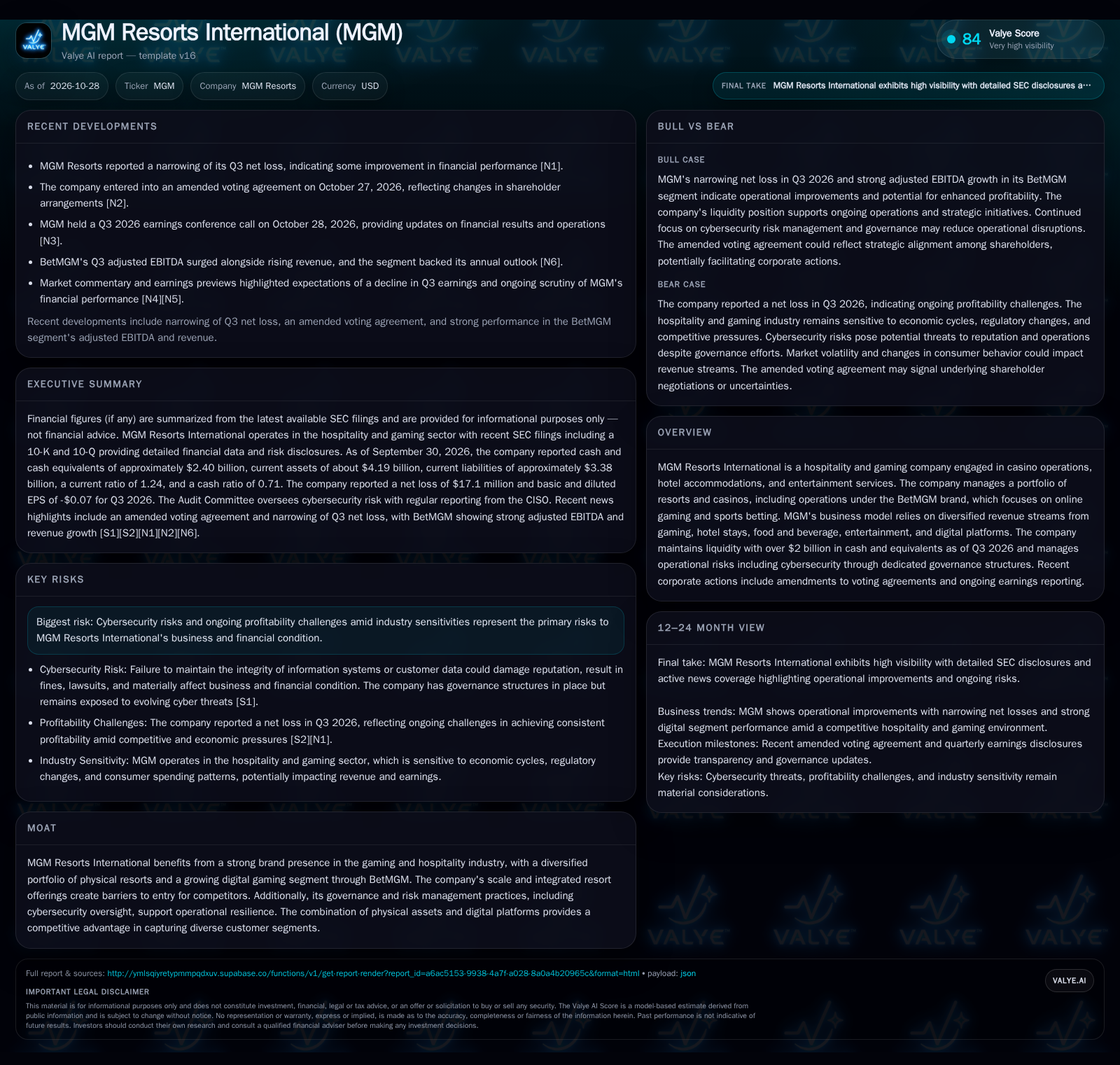
MGM Resorts posted a narrowed Q3 2026 net loss and maintains substantial cash reserves, while an amended voting agreement signals ongoing governance evolution. The company’s digital segment, BetMGM, continues to show strong growth, but overall profitability remains elusive. Cybersecurity oversight and industry sensitivities are central to risk management as MGM seeks to leverage both scale and digital expansion for future gains. [S2] [N1] [N2]
MGM Resorts International’s latest financial disclosures reveal a company in the midst of significant operational transition. While the Q3 2026 net loss narrowed to $17.1 million, the business remains short of profitability as it navigates the shifting landscape of hospitality, gaming, and digital entertainment. Meanwhile, recent governance developments and ongoing cybersecurity vigilance underscore the complexity of managing both legacy and new-economy risks in a sector defined by high fixed costs, regulatory scrutiny, and rapid technological change. [S2] [N1] [N2]
Recent Earnings, Governance Actions, and Financial Position Shape the 2026 Outlook
MGM Resorts reported a Q3 2026 net loss of $17.1 million, marking a narrowing of losses compared to prior periods and signaling some operational improvement, though profitability remains out of reach [S2] [N1]. As of September 30, 2026, the company held $2.40 billion in cash and equivalents, with current assets of $4.19 billion and current liabilities of $3.38 billion, resulting in a current ratio of 1.24 [S2]. In parallel, MGM executed an amended voting agreement on October 27, 2026, which may affect governance dynamics or strategic flexibility going forward [N2]. The company’s Audit Committee continues to prioritize cybersecurity oversight, with the CISO reporting directly to senior leadership and the board [S1]. These developments collectively frame MGM’s operational, financial, and governance context as it enters a new fiscal cycle.
How MGM Resorts Makes—and Could Scale—Money Across Physical and Digital Channels
MGM’s revenue model is built on multiple streams: casino gaming, hotel accommodations, food and beverage, live entertainment, and the expanding BetMGM digital platform. The traditional casino and hotel operations are characterized by high fixed costs (property, staff, maintenance) and variable costs tied to occupancy and visitor volume. Margins are typically driven by property utilization and the mix between high-margin gaming revenue and lower-margin hospitality or entertainment services.
Digital gaming, represented by BetMGM, introduces a more scalable, asset-light segment where incremental revenue growth may yield higher contribution margins once customer acquisition costs are absorbed. This segment’s economics hinge on user acquisition, retention, and regulatory compliance across states. If BetMGM’s growth outpaces the decline or stagnation of legacy segments, MGM could see operating leverage improve—especially if digital profitability offsets flat or declining margins in traditional operations.
[S2]
Scale, Brand, and Digital Ambitions Underpin MGM’s Competitive Standing—But Barriers Persist
MGM’s competitive advantages are rooted in its diverse physical portfolio, iconic brand, and the integration of digital gaming through BetMGM. The scale of its resorts and the breadth of its entertainment offerings create customer stickiness and offer cross-selling opportunities. However, the gaming and hospitality landscape remains intensely competitive, with regional operators, tribal casinos, and global hospitality brands vying for market share.
Digital disruption is both an opportunity and a threat. BetMGM’s growth positions MGM to capture a new demographic and geography beyond traditional casino floors, but it faces formidable rivals in the online gaming and sports betting space, where customer loyalty is limited and marketing costs are high. Technology investments, regulatory agility, and partnerships will be critical to defending share and improving digital profitability.
Barriers to entry in large-scale casino operations remain high due to capital intensity and licensing requirements, but digital platforms lower those barriers for new entrants in online gaming. MGM’s ability to blend physical and digital experiences may be a differentiator, but execution risk and regulatory complexity are ongoing hurdles.
Digital Scale, Operational Efficiencies, and Governance Alignment Drive a Turn to Profitability
A favorable scenario emerges if MGM leverages BetMGM’s growth to generate substantial incremental margin, offsetting the fixed costs of its resort portfolio. Key to this is the ability to drive higher digital engagement without proportionally increasing costs—suggesting that improved user retention, lower customer acquisition expenses, and expanded state-by-state legalization of online gaming could provide outsized returns.
Operationally, if MGM can further rationalize costs in its physical properties—through automation, dynamic pricing, or portfolio optimization—while maintaining occupancy and gaming volume, fixed-cost leverage could amplify earnings as top-line performance improves. The amended voting agreement may also allow for more decisive strategic moves or capital allocation, particularly if it streamlines decision-making or aligns key stakeholders [N2].
Evidence for this scenario would include a return to sustained profitability, sequential improvement in both physical and digital margins, and public disclosures of BetMGM’s growing share of EBITDA. Announcements of new state market entries, digital platform enhancements, or major partnerships would further confirm the pathway to a more digitally weighted, profitable MGM.
Balancing Legacy Operations with Digital Growth Amid Persistent Profitability Pressure
The most plausible near-term outcome is that MGM continues to make incremental operational improvements—narrowing losses but struggling to achieve consistent profitability. Casino and hotel operations remain stable, with modest growth or stagnation as consumer demand fluctuates and competition intensifies. BetMGM continues to expand, but digital profitability is tempered by heavy marketing and regulatory costs.
[S2] The amended voting agreement introduces some uncertainty, but unless it results in significant governance change, its impact may be limited to boardroom dynamics [N2].
Confirmation would come from continued modest net losses or breakeven results, stable casino/hotel revenue, and steady but not explosive growth in digital EBIT contributions. Falsification would occur if digital losses widened or physical operations suffered a sharp demand shock.
Economic Shocks, Regulatory Setbacks, or Cyber Incidents Exacerbate Losses and Erode Value
On the downside, MGM could face a confluence of headwinds: a recession or consumer pullback reduces casino and hotel traffic, while regulatory changes or delays slow BetMGM’s digital expansion. A major cybersecurity event—despite oversight—could disrupt operations, incur costs, and damage brand equity. Persistent net losses would drain liquidity, forcing asset sales, reduced investment, or capital raises at unfavorable terms.
If competitive intensity escalates, especially in digital, MGM might engage in unsustainable promotional spending, eroding margins further. Governance disruptions—potentially signaled by the amended voting agreement—could distract management or constrain strategic flexibility [N2].
Confirmation would come from a re-acceleration of net losses, declining liquidity, digital market share losses, or public disclosures of cyber incidents with material financial or reputational impact.
What Will Determine MGM’s Ability to Convert Scale and Digital Growth into Sustainable Earnings?
Quarterly net income/loss trends, particularly the speed at which MGM can move from narrowed losses to sustained profitability.
BetMGM’s revenue and adjusted EBITDA growth—if disclosed—including user retention and state-level expansion rates.
Physical property performance measures: occupancy rates, gaming volume, and average daily rates, as indicators of core business health.
Marketing and customer acquisition costs for the digital segment, which will influence the scaling economics of BetMGM.
Liquidity and capital expenditure disclosures—especially any changes in cash reserves, debt, or significant asset sales.
Updates on material cybersecurity incidents or changes in the company’s risk posture, given the sector’s vulnerability.
Any further amendments to governance structures, shareholder agreements, or board composition that could affect strategy or control.
Regulatory developments impacting gaming legalization, especially in new U.S. states or international markets.
Disclaimer: This is research-only, informational analysis and not investment advice. It may include AI-generated interpretation and general industry context. Always verify important details using primary sources.

Comments