
AmBase Corporation: Asset Recovery, Litigation Overhang, and the Challenge of Survival with reported liquidity position
With its primary real estate asset impaired and ongoing legal battles draining scarce resources, AmBase faces existential questions about funding, asset monetization, and the prospects for value recovery. The company's future now hinges almost entirely on litigation outcomes and its ability to secure external capital amid persistent operating losses.
AmBase Corporation remains a litigation-driven holding company with its core value proposition tied up in a disputed New York City real estate interest. The outcome of litigation over 111 West 57th Street, and AmBase's ability to raise funding—potentially at significant cost—will determine whether any equity value can be salvaged or if the company is forced to wind down operations.
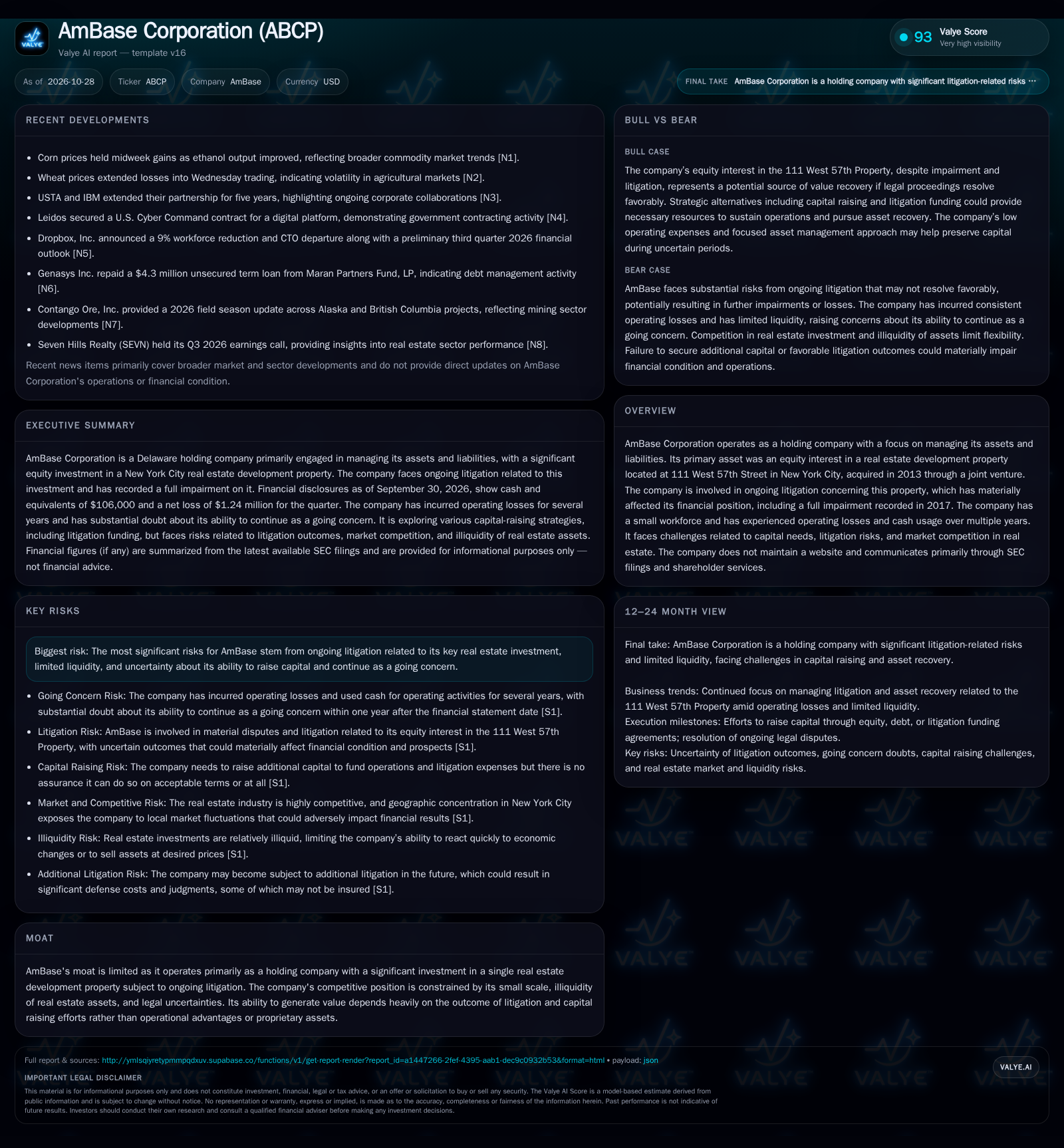
AmBase Corporation stands at a precarious crossroads, reduced to a litigation vehicle with minimal cash and no ongoing business operations outside its impaired and disputed interest in a single New York City real estate development. With $106,000 in cash left and another quarter of seven-figure losses, the company faces an existential threat: unless it wins its legal battles or secures new capital—potentially on costly and dilutive terms—AmBase may be forced to wind down. The company's fate is now almost entirely decoupled from real estate market fundamentals, and instead rests on legal outcomes and capital market access.
Litigation, Dwindling Cash, and the Erosion of the Asset Base
AmBase's present reality is defined by three interlocking facts: its equity interest in the 111 West 57th Street property remains impaired and the subject of ongoing litigation; its cash position has shrunk to $106,000 as of September 2026; and it continues to incur significant operating losses, with a net loss of $1.24 million for the most recent quarter [S2]. The company has not generated positive operating cash flow for several years and now faces substantial doubt about its ability to continue as a going concern within the next year [S1] [S2].
The only plausible path to meaningful value for shareholders is a successful legal resolution regarding the 111 West 57th Street property. However, the company’s ability to finance continued litigation and basic operations is uncertain, and any financing obtained—particularly litigation funding—may come with significant repayment obligations, multiples, and fees [S1].
Value Creation Hinges on Litigation Outcomes and Cost of Capital
AmBase’s business model no longer resembles a traditional real estate holding company; instead, it has become a binary legal recovery play. There is no recurring revenue, rent, or asset management fee stream—only the possibility of a windfall if the litigation over its impaired 111 West 57th Street stake is resolved in its favor.
The company’s cost structure is dominated by legal and administrative expenses, which are likely to remain elevated or even increase as litigation intensifies [S1]. The company reported cash and liquidity metrics for the period; these figures do not by themselves establish operating runway, investment capacity, financial flexibility, or financing capacity. If it secures litigation funding, such arrangements often require repayment of the initial outlay plus a multiple or a share of any recovery, severely diluting net proceeds to equity holders if successful.
The economics here are high-risk, high-uncertainty: if AmBase loses or settles unfavorably, there is likely no residual value; if it wins, the value realized depends heavily on the size of the legal recovery net of funding costs and any additional liabilities. The company’s minimal fixed assets mean there is little operating leverage to exploit, and the capital requirement is entirely driven by litigation and basic overhead.
No Moat, No Scale: Legal Uncertainty and Illiquidity Define the Competitive Landscape
AmBase’s competitive position is extremely weak. Unlike diversified real estate investment peers or litigation finance specialists, it has a single impaired asset, a small workforce, and no operational scale [S1]. The company’s fortunes are tied to a highly illiquid, geographically concentrated investment in the Manhattan luxury property market, which it cannot monetize outside of litigation.
There is no proprietary advantage, switching cost, or brand equity; AmBase’s only lever is the contingent upside from prevailing in court. In the broader context, real estate investment trusts (REITs), distressed asset funds, and litigation finance vehicles all offer more diversified exposure and operational flexibility. AmBase’s unique risk profile—high concentration, legal overhang, and minimal liquidity—leaves it at a disadvantage even among special situation or event-driven investors.
The company also faces competitive risks from other claimants or stakeholders in the litigation, as well as the broader volatility of New York City’s luxury real estate market, which could affect the asset’s ultimate value if recovered.
Favorable Legal Outcome Could Unlock Recovery—But Only If Funding Is Secured and Net Proceeds Remain
The optimistic scenario is straightforward but challenging: AmBase secures enough capital—through equity, debt, or litigation finance—to see its legal case through to a favorable resolution. If the company prevails, it could regain an equity interest or receive a substantial settlement or damages payment tied to the value of the 111 West 57th Street property.
For shareholders to benefit, two conditions must be met: (1) the legal outcome must be sufficiently positive to generate material recovery, and (2) the terms of any litigation funding or new capital must not consume the bulk of the proceeds through repayment multiples, fees, or equity dilution. Evidence that would support this scenario includes public disclosure of new funding at reasonable terms, progress or victories in court, and any indication that the asset’s underlying value remains robust in the current NYC real estate environment.
This scenario would be falsified by an adverse legal ruling, inability to secure funding, or disclosure of highly dilutive or punitive financing terms that leave little residual value for common shareholders.
Protracted Legal Process, Rising Costs, and Erosion of Residual Value
The most plausible near-term trajectory for AmBase is ongoing litigation with incremental progress but continued cash burn. The company may secure short-term funding—possibly on onerous terms—to keep the legal process alive, but rising costs and the time value of money erode any potential recovery.
Under this scenario, the company’s net asset value remains deeply negative or highly uncertain, and equity holders face ongoing dilution from new financing. The business effectively becomes a pass-through for external capital providers and legal professionals, with shareholders exposed to a binary outcome and high risk of total loss.
This base case would be confirmed by continued operating losses, further reductions in cash, announcements of high-cost litigation funding, and a lack of substantive legal victories or settlements. It would be falsified if the company either rapidly secures a favorable legal resolution or is unable to obtain any further funding, forcing a wind-down.
Inability to Raise Capital or Adverse Judgment Triggers Liquidation
The most adverse scenario is that AmBase is unable to raise sufficient capital—either through equity, debt, or litigation finance—to sustain operations or legal proceedings. Alternatively, a major adverse court ruling could permanently impair any remaining claim to the 111 West 57th Street asset.
In this case, the company would face forced liquidation or bankruptcy, with remaining cash quickly exhausted by legal and administrative expenses. Shareholders would likely be left with no recovery. Confirmation of this scenario would come from public disclosures of failed capital-raising efforts, a negative legal outcome (such as dismissal of claims or summary judgment against AmBase), or auditor statements indicating imminent insolvency and liquidation.
Milestones That Will Determine Whether Any Value Can Be Recovered
Any public disclosure of new capital raised, whether through equity, debt, or litigation funding, and the specific terms attached to such funding.
Progress reports or court filings indicating substantive advances—or setbacks—in the litigation process regarding the 111 West 57th Street property.
Trends in quarterly cash burn and updated cash balances; a useful metric would be forecastedreported liquidity position if disclosed.
Announcements of settlements, judgments, or other legal outcomes directly affecting AmBase’s claim to the 111 West 57th Street asset.
Disclosure of any significant increases in legal or administrative expenses, particularly if they accelerate cash depletion.
Auditor or management commentary in SEC filings regarding the likelihood of continued operations versus wind-down or liquidation.
Any indication of additional litigation or unexpected liabilities that could further impair the company’s already precarious financial position.
Disclaimer: This is research-only, informational analysis and not investment advice. It may include AI-generated interpretation and general industry context. Always verify important details using primary sources.

Comments