
Lennox International in 2026: Operational Transformation, Competitive Pressures, and the Economics of HVACR Leadership
Lennox International’s Q3 2026 results highlight a business at the intersection of robust product breadth, operational self-improvement initiatives, and the persistent challenges of capital intensity and market rivalry.
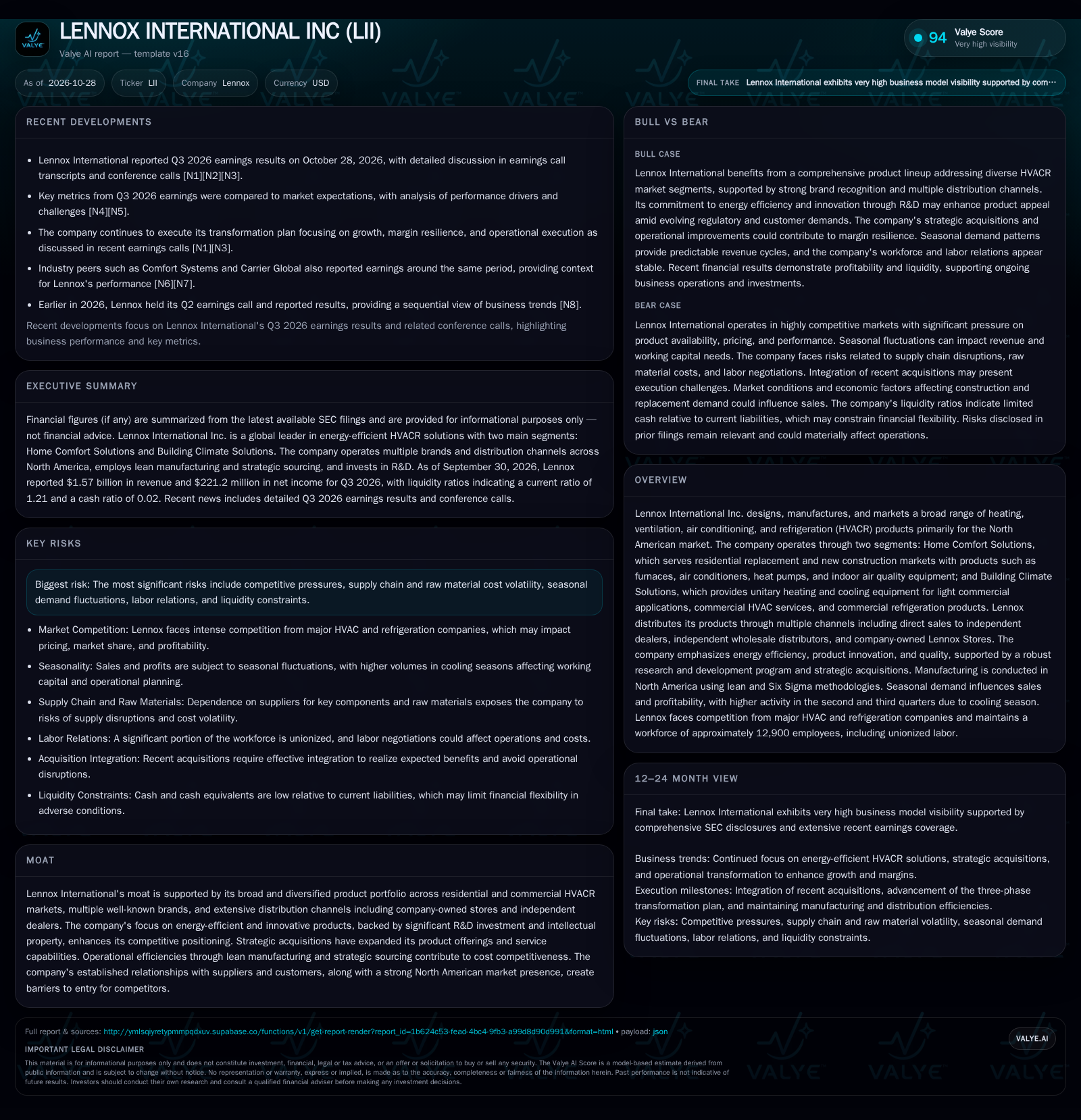
Lennox International reported Q3 2026 revenues of $1.57 billion and net income of $221.2 million, reflecting strong presence in both residential and commercial HVACR markets. While recent acquisitions expand its product and service capabilities, low cash relative to current liabilities and ongoing competitive and supply chain pressures could limit potential financial flexibility. The success of Lennox’s transformation plan and ability to integrate new businesses will be pivotal as industry rivalry and macroeconomic headwinds persist. [S2] [N2]
Lennox International’s Q3 2026 performance underscores the duality of operating strength and structural challenges in the HVACR industry. With $1.57 billion in quarterly revenue and a multi-segment product portfolio, Lennox remains a critical supplier for both residential and commercial climate control markets. How Lennox adapts to competitive threats and supply chain volatility will determine whether operational improvements translate into lasting shareholder value.
Recent Results Signal Scale, Transformation, and Financial Constraints
Lennox International reported Q3 2026 revenue of $1.57 billion and net income of $221.2 million, demonstrating continued profitability and scale in the HVACR sector. The company reported cash and liquidity metrics for the period; these figures do not by themselves establish operating runway, investment capacity, financial flexibility, or financing capacity. This financial posture may constrain Lennox’s flexibility to absorb shocks or pursue aggressive investment without external financing. Recent acquisitions—including AES Industries, AES Mechanical Service Group, Duro Dyne, and Supco—expand Lennox’s product and service reach, but also bring integration complexity. The ongoing three-phase transformation plan prioritizes differentiated growth and margin resilience, but its success hinges on execution amid a competitive and capital-intensive landscape. [S2] [N2] [N3]
This condition may necessitate prioritizing operating cash flow generation and working capital efficiency to avoid dilution or unfavorable financing terms. Moreover, the integration complexity of multiple acquisitions simultaneously could strain management bandwidth and distract from core operational improvements, potentially delaying anticipated synergies. The effectiveness of the transformation plan will likely depend on disciplined capital allocation, robust project management, and transparent communication to align stakeholder expectations during this transitional phase.
HVACR Economics: Seasonal Cyclicality and the Leverage of Installed Base
Lennox generates revenue primarily from the sale of HVACR equipment—such as furnaces, air conditioners, heat pumps, and refrigeration systems—across residential and commercial markets. The business is volume-driven, with pronounced seasonality: sales and profits peak in the second and third quarters, coinciding with North American cooling demand. Margins are shaped by product mix (premium versus value lines), the share of aftermarket parts and service, and the ability to pass through raw material cost inflation. Fixed costs tied to manufacturing, R&D, and centralized sourcing create the potential for operating leverage as volumes rise, but also expose Lennox to profit compression in downturns.
The recent acquisitions may enable a higher share of recurring revenue from aftermarket parts and service, if Lennox can successfully cross-sell to its installed base. However, the capital intensity of manufacturing, inventory requirements, and distribution means that working capital management is critical, especially during periods of demand volatility. The company’s strategic focus on energy efficiency and next-generation controls aligns with regulatory and customer trends, but also requires sustained R&D and capital investment, potentially straining resources if liquidity is not improved.
The seasonal cyclicality of HVACR demand also implies that Lennox’s working capital requirements fluctuate significantly throughout the year, requiring agile inventory and receivables management to optimize cash flow. If the company can enhance forecasting accuracy and supply chain responsiveness, it may reduce excess inventory costs and improve service levels, thereby strengthening customer loyalty. Additionally, expanding the aftermarket parts and service business could provide a more stable revenue stream less sensitive to seasonal swings, but this shift demands investment in service infrastructure and skilled personnel. Balancing these capital-intensive needs against reported liquidity position will be critical to sustaining profitable growth in a capital-heavy industry.
Competing on Brand, Channel, and Innovation—But Facing Intense Industry Rivalry
Lennox’s competitive position is anchored by a broad product portfolio, multiple brands, and extensive distribution through both company-owned stores and independent dealers and distributors. This breadth creates some channel stickiness, particularly in the residential replacement market, and allows Lennox to capture value across a range of price points and customer segments.
However, the HVACR industry is highly competitive, with major global players such as Carrier Global, Trane Technologies, and Daikin vying for market share. These competitors also invest heavily in energy-efficient technologies and have comparable or greater scale, potentially limiting Lennox’s ability to sustainably out-innovate or out-price rivals. Switching costs for end customers are moderate—driven more by installer relationships and brand reputation than by technical lock-in. The company’s recent acquisitions may offer incremental differentiation in parts and service, but integration execution is key to realizing any sustained advantage.
In an industry where technological innovation is a key differentiator, Lennox’s ability to sustain R&D investment amid financial constraints will be pivotal. The company’s competitive advantage may hinge on developing proprietary technologies that not only meet evolving energy efficiency standards but also integrate digital controls and connectivity features favored by commercial and residential customers. However, given that switching costs are moderate and brand loyalty can be influenced by installer preferences, Lennox must also invest in strengthening dealer relationships and after-sales support. Failure to do so could erode market share despite product innovation, as competitors with deeper pockets may outspend Lennox in marketing and channel incentives.
Transformation Delivers Margin Expansion and Aftermarket Growth
A favorable scenario for Lennox would see its three-phase transformation plan drive both revenue and margin expansion. Successful integration of recent acquisitions could increase the share of higher-margin aftermarket parts and services, reducing earnings cyclicality and deepening customer relationships. If Lennox leverages its R&D investments to launch differentiated, energy-efficient products ahead of regulatory curves, it could gain pricing power and capture share in both replacement and new construction markets.
Confirmation of this upside would come from sustained gross and operating margin expansion, improved cash conversion cycles, evidence of cross-selling synergies, and accelerated growth in aftermarket and controls revenue. A declining reliance on seasonal peaks and a higher proportion of recurring revenue from service contracts or proprietary components would further validate the thesis.
Sustaining Market Share Amid Cost Pressures and Cyclical Demand
The most plausible path is that Lennox maintains its market share and operational performance, with modest margin improvement as transformation initiatives take hold. Revenue growth likely tracks industry averages, driven by replacement demand, regulatory tailwinds for energy efficiency, and incremental product innovation. However, competition and input cost volatility may limit margin expansion, and liquidity constraints could restrict the pace of investment in new technology or channel expansion.
Evidence of this scenario would include stable or slightly improving operating margins, continued R&D and capital expenditure at current rates, and successful—but not transformative—integration of recent acquisitions.
Liquidity Constraints and Integration Risks Erode Competitive Standing
Integration missteps with new acquisitions could lead to operational disruptions, margin compression, or loss of key customers. Aggressive pricing or innovation by major rivals may further erode Lennox’s share in core markets.
Confirmation of downside risk would include declining gross and operating margins, rising debt or dilutive equity issuance, failure to realize acquisition synergies, or customer attrition in key segments.
Milestones That Will Shape Lennox’s Margin and Growth Trajectory
Progress on the three-phase transformation plan, including specific cost reduction and margin improvement targets, if disclosed, will be a direct test of operational execution.
Tracking the integration outcomes of the AES, Duro Dyne, and Supco acquisitions—particularly any disclosed revenue synergies, cost savings, or margin impacts.
Trends in aftermarket parts and service revenue as a percentage of total sales, which would indicate success in growing higher-margin, less cyclical business lines.
Gross and operating margin progression, especially during off-peak quarters, to assess resilience against seasonality and input cost volatility.
Working capital metrics—such as days sales outstanding, inventory turns, and cash conversion cycle—to gauge efficiency and liquidity risk.
R&D expenditure levels and the cadence of new product launches, which would signal ongoing innovation and potential regulatory-driven growth.
Any changes in competitive dynamics, such as new product introductions or pricing actions by major rivals, that could pressure Lennox’s volumes or margins.
Labor relations developments, including the status of union contract negotiations and any reported disruptions or cost impacts.
Disclaimer: This is research-only, informational analysis and not investment advice. It may include AI-generated interpretation and general industry context. Always verify important details using primary sources.

Comments