
Zedge, Inc.: Creator Economies, AI Data Ambitions, and the Search for Profitable Scale
With two sizable creator-driven platforms and a new push into AI training data, Zedge aims to leverage its unique content assets for diversified monetization.
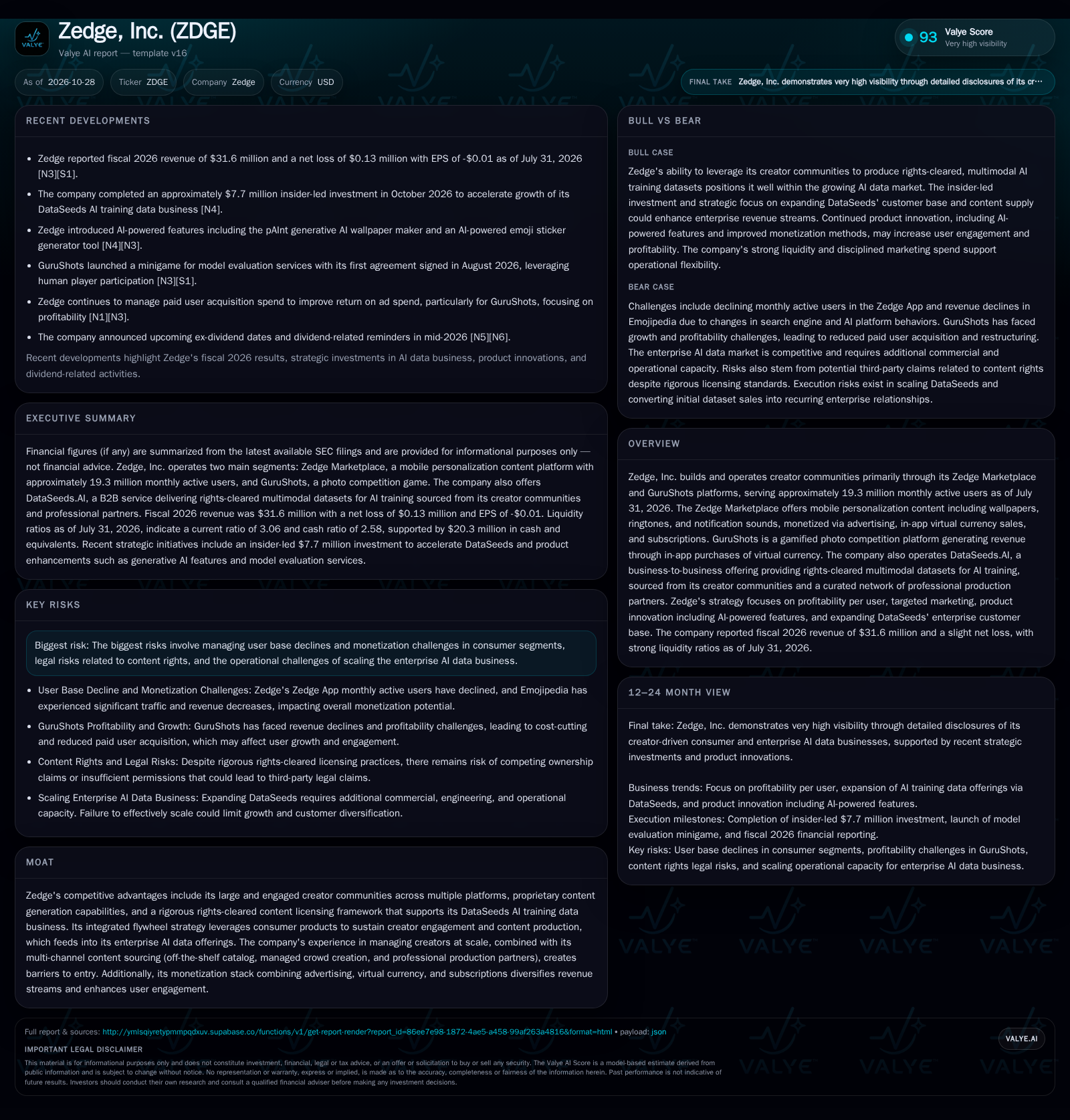
Zedge, Inc. operates the Zedge Marketplace and GuruShots platforms, serving roughly 19.3 million monthly active users and generating $31.6 million in revenue for fiscal 2026, but posted a slight net loss. The company is using an insider-led $7.7 million investment to accelerate DataSeeds, a B2B AI training data initiative leveraging its vast, rights-cleared creator content.
Zedge, Inc. sits at a crossroads between consumer digital content and the burgeoning market for AI training data. With nearly 20 million monthly active users spread across mobile personalization and gamified photography, the company has amassed a substantial library of creator-generated, rights-cleared assets. It now seeks to convert this asset base into a flywheel spanning consumer engagement and enterprise-grade AI data sales. Recent insider investment and AI-powered feature rollouts provide financial and strategic momentum, but Zedge’s path to sustained profitability and competitive differentiation will depend on its ability to scale DataSeeds, maintain creator and user engagement, and navigate legal and operational complexities inherent in digital content and AI data markets.
Recent Investment and AI Initiatives Reshape Zedge’s Strategic Focus
Zedge’s fiscal 2026 results showed $31.6 million in revenue with a marginal net loss of $0.13 million and EPS of -$0.01 as of July 31, 2026. The company maintains a substantial cash position ($20.3 million) and reported liquidity position, with a current ratio of 3.06 and a cash ratio of 2.58 [N3] [S1].
A significant inflection point came in October 2026 with a $7.7 million insider-led investment intended to accelerate DataSeeds, Zedge’s B2B AI training data initiative [N4]. This move is paired with the launch of AI-powered features—such as the pAInt generative wallpaper maker and an AI emoji sticker generator—intended to enhance engagement and expand the company’s enterprise data footprint [N3] [N4].
Zedge’s user base remains large, with approximately 19.3 million monthly active users across its consumer platforms, and about 1.3 million active subscriptions as of July 2026 [S1]. However, certain legacy properties like Emojipedia have seen traffic and revenue declines, reflecting shifting digital attention and the impact of changes in search and AI platform behaviors.
Monetization Mechanics: From Freemium and Ads to Enterprise Data Sales
Zedge’s revenue model combines three main engines: advertising, in-app purchases of virtual currency, and paid consumer subscriptions. The Zedge Marketplace relies on a freemium approach, driving both ad impressions and upsell opportunities for premium content. GuruShots monetizes via virtual currency sales as users compete in photo challenges—a model that can deliver high-margin digital revenue if user engagement remains robust.
The economics of these consumer platforms hinge on active user engagement and the company’s ability to convert free users to paying subscribers or buyers of virtual goods. Subscription revenue (about 1.3 million active subscriptions as of July 2026) offers recurring income, but the scale and churn dynamics are not disclosed. Ad revenues are inherently variable and vulnerable to platform algorithm changes and user base shifts.
The DataSeeds AI data business introduces a different set of economics. Here, Zedge seeks to monetize its vast library of creator-generated, rights-cleared content by selling multimodal datasets (images, video, audio) to enterprise AI customers. This B2B segment could command higher gross margins and larger contract sizes, but requires upfront investment in data curation, compliance, and sales infrastructure. The capital intensity is moderate compared to physical goods but higher than the purely digital consumer business, especially as Zedge expands its content supply and customer base. Operating leverage could increase if DataSeeds achieves scale, but early-stage enterprise data sales often entail lumpy, project-driven revenue rather than smooth recurring streams.
Where Zedge Sits in the Digital Content and AI Data Ecosystem
Zedge’s competitive position in consumer digital content is anchored by its large, established creator and user communities, especially within the Zedge Marketplace for mobile personalization. This confers a degree of scale and brand recognition, but switching costs for end-users are typically low, and the market is crowded with alternative personalization apps and content sources.
GuruShots faces competition from other gamified photography and social platforms. Its differentiation lies in the volume of active competitions and the engagement loop of in-app voting and virtual currency, but sustaining this engagement is an ongoing challenge as digital tastes shift rapidly.
The DataSeeds initiative positions Zedge in a highly competitive and evolving segment: the supply of rights-cleared, diverse, and scalable datasets for AI training. Here, Zedge’s moat is built on its proprietary, consented content library and its experience managing creator rights at scale. However, the company faces competition from specialist data providers, stock content platforms, and in some cases, direct corporate or open-source data aggregation efforts. The flywheel linking consumer content creation to enterprise data sales could enable differentiated offerings, but the degree of defensibility will depend on Zedge’s ability to maintain rights rigor, scale enterprise relationships, and innovate on data packaging and delivery.
DataSeeds Achieves Scale: The Flywheel Spins
If Zedge successfully leverages its creator communities to build a robust, rights-cleared data supply and converts initial DataSeeds deals into repeat enterprise customers, the company could shift its revenue mix toward higher-margin, less volatile B2B data sales. The flywheel would see consumer engagement driving content creation, which then feeds DataSeeds, whose success further incentivizes creators and enables reinvestment in platform features.
Acceleration of AI-powered feature adoption, strong enterprise demand for diverse and consented datasets, and successful scaling of sales operations would be confirming evidence. Meaningful multi-year DataSeeds contracts, growing revenue contribution from the B2B segment, and increasing creator participation in data licensing would further validate this scenario.
Falsification would come from DataSeeds failing to win repeat or sizable contracts, slow enterprise adoption, or inability to maintain content rights rigor at scale—leading to legal or reputational setbacks.
Mixed Consumer Trends with Gradual DataSeeds Traction
The most plausible near-term trajectory is that Zedge’s legacy consumer platforms experience stable-to-declining user engagement, with monetization per user incrementally improving through targeted marketing and feature innovation. Advertising and virtual currency sales remain the primary revenue drivers, while subscription growth is steady but not explosive.
DataSeeds, meanwhile, demonstrates proof-of-concept with a handful of enterprise deals and continued expansion of rights-cleared data supply, but takes time to scale meaningfully given the complexity and sales cycles of the AI training data market. The $7.7 million insider investment provides the operational runway to refine offerings and build out commercial capacity.
Evidence confirming this scenario would include stable or slightly declining MAUs, modest but growing DataSeeds revenue, and continued product launches that maintain user engagement. A shift in revenue mix toward B2B, without significant consumer segment erosion, would mark progress. Falsification would be signaled by sharp user losses, consumer monetization declines outpacing DataSeeds gains, or operational setbacks in enterprise data delivery.
User Declines and DataSeeds Execution Risks Constrain Growth
Adverse outcomes could materialize if Zedge’s consumer user base contracts more rapidly than anticipated—whether from competitive substitution, declining relevance, or platform algorithm changes. With low switching costs and fickle digital attention spans, a loss of engagement would directly impact advertising and in-app purchase revenue.
If DataSeeds encounters legal hurdles around content rights, struggles to differentiate in a crowded market, or fails to convert trial projects into repeat, scalable contracts, the segment could remain subscale and margin-dilutive. Early-stage enterprise data sales are often lumpy and resource-intensive, and failure to build operational or commercial momentum could result in a drag on profitability.
Confirming evidence would include sustained or accelerating declines in MAUs, falling per-user monetization, lack of announced DataSeeds customer wins or revenue contribution, and any material legal disputes over content rights. A scenario in which consumer headwinds are not offset by B2B gains would force cost-cutting or strategic retrenchment.
Milestones and Metrics That Will Define Zedge’s Transformation
Monthly active users (MAUs) for Zedge Marketplace and GuruShots: Watch for stabilization or further decline, as this directly impacts the consumer revenue base.
Active subscription count and ARPU (average revenue per user): If disclosed, these would indicate the effectiveness of monetization strategies and user willingness to pay.
DataSeeds revenue contribution and customer count: Growth here would demonstrate traction in the enterprise AI data market.
Number and size of DataSeeds contracts, especially multi-year or recurring deals: These would validate the shift toward higher-margin B2B sales.
Incidents or claims related to content rights/licensing: Any material disputes would test the robustness of Zedge’s rights-cleared framework.
Cost structure and margin trends by segment: Segment-level disclosures, if available, would clarify where Zedge is realizing leverage or facing pressure.
Creator community growth and participation in data licensing: Higher engagement and supply are prerequisites for scaling DataSeeds.
Adoption and engagement metrics for new AI-powered features: Uptake here would indicate whether product innovation is translating into user and creator stickiness.
Disclaimer: This is research-only, informational analysis and not investment advice. It may include AI-generated interpretation and general industry context. Always verify important details using primary sources.

Comments