
Star Fashion Culture: Capital-Raising, Client Retention, and the Search for Sustainable Margins in China’s Content Marketing Arena
Star Fashion Culture Holdings Ltd faces the dual challenge of expanding its integrated marketing services and achieving profitability, as recent large-scale equity offerings underscore ongoing capital needs. The company’s established client relationships and ambitions in proprietary content and new technologies could drive growth, but margin pressure and execution risk remain central to the investment debate.
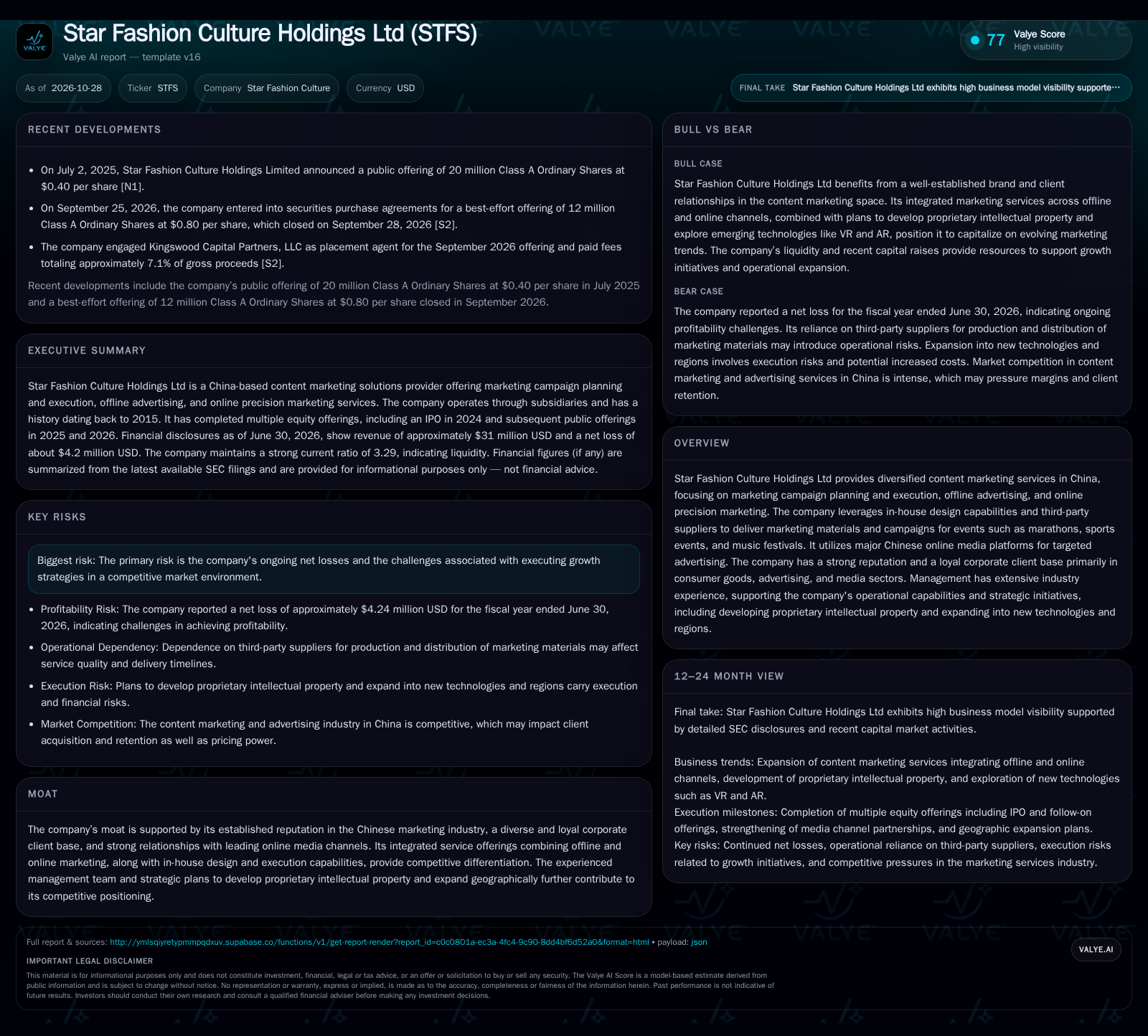
Star Fashion Culture Holdings Ltd, a China-based content marketing services provider, reported $31 million in revenue and a $4.2 million net loss for the year ended June 2026. The company recently completed two major equity offerings to support expansion plans, including in-house IP development and entry into VR/AR marketing. Its ability to convert a loyal client base and capital inflows into sustainable margins and differentiated offerings will determine long-term value creation. Execution risk and intense competition are key constraints. [S1] [S2] [N1]
Star Fashion Culture Holdings Ltd sits at a crossroads familiar to many high-growth Chinese marketing firms: the company is leveraging established client relationships and expanding into new channels, including VR/AR and Southeast Asia, yet struggles to convert top-line momentum into lasting profitability. Recent capital raises—at significantly lower share prices—signal both the ambition and the financial demands of this strategy. With intense competition and operational dependencies, the company’s next steps will test whether its integrated marketing model and proprietary content ambitions can deliver sustained value.
Recent Equity Offerings and Financial Performance Shape Strategic Options
Three facts stand out in Star Fashion Culture’s recent trajectory. First, as of June 30, 2026, the company reported $30.98 million in revenue but a net loss of $4.24 million, underlining a persistent challenge in achieving profitability. [S1] Second, the company completed two sizable equity offerings: a 20 million share offering at $0.40 per share in July 2025 [N1], and a 12 million share best-effort offering at $0.80 per share in September 2026. [S2] These capital raises were at markedly lower prices than the October 2024 IPO ($4.00 per share), reflecting either increased dilution, market skepticism, or urgent funding needs. Third, the company reported liquidity-ratio trends of 3.29 with $69,450 in cash and $16.1 million in current assets against $4.9 million in current liabilities as of June 2026. The company reported cash and liquidity metrics for the period; these figures do not by themselves establish operating runway, investment capacity, financial flexibility, or financing capacity. [S1]
Integrated Marketing Services and the Economics of Scale, Mix, and Execution
Star Fashion Culture’s business model is built around service revenue from marketing campaign planning, offline advertising, and online precision marketing, serving primarily consumer goods and media sector clients. The company’s economics are likely driven by project-based contracts, with revenue recognition tied to campaign delivery and media spend. Gross margins could be structurally pressured by reliance on third-party suppliers for production and distribution of marketing materials, as well as by the need to purchase media inventory from dominant Chinese platforms. Variable costs likely scale with campaign volume, while in-house design and project management represent semi-fixed costs.
Operating leverage could be realized if the company succeeds in increasing the volume or value of campaigns with existing resources, or if a shift toward proprietary content/IP (including VR/AR) enables higher-margin offerings. However, the persistent net losses suggest that, to date, either pricing power is limited, client budgets are volatile, or cost discipline is elusive. The capital-intensive nature of client acquisition, new media channel partnerships, and technology investments (such as VR/AR integration) may require continued external funding unless Star Fashion Culture can improve project profitability or secure longer-term, recurring contracts.
Navigating China’s Crowded Content Marketing Landscape
The Chinese content marketing sector is intensely competitive, with a mix of large integrated agencies, digital-first upstarts, and in-house marketing teams at major brands. Star Fashion Culture’s reported retention of 12 returning clients out of 18 over two years indicates some degree of client loyalty, but does not confirm the existence of recurring revenue contracts or high switching costs. [S1] The company’s integrated approach—combining offline event marketing, outdoor advertising, and digital campaigns—may help differentiate it from single-channel competitors, especially when paired with in-house design capabilities.
However, barriers to entry in marketing services are generally low, and the company’s dependence on third-party suppliers could limit its ability to control quality or margins. The planned expansion into proprietary IP and VR/AR content could create new niches or higher-value offerings, but also puts Star Fashion Culture in competition with both traditional agencies and tech-savvy digital studios. Long-term defensibility may depend on the company’s ability to build unique client experiences, integrate across platforms, and establish exclusive media or technology partnerships.
Proprietary Content and New Technologies Unlock Margin Expansion
The most favorable outcome would see Star Fashion Culture successfully developing in-house intellectual property and launching VR/AR-driven campaigns that command premium pricing. This could enable the company to move up the value chain—from commoditized campaign execution to differentiated branded content and immersive experiences. If the company can leverage its existing client relationships to upsell these new services, revenue per client could rise, and gross margins could improve as dependence on third-party suppliers decreases.
Evidence supporting this scenario would include a rising proportion of revenue from proprietary content or technology-driven campaigns, improved gross margin trends, and public client references to successful VR/AR activations. Additional confirmation would come from new multi-year contracts, expansion into Southeast Asian markets with marquee wins, or disclosures of reduced client churn.
Incremental Growth, Ongoing Margin Pressure, and Capital Dependence Persist
The most plausible near-term scenario is that Star Fashion Culture continues to grow revenue through a mix of new client wins and expansion with existing accounts, but struggles to substantially improve profitability. The company may achieve modest share gains in offline and online marketing, but competitive pricing and reliance on third-party suppliers keep margins thin. Ongoing investment in new technologies and geographic expansion absorbs much of the gross profit, sustaining the need for external capital—especially if project-based revenue remains lumpy and client retention does not translate into longer-term contracts.
This scenario would be confirmed by continued sequential revenue growth but persistent net losses, further equity raises at pressured valuations, and limited evidence of high-margin recurring revenue streams. Falsification would require a sustained shift in profitability metrics or clear evidence of structural cost reduction.
Execution Missteps and Competitive Pressure Erode Client Base and Dilute Value
The adverse case is that Star Fashion Culture faces execution setbacks in developing proprietary IP or integrating new technologies, leading to cost overruns and failed campaigns. Intense competition from larger agencies or digital-native competitors could drive down pricing, while operational hiccups with third-party suppliers might result in client dissatisfaction and churn. If capital markets tighten or dilution from repeated low-priced offerings undermines investor confidence, the company could struggle to fund working capital or strategic initiatives.
This scenario would be confirmed by declining revenue, accelerating net losses, or a shrinking client base. Additional red flags would include negative gross margins, delayed or abandoned technology initiatives, or an inability to access fresh capital on reasonable terms.
What Will Determine Star Fashion Culture’s Trajectory in Content Marketing?
Gross margin trends, if disclosed, would clarify whether proprietary content and technology investments are improving underlying economics.
The proportion of revenue from recurring or multi-year contracts versus project-based work would help assess revenue visibility and client stickiness.
Client retention and expansion rates—the number of returning versus new clients, and whether average revenue per client is rising.
Disclosure of VR/AR or proprietary IP-driven campaign wins, including marquee client references or case studies.
Cash burn rate and operating cash flow trends, especially in relation to periodic equity offerings.
Progress on Southeast Asia expansion, including any announced clients or partnerships in the region.
Impact of supplier relationships on service quality, delivery timelines, and cost structure—any evidence of operational disruptions or renegotiated terms.
The terms and success of future capital raises, particularly pricing and dilution relative to previous offerings.
Disclaimer: This is research-only, informational analysis and not investment advice. It may include AI-generated interpretation and general industry context. Always verify important details using primary sources.

Comments