
Galaxy Payroll Group Ltd: Limited Disclosure, Cross-Border Complexity, and the Search for Sustainable Economics
Galaxy Payroll Group Ltd operates payroll services through subsidiaries in Greater China, reporting modest revenue but ongoing net losses as of mid-2026. With scant public disclosure on its business model and recent trading volatility, the company presents a challenging case for assessing future prospects, competitive positioning, and operational resilience.
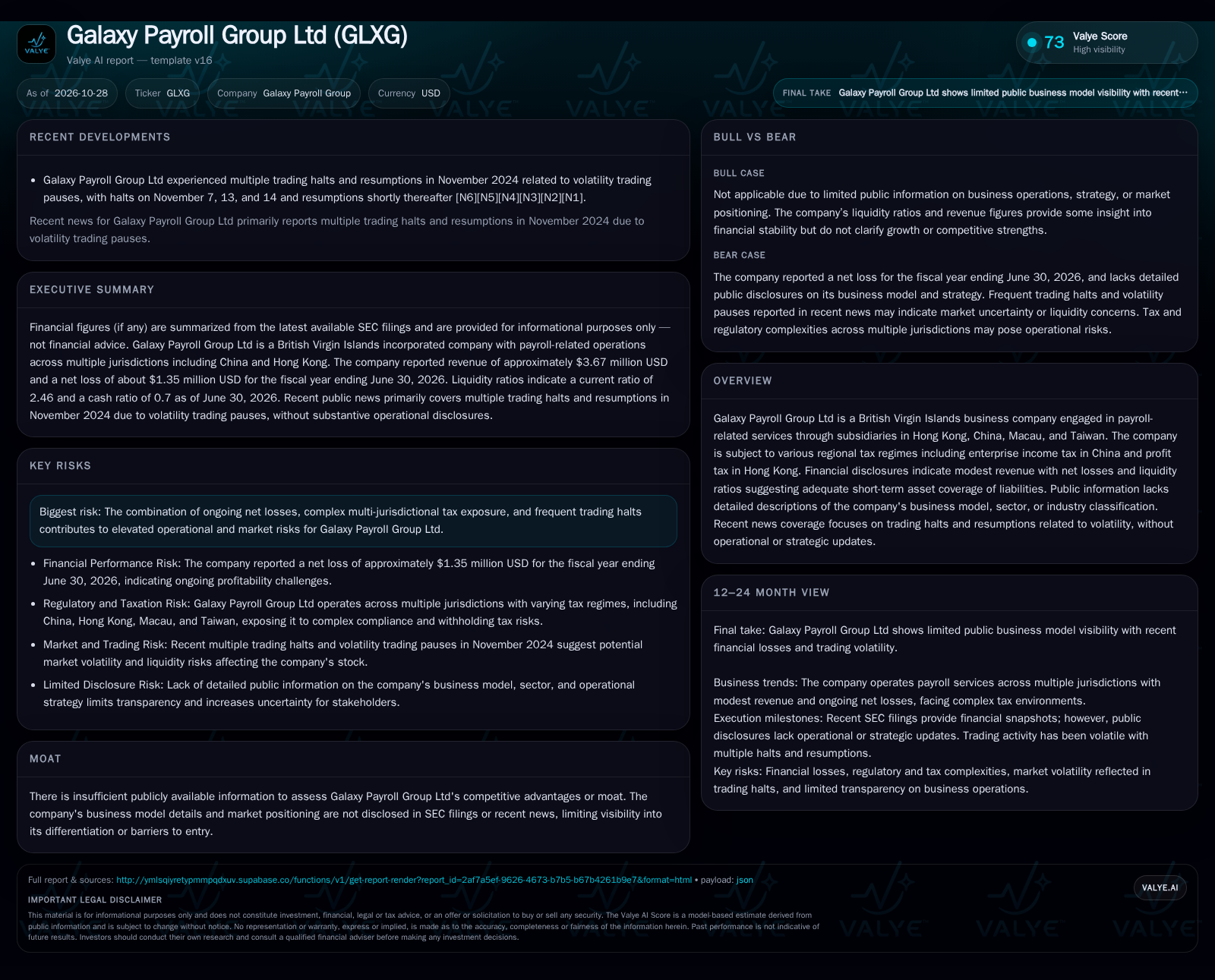
Galaxy Payroll Group Ltd reported $3.67 million in revenue and a net loss of $1.35 million for the year ended June 30, 2026. Operating through subsidiaries in China, Hong Kong, Macau, and Taiwan, the company faces complex tax and regulatory burdens, but its liquidity ratios suggest short-term asset coverage. However, the lack of business model transparency and repeated trading halts in late 2024 leave critical questions unanswered about its core economics, strategic direction, and ability to achieve profitability.
Galaxy Payroll Group Ltd illustrates the analytical challenge posed by companies with minimal public disclosure yet cross-border operational footprints. Despite generating $3.67 million in revenue for the year ended June 30, 2026, the company remains unprofitable, reporting a $1.35 million net loss and only basic liquidity coverage. Its operations span several complex regulatory environments in Greater China, but the absence of detail on its commercial mechanics, customer relationships, or strategic priorities leaves investors and analysts with limited ability to assess the sustainability or scalability of its economics. Trading volatility in late 2024 further clouds the outlook, highlighting both market uncertainty and the difficulty of building conviction in the absence of transparency.
Recent Financials and Market Volatility: What the Numbers Reveal—and What They Don’t
As of June 30, 2026, Galaxy Payroll Group Ltd reported $3.67 million in revenue and a net loss of $1.35 million, with basic EPS at -3.78 HKD and diluted EPS at -0.48 USD [S1]. The company’s liquidity position showed current assets of $4.85 million and current liabilities of $1.97 million, yielding a current ratio of 2.46 and a cash ratio of 0.7 [S1]. Notably, the company’s shares experienced multiple trading halts and resumptions in November 2024, driven by volatility trading pauses rather than operational disclosures [N6] [N5] [N4] [N3] [N2] [N1]. Public filings continue to lack detail on the company’s business model, customer composition, or sector classification, leaving a significant informational gap.
How Value Might Be Created—or Eroded—in a Multi-Jurisdiction Payroll Platform
Without direct disclosure of Galaxy Payroll Group’s business model, one must infer from industry norms: payroll service providers typically generate revenue through per-employee or per-company subscription fees, transaction-based charges, or bundled HR solutions. Gross margins in such businesses can be attractive if the platform is scalable and can amortize fixed software and compliance costs across a growing client base. However, the company’s ongoing net losses suggest that either its scale is insufficient to cover fixed costs, its pricing power is weak, or its cost structure is burdened by regulatory complexity and cross-border compliance.
Operating in China, Hong Kong, Macau, and Taiwan, Galaxy Payroll Group faces diverse tax regimes—ranging from 12% to 25% effective rates—and additional friction from withholding tax on intra-group dividends [S1]. This complexity could inflate compliance costs, reduce net margins, and limit the company’s ability to repatriate earnings efficiently. In the absence of detailed disclosure, it is unclear if the company operates a software-as-a-service (SaaS) model, a service bureau, or a hybrid structure. Each would carry different implications for operating leverage, customer retention, and capital intensity.
The modest revenue base ($3.67 million) paired with ongoing losses points to insufficient scale or low unit economics. If Galaxy Payroll is investing ahead of growth—building technology or acquiring customers—future operating leverage could emerge. However, the absence of capex or R&D disclosure leaves this speculative.
Competitive Dynamics: Fragmented Payroll Markets, Compliance Hurdles, and the Challenge of Differentiation
The payroll services market in Asia is crowded, with local and regional providers competing alongside global payroll and HR platforms. In Greater China, compliance requirements are regionally idiosyncratic, which can create barriers to entry for new players but also make it difficult for smaller firms to scale efficiently across borders.
Galaxy Payroll Group’s presence in multiple jurisdictions could, in theory, offer clients integrated cross-border payroll solutions—a potential differentiator for multinationals or companies with pan-Asian operations. However, the lack of disclosure on customer composition, product breadth, or integration capabilities makes it impossible to assess whether Galaxy Payroll has achieved this competitive advantage or is simply exposed to greater regulatory risk and execution complexity.
Without evidence of proprietary technology, deep client relationships, or regulatory licensure that could increase switching costs, Galaxy Payroll Group may face intense pricing pressure from both established incumbents and digital-native challengers. The question is whether its multi-jurisdiction footprint confers real scale benefits or merely operational complexity.
What Could Drive a Turnaround: Scale, Technology, and Cross-Border Client Wins
A favorable scenario for Galaxy Payroll Group would involve leveraging its presence in multiple Greater China markets to attract multinational clients seeking unified payroll and compliance solutions. If the company can demonstrate strong customer acquisition—ideally with evidence of multi-country contracts, recurring subscription revenue, or increasing customer retention—operating leverage may develop as fixed costs are spread across a broader base.
The emergence of proprietary technology, such as a cloud-based payroll platform or value-added HR analytics, could provide differentiation and pricing power. Confirmation would require disclosure of customer wins, product launches, or margin expansion in future filings.
Falsification of this scenario would be apparent if revenue stagnates, losses widen, or no evidence emerges of scale benefits or client wins across jurisdictions.
Stagnation Amid Complexity: A Plausible Near-Term Trajectory
Given the company’s modest revenue, persistent losses, and lack of operational transparency, the most plausible scenario is continued struggle to achieve meaningful scale or profitability. The multi-jurisdiction presence may generate incremental business but also sustain high compliance and administrative costs, offsetting any operational gains.
Absent disclosure of customer growth, cost control, or technology investment, it is reasonable to expect that Galaxy Payroll Group will continue to operate at or near breakeven, with periodic losses and limited ability to invest for future growth. Trading volatility and thin public float could persist in the absence of new investor communications or strategic initiatives.
This scenario would be confirmed by stable or slightly declining revenue, continued net losses, and ongoing lack of business model clarity. It could be falsified if the company delivers detailed operational disclosures, demonstrates customer traction, or reports a path to profitability.
When Complexity Overwhelms: Regulatory, Market, and Disclosure Risks Compound
The adverse scenario for Galaxy Payroll Group involves escalating compliance costs, tax friction, and competitive pressure eroding already thin margins. Regulatory changes in any of its operating jurisdictions could increase costs or restrict its ability to serve key customer segments.
Repeated trading halts could further unsettle investors, depress valuation, and limit the company’s ability to attract new capital.
This scenario would be confirmed by rising operating losses, declining liquidity metrics, negative regulatory developments, or additional volatility-induced trading suspensions. Falsification would require evidence of cost containment, regulatory clarity, or improved access to funding.
Testing the Thesis: Disclosures, Execution, and External Triggers to Track
Disclosure of customer numbers, contract types, or geographic revenue split—if provided—would help clarify scale, retention, and cross-border traction.
Any indication of recurring revenue, multi-year client agreements, or SaaS-like economics would materially alter the growth and margin thesis.
Updates on technology investment, product launches, or integration partnerships would provide insight into potential differentiation and operating leverage.
Quarterly or interim reporting on net cash flow, burn rate, and capital needs—if disclosed—would help assess the risk of liquidity stress or need for external funding.
Regulatory news or tax changes affecting payroll or HR service providers in China, Hong Kong, Macau, or Taiwan could materially impact compliance costs and profitability.
Resolution or reduction in frequency of trading halts and volatility pauses would be a sign of stabilizing market confidence.
A useful metric would be gross margin by geography or business line, to understand where (if anywhere) the company is achieving scale or pricing power.
Management communication about strategy, customer acquisition, or product roadmap—currently absent—would help investors evaluate execution risk and competitive positioning.
Disclaimer: This is research-only, informational analysis and not investment advice. It may include AI-generated interpretation and general industry context. Always verify important details using primary sources.

Comments