
Orion Group Holdings: Project Concentration, Regulatory Barriers, and the Search for Sustainable Construction Economics
Orion Group Holdings’ strong Q3 2026 results and recent acquisition underscore its ambition to scale through large, complex projects and vertical integration in marine and concrete construction. Yet, project concentration, regulatory restrictions, and labor dynamics pose persistent risks to margin stability and long-term value creation.
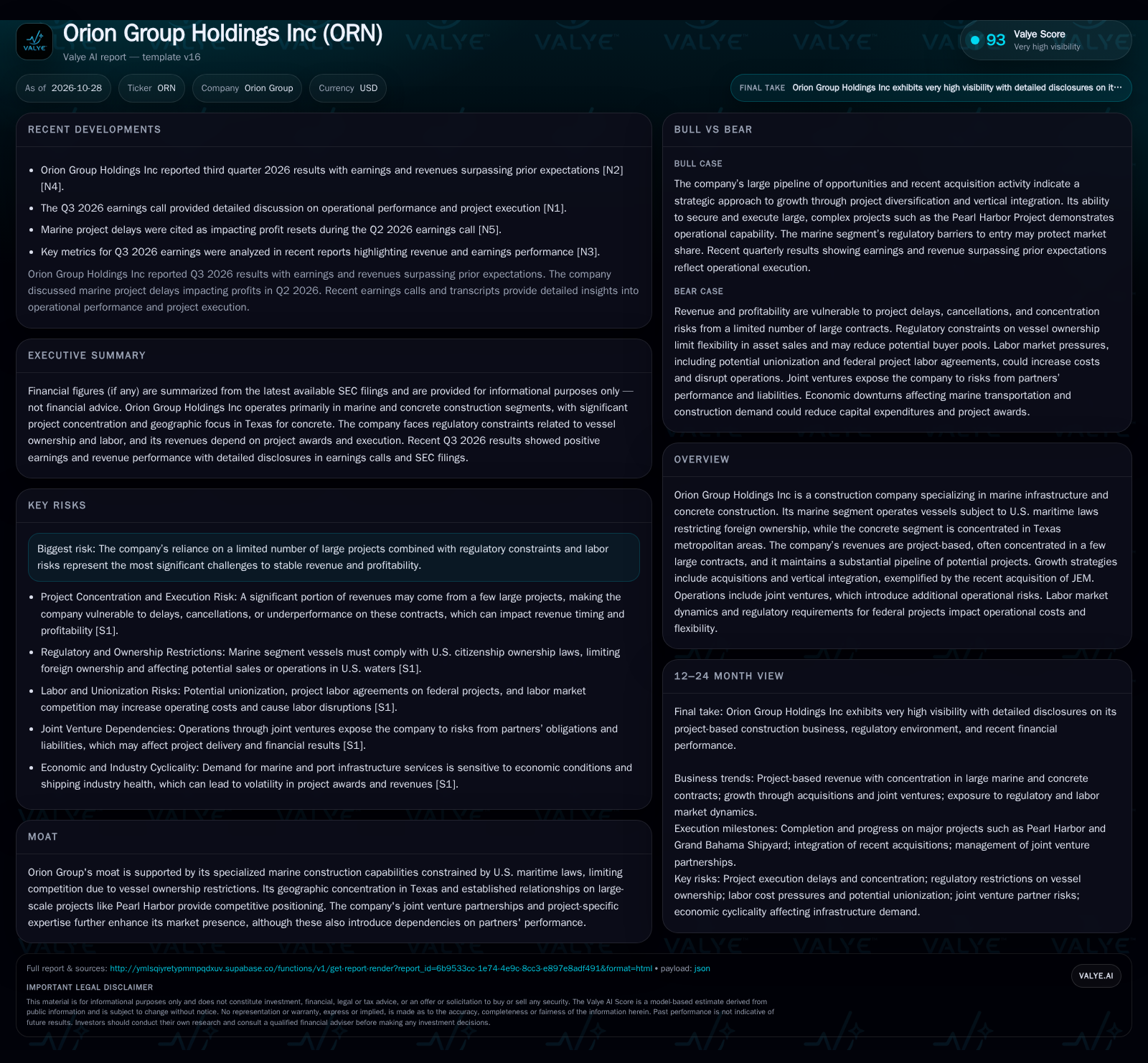
Orion Group Holdings’ Q3 2026 revenue and earnings exceeded expectations, supported by major project execution and a robust $22 billion pipeline. The company’s acquisition of JEM and focus on vertical integration signal strategic growth, but ongoing dependency on a handful of large contracts, regulatory constraints in its marine segment, and labor market pressures continue to shape its risk profile. Sustainable margins and value depend on project delivery, integration success, and managing concentrated exposures. [S1] [S2] [N2] [N4]
Orion Group Holdings Inc enters late 2026 with a mix of positive momentum and structural vulnerabilities. Its Q3 results outpaced expectations, driven by project execution in both marine and concrete construction and supported by a substantial pipeline. The company’s latest acquisition and focus on vertical integration highlight a strategic effort to enhance scale and operational control. However, Orion’s dependence on a few large contracts, exposure to regulatory and labor risks, and the inherent cyclicality of construction markets mean that translating strong quarters into sustainable value will require more than headline growth.
Recent Results, Acquisition, and Project Pipeline: Setting the Stage for Orion’s Next Phase
Orion Group Holdings’ Q3 2026 financials showed net income of $5.47 million and basic/diluted EPS of $0.14, with both revenue and earnings surpassing analyst estimates. This performance was attributed to strong project execution, particularly in its core marine and Texas-focused concrete segments. The completion of the JEM acquisition in February 2026 marks a continued push toward vertical integration and expanded capabilities. Meanwhile, Orion’s project pipeline stands at approximately $22 billion, reflecting the potential scale of future opportunities. However, this pipeline represents projects tracked, not contracted revenue, so actual conversion remains a key uncertainty. The company’s project portfolio continues to be concentrated around large, complex contracts such as the Pearl Harbor and Grand Bahama Shipyard projects, further magnifying both upside potential and risk. [S1] [S2] [N2] [N4]
Project-Based Revenue, Margin Volatility, and the Economics of Scale in Construction
Orion’s business model relies on project-based revenue, with substantial portions tied to a handful of major contracts. This structure can produce lumpy revenue recognition and exposes margins to execution risk, delays, and renegotiations. Pricing is typically set at contract inception, limiting the ability to pass on unforeseen cost increases—especially for labor and materials. The concrete segment’s geographic concentration in Texas may offer some logistical and supplier efficiencies, but it also amplifies exposure to local market cycles and competitive pricing pressures.
Fixed costs for vessel ownership and specialized equipment in the marine segment create high operating leverage, meaning that underutilization can quickly erode profitability. Conversely, periods of high project activity can deliver strong contribution margins, as seen in Q3 2026. The company’s push toward vertical integration (exemplified by the JEM acquisition) could, if executed well, reduce third-party dependency and improve margin capture on complex projects. However, integration costs and the risk of overpaying for acquisitions remain real concerns.
Joint ventures are a recurring feature, allowing Orion to participate in larger bids but also exposing it to shared liabilities and the risk of counterparty underperformance. Overall, working capital needs can be significant, particularly when ramping up new projects or when milestone payments are delayed.
Barriers, Concentration, and the Limits of Regulatory Moats in Marine Construction
Orion’s marine segment benefits from regulatory barriers such as the Jones Act and Foreign Dredge Act, which restrict foreign ownership of U.S. vessels and effectively limit direct competition from international firms. This creates a defensible niche and helps sustain margins in specialized projects. However, these same regulations limit Orion’s flexibility to sell or lease marine assets and reduce the pool of potential buyers, constraining capital recycling options.
In concrete construction, Orion’s heavy focus on Houston and Dallas gives it deep local experience but also exposes it to regional competition and demand swings. Large, diversified contractors, regional specialists, and private infrastructure funds are all relevant competitors, each with different risk appetites and cost structures. Orion’s ability to win and execute large, federally funded projects—often in joint ventures—may provide some differentiation, but also increases exposure to project labor agreements and unionization pressures.
The acquisition of JEM suggests a strategy to deepen vertical integration and potentially offer bundled solutions, which could improve win rates and margins if Orion can leverage cross-segment synergies. However, the durability of these advantages depends on successful integration and continued execution on complex, large-scale projects.
Leveraging Project Wins and Integration to Drive Margin Expansion
A favorable scenario for Orion hinges on its ability to consistently win and deliver large, high-margin projects from its $22 billion pipeline. Successful integration of JEM could reduce costs, improve project execution, and enable Orion to capture more value across the project lifecycle. If the company can maintain high utilization of its marine assets and avoid major project delays, operating leverage could drive outsized margin gains.
Confirmation of this scenario would come from: sustained revenue growth outpacing industry averages; margin expansion due to vertical integration; backlog growth from new contract awards; and evidence of successful cross-segment collaboration. A material increase in the conversion rate from pipeline to contracted backlog would also support this thesis.
Navigating Concentration and Cyclicality in a Project-Driven Environment
The most plausible outlook is one of steady but uneven progress, with Orion continuing to secure and execute a mix of large and mid-sized projects. Revenue and earnings are likely to remain volatile, reflecting the lumpy nature of project awards and completions. The company could see periods of strong profitability punctuated by quarters where project delays, cost overruns, or client-driven changes erode margins.
Integration of JEM and other acquisitions may deliver incremental cost savings, but synergies are likely to be gradual and may be offset by ongoing integration costs. The risk of labor cost escalation and regulatory pressures will remain persistent headwinds.
Evidence confirming this base case would include: stable revenue with quarter-to-quarter fluctuations; modest improvements in margin; continued concentration in a few large projects; and periodic disclosures of project delays or renegotiations. Any signs of geographic or customer diversification would suggest gradual de-risking of the business model.
Project Delays, Cost Overruns, and the Impact of Concentrated Exposures
The adverse scenario materializes if Orion experiences significant delays or underperformance on one or more of its largest contracts, such as the Pearl Harbor or Grand Bahama Shipyard projects. Because a substantial share of revenue is concentrated in a limited number of projects, any disruption can have an outsized impact on earnings and cash flow.
Further, if labor market pressures intensify—through unionization, project labor agreements, or wage inflation—costs could rise faster than contract pricing allows, compressing margins. Regulatory changes or adverse rulings could also restrict operations or increase compliance costs, especially in the marine segment.
This scenario would be confirmed by: unexpected contract cancellations or renegotiations; sharp drops in reported backlog; negative earnings surprises tied to project execution; and evidence of cash flow stress or increased reliance on joint venture partners to share risks.
What Will Determine Orion’s Ability to Deliver Sustainable Value?
Conversion rate of the $22 billion pipeline into contracted backlog and subsequent revenue, if disclosed, is critical to future growth.
Frequency, size, and margin profile of new project awards, particularly in the marine segment, would help test execution strength.
Progress and cost outcomes on major ongoing projects like Pearl Harbor and Grand Bahama Shipyard should be monitored for delay or overrun risk.
Post-acquisition integration milestones and realized synergies from JEM, as disclosed in future filings, will be important for margin improvement.
Trends in labor costs and any disclosures regarding unionization or project labor agreements could materially affect cost structure.
Quarterly gross margin and operating margin trends will signal the effectiveness of project execution and cost management.
Any diversification in customer base or geography, if disclosed, would indicate progress in reducing project and regional concentration risk.
Changes in joint venture participation and any associated liabilities or disputes should be tracked for partnership risk exposure.
Disclaimer: This is research-only, informational analysis and not investment advice. It may include AI-generated interpretation and general industry context. Always verify important details using primary sources.

Comments