
DBV Technologies Nears Regulatory Crossroads: Peanut Allergy Patch, Financial Pressure, and the Commercialization Test
With its VIASKIN Peanut Patch advancing through late-stage regulatory review and a reported cash position, DBV Technologies faces a pivotal moment. Will FDA approval translate into commercial success, or will prolonged losses and market adoption hurdles challenge the company's ambitions in pediatric allergy immunotherapy?
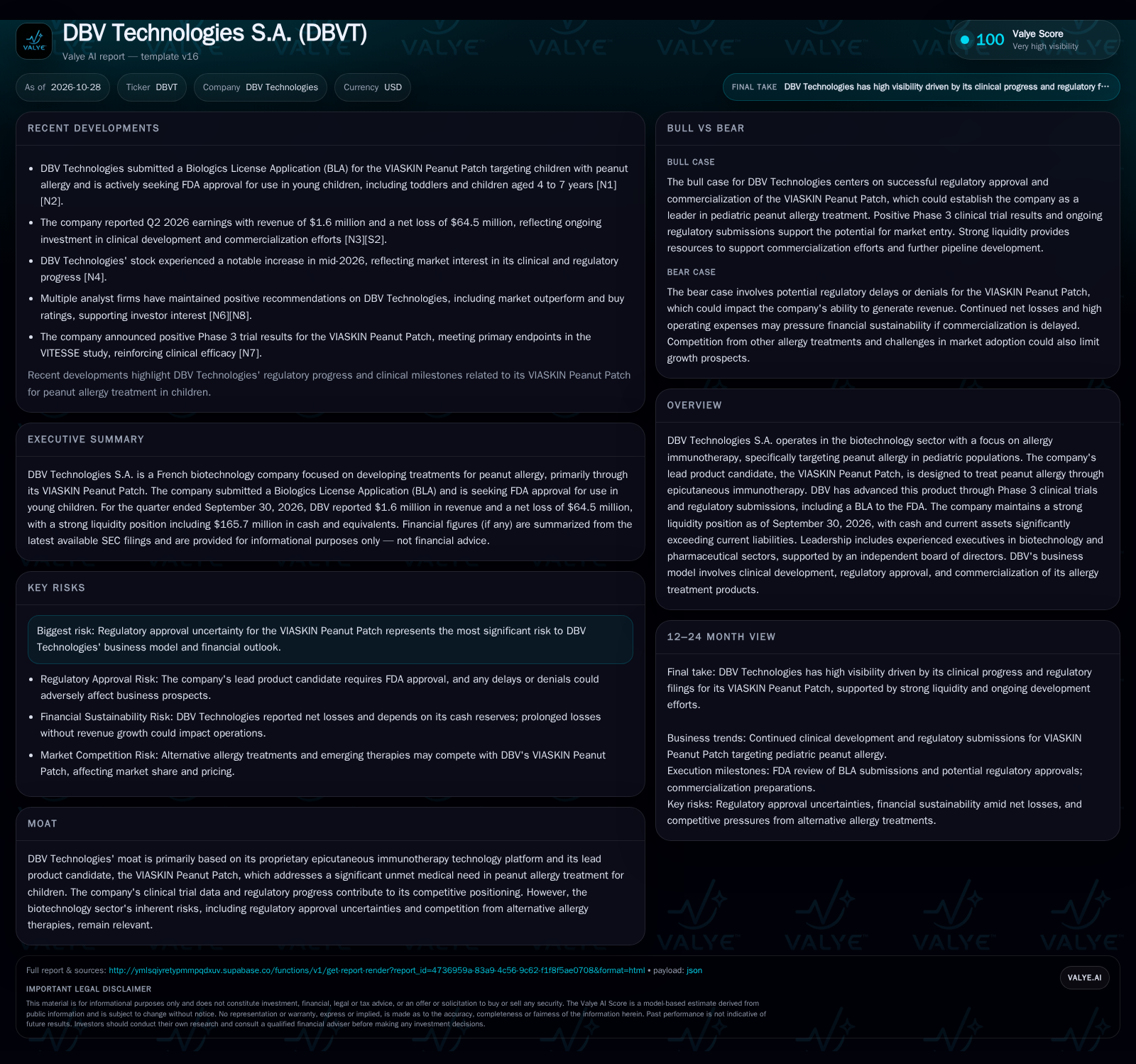
DBV Technologies is approaching a critical juncture as it seeks FDA approval for its lead product, the VIASKIN Peanut Patch, targeting pediatric peanut allergies. The company reported $1.6 million in revenue and a net loss of $64.5 million for Q3 2026, but maintains $165.7 million in cash. [S2] [N3]
The next phase—if approval is secured—will test DBV’s ability to convert regulatory success into commercial traction in a field crowded with alternative therapies and evolving patient expectations.
Regulatory Submission, Financials, and the Waiting Game
DBV Technologies reported $1.6 million in revenue and a net loss of $64.5 million for the quarter ended September 30, 2026, underscoring the pre-commercial stage of its lead product, the VIASKIN Peanut Patch. The company submitted a Biologics License Application (BLA) for the patch, targeting children aged 4–7, and is currently seeking FDA approval. The company’s near-term outlook is dominated by the regulatory review process, while its financial results reflect the high costs of clinical development and pre-launch activities. [S2] [N3]
How the Peanut Patch Could Reshape DBV’s Revenue Model
DBV’s business model is built on developing and commercializing allergy immunotherapy products—most notably, the VIASKIN Peanut Patch. If approved, revenue would likely shift from minimal clinical-stage grants and milestone payments to product sales, with pricing potentially influenced by value-based arguments and payer negotiations in the pediatric allergy space. The economics of the patch hinge on manufacturing scale, margin structure (which for biologics can be high but often requires significant upfront investment), and the ability to secure reimbursement from insurers and public health systems.
Operating leverage could become a significant factor: while R&D expenses may taper post-approval, commercial costs (sales force buildout, education, and distribution) will ramp up.
The sustainability of DBV’s revenue model will also depend heavily on the competitive dynamics within payer negotiations, particularly in how value-based pricing frameworks evolve for pediatric allergy treatments. If payers increasingly demand evidence of long-term health outcomes and cost offsets—such as reductions in emergency interventions or hospitalizations—DBV’s ability to generate robust real-world evidence will be critical. Moreover, the company must consider the potential impact of biosimilar or generic competitors in the longer term, which could compress margins and necessitate continuous innovation or lifecycle management strategies to maintain pricing power. Operational efficiencies in manufacturing and supply chain will also influence gross margins, especially given the biologic nature of the patch.
Another important factor is the scalability of the commercial infrastructure relative to market penetration. DBV will need to balance upfront investments in sales and marketing with the pace of physician adoption and patient demand to avoid excessive cash burn. The timing and magnitude of these investments could be optimized through phased geographic rollouts or targeted patient segments, which would help manage risk and improve capital efficiency. Additionally, strategic partnerships with healthcare providers or payers could facilitate broader access and reduce direct selling costs, although such collaborations might involve revenue-sharing arrangements that impact net margins.
Competing in Pediatric Allergy: Barriers and Vulnerabilities
DBV’s competitive position centers on its proprietary epicutaneous immunotherapy platform, which offers a non-oral, non-injection alternative for peanut allergy treatment in children. This could be attractive to parents and caregivers wary of the risks and burdens associated with oral immunotherapy (OIT) or injectable options. However, the allergy treatment field is crowded, with OIT already approved for peanut allergy and additional competitors developing oral, sublingual, and injectable therapies, some with established commercial infrastructure.
The potential moat for DBV lies in differentiation—if the Peanut Patch demonstrates a superior safety profile, ease-of-use, or adherence in real-world settings. Yet, switching costs may be limited if payers or physicians perceive competing therapies as equally effective or more economical. Market entry barriers are high for newcomers, but established players with broader allergy portfolios could leverage their scale and relationships to compete aggressively on price or access. DBV’s long-term advantage may depend on clinical outcomes, patient preference, and the ability to expand its platform to other allergens or age groups.
What Success Looks Like: Approval, Adoption, and Pipeline Leverage
A favorable scenario unfolds if the VIASKIN Peanut Patch secures FDA approval for the pediatric population and is rapidly adopted by allergists and caregivers. This would validate DBV’s technology platform and could accelerate payer coverage, driving a swift ramp in revenue as the company captures a share of the large, underserved pediatric peanut allergy market. If commercial uptake is strong, DBV could achieve operating leverage, reduce cash burn, and reinvest in its pipeline or platform expansion.
Evidence that would confirm this scenario includes regulatory approval without major label restrictions, rapid formulary inclusion, positive post-market safety and adherence data, and strong initial sales growth. Pipeline progress—such as advancing additional VIASKIN products for other allergens—would further support a virtuous cycle of platform value creation.
Commercial Launch Brings Gradual Uptake and Ongoing Cash Burn
The most plausible middle path is regulatory approval with moderate uptake: the Peanut Patch is approved for children, but adoption is gradual as payers, providers, and caregivers weigh the new option against established therapies. Revenue begins to grow, but not at a pace sufficient to immediately offset ongoing commercial and development expenses, resulting in continued but narrowing net losses.
Delays in payer coverage, slow changes in physician prescribing habits, or the need for additional studies to broaden the label could temper the pace of profitability. The scenario would be falsified if commercialization stalls or if the company is forced to seek new capital sooner than anticipated.
Setbacks in Approval or Adoption Could Force a Strategic Reset
The adverse scenario materializes if the FDA delays or denies approval for the Peanut Patch, or if approval is granted with significant restrictions that limit market potential. Alternatively, even with approval, if the product struggles to gain traction due to payer resistance, safety concerns, or competitive responses, DBV’s revenue may remain negligible while losses continue.
Confirmation of this scenario would include adverse regulatory decisions, negative post-market safety signals, weak initial sales, or public payer rejections. Protracted cash burn in the face of limited revenue could force DBV to seek dilutive financings, pursue partnerships on unfavorable terms, or pivot to alternative indications, eroding shareholder value and market confidence.
Milestones That Will Define DBV’s Next Chapter
Final FDA decision on the VIASKIN Peanut Patch Biologics License Application, including any label restrictions or post-marketing requirements.
Initial sales figures and prescription trends in the first quarters following launch, if disclosed, as an indicator of physician and patient adoption.
Updates on payer coverage decisions, formulary placements, and reimbursement rates for the Peanut Patch.
Post-marketing safety and adherence data, especially in real-world pediatric populations, which could impact uptake and regulatory standing.
Progress on expanding the VIASKIN platform to additional allergens or broader age groups, which would test the scalability of the technology.
Competitive product launches or changes in guidelines for peanut allergy treatment that could alter the market landscape or pricing dynamics.
Disclaimer: This is research-only, informational analysis and not investment advice. It may include AI-generated interpretation and general industry context. Always verify important details using primary sources.

Comments