
Bio-Techne in 2026: Margin Recovery, Global Expansion, and the Strategic Complexity of Life Science Tools
Bio-Techne enters fiscal 2027 with reported liquidity position, a growing international footprint, and ongoing restructuring efforts aimed at restoring margins. With recent net profit improvements and a diverse, acquisition-savvy board, the company faces both the promise and peril of scaling in a competitive, innovation-driven life sciences sector.
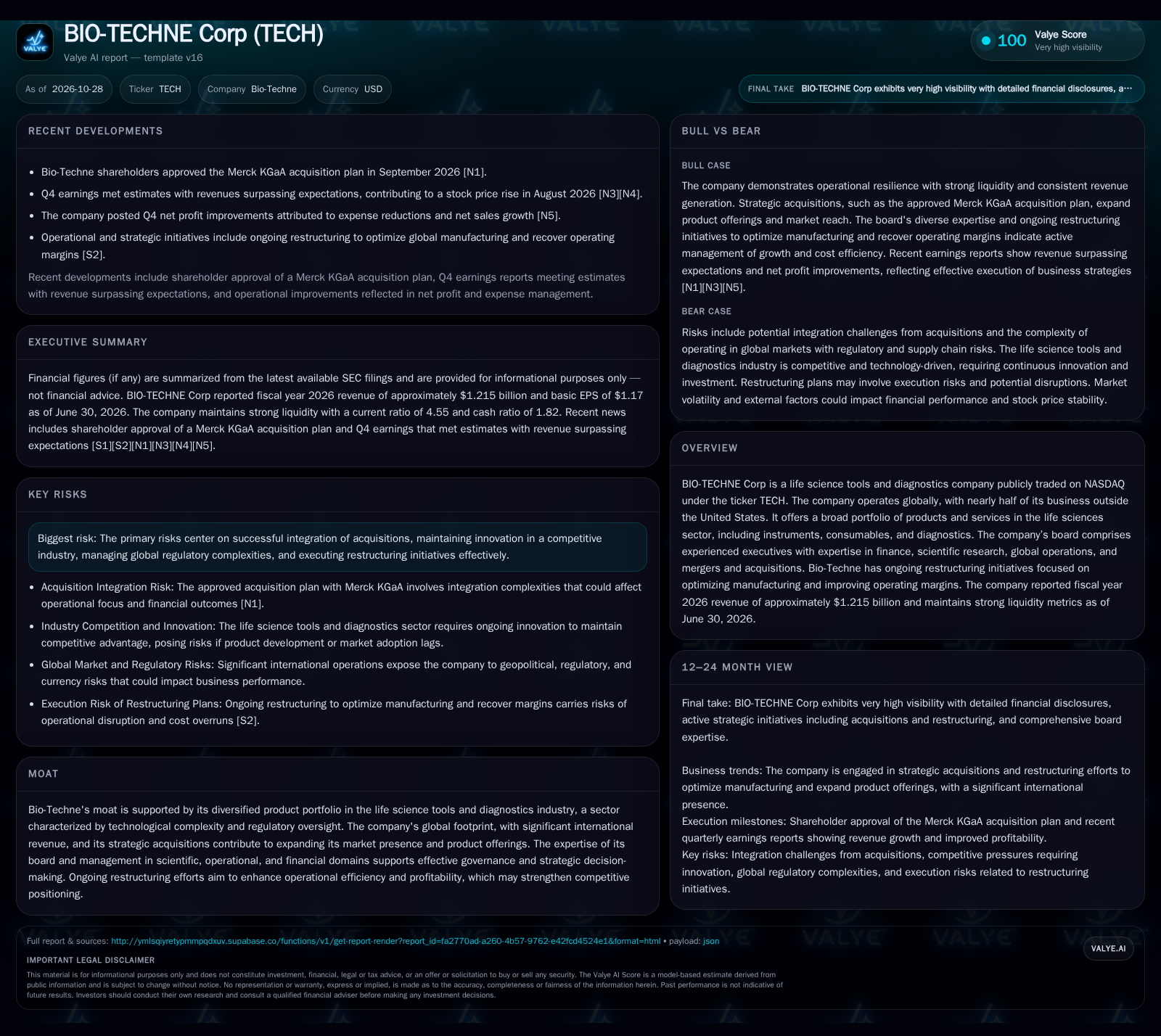
Bio-Techne reported $1.215 billion in fiscal 2026 revenue and maintains a reported balance sheet position, with recent profit gains linked to expense control and sales growth. Ongoing restructuring aims to optimize manufacturing and recover operating margins as the company expands internationally and pursues strategic acquisitions. The challenge ahead lies in balancing operational improvements with the execution risks of transformation in a highly competitive industry. [S1] [S2] [N5]
Bio-Techne Corp stands at a critical inflection point in late 2026, reporting robust revenue and liquidity while aggressively pursuing operational restructuring and international expansion. Fiscal 2026 saw the company exceed $1.2 billion in revenue, with recent quarters benefiting from both sales growth and disciplined expense management. As Bio-Techne seeks to optimize its manufacturing footprint and recover operating margins, the company's ability to integrate acquisitions, manage global regulatory complexity, and sustain innovation will be tested. The path forward is defined by both the opportunities of scale and the inherent execution risks of transformation in a rapidly evolving life science tools market.
How Recent Results and Strategic Moves Set Bio-Techne’s Near-Term Agenda
Bio-Techne ended fiscal 2026 with $1.215 billion in revenue and cash and equivalents of $264.7 million, supporting a current ratio of 4.55 as of June 30, 2026 [S1]. This financial position provides operational stability as the company undertakes restructuring efforts. Net income for the March 2026 quarter was $51.0 million, reflecting improvements attributed to both net sales growth and expense reductions [S2] [N5]. The company continues to emphasize operational optimization, with ongoing restructuring initiatives targeting global manufacturing and margin recovery [S2]. Notably, nearly half of Bio-Techne’s business is generated outside the U.S., amplifying the relevance of international market dynamics and regulatory environments [S1]. These facts frame a company in active transformation, leveraging a reported balance sheet position to pursue efficiency and scale.
Decoding the Economics of Life Science Tools: Volume, Margins, and Capital Intensity
Bio-Techne’s economic profile is shaped by the dual nature of its portfolio—recurring consumables and higher-ticket instruments—serving research, diagnostics, and clinical customers. Revenue growth is generally a function of both volume expansion (driven by R&D activity, clinical adoption, and geographic reach) and product mix (proportion of high-margin reagents versus capital equipment). The company’s recent net profit recovery was attributed to expense management and improved sales, but the underlying margin structure is sensitive to manufacturing efficiency, scale, and product innovation [N5].
Operating leverage can be meaningful in this sector: once fixed costs for R&D, manufacturing, and regulatory compliance are covered, incremental sales of consumables often carry high gross margins. The company reported cash and liquidity metrics for the period; these figures do not by themselves establish operating runway, investment capacity, financial flexibility, or financing capacity. [S1]
The capital intensity inherent in life science tools companies like Bio-Techne also warrants close scrutiny. Investments in advanced manufacturing technologies, quality control systems, and regulatory compliance infrastructure are substantial and often front-loaded, affecting near-term cash flow and margin profiles. However, these investments can create durable competitive advantages by enabling scale efficiencies and faster product iteration cycles. The timing and scale of capital deployment relative to revenue growth will influence the company’s ability to sustain operating leverage. Additionally, the balance between internally developed innovation and acquisition-driven portfolio expansion will shape capital allocation priorities and risk exposure.
Assessing Bio-Techne’s Edge Amid Intense Global Competition
Bio-Techne operates in an industry dominated by global life science tools providers and diagnostics firms, many with substantial R&D budgets and deep commercial reach. Its competitive advantages may stem from a broad, diversified product portfolio, international market access, and the ability to serve both research and clinical end-markets. The company’s history of strategic acquisitions and a board with experience in cross-border M&A suggest a willingness to pursue inorganic growth to fill product gaps and extend geographic reach [S1].
Nevertheless, competition is fierce, with rival firms continually innovating and expanding their offerings. Switching costs for consumables can be moderate in research settings but higher in regulated clinical applications where validation is required. Pricing power is often limited by procurement practices at large institutions and the commoditization of some product lines. Regulatory complexity and global supply chain management add further layers of challenge. The question is whether Bio-Techne’s restructuring and portfolio breadth can sustain differentiation and margin recovery in this environment.
In this competitive landscape, Bio-Techne’s ability to differentiate depends not only on product breadth but also on the depth of customer relationships and service capabilities. High switching costs in clinical applications create an opportunity for the company to lock in recurring revenue streams, but only if it maintains rigorous quality standards and regulatory compliance. Furthermore, global supply chain resilience is increasingly a strategic imperative; disruptions can undermine customer trust and margin stability. The company’s geographic diversification introduces currency and geopolitical risks that must be actively managed through hedging strategies and localized operational agility. Ultimately, sustaining competitive advantage will require continuous innovation aligned with evolving customer needs and regulatory frameworks.
What Margin Expansion and Global Scale Could Unlock for Bio-Techne
A favorable outcome for Bio-Techne would involve successful execution of restructuring plans, leading to sustained margin expansion and improved operating leverage. If manufacturing optimization reduces costs without disrupting supply or quality, and if recent sales momentum is maintained, the company could see EPS growth outpace revenue gains. Expansion into new international markets—supported by targeted acquisitions—could further diversify revenue streams and buffer against regional downturns.
Evidence supporting this scenario would include consecutive quarters of rising operating margins, increased contribution from higher-margin consumables, and successful integration of new product lines or acquisitions. Additional confirmation might come from expanding international sales as a percentage of revenue and continued positive net income trends, even as the company invests in innovation and commercial infrastructure.
Operational Improvements Meet Industry Headwinds: The Most Plausible Trajectory
The most likely scenario is that Bio-Techne continues to realize incremental gains from restructuring and cost control, but faces ongoing competitive and regulatory pressures that limit the pace of margin recovery. Revenue growth may remain modest as the company integrates acquisitions and navigates international expansion, but incremental improvements in operating efficiency could offset price competition in mature product lines.
This trajectory would be confirmed by stable or gradually improving gross and operating margins, steady international revenue contributions, and modest EPS growth. Falsifying evidence would include persistent restructuring charges, margin erosion, or signs that integration and regulatory hurdles are outpacing operational improvements. The balance between cost discipline and continued investment in innovation will be central to this middle path.
Where Execution Risk and Market Volatility Could Derail Progress
A negative scenario emerges if restructuring efforts lead to operational disruption, quality lapses, or loss of key personnel, resulting in supply chain hiccups or customer attrition. Additionally, failure to integrate acquisitions or adapt to shifting global regulatory requirements could erode margins and delay revenue contributions from new markets. Intensifying competition—especially from better-capitalized global players—could trigger price wars or commoditization in core product segments.
Evidence for this scenario would include repeated one-time charges from restructuring, declining gross or operating margins, missed earnings targets, or unexpected customer churn. Adverse regulatory developments or foreign exchange volatility, given the company’s international exposure, could further exacerbate downside risks. A sustained lack of EPS growth or the need to tap external capital to fund ongoing operations would also support a bearish interpretation.
Milestones That Will Define Bio-Techne’s Margin Recovery and Global Expansion Thesis
Quarterly trends in operating and gross margin, especially as restructuring progresses, will be critical in assessing whether cost savings are translating to sustainable profitability.
Growth rates of international revenue as a percentage of total sales would help test the effectiveness of global expansion and acquisition strategies.
If disclosed, customer retention rates and recurring revenue mix (particularly from consumables versus instruments) would clarify the stability of Bio-Techne’s sales base.
Integration milestones and performance of newly acquired businesses or product lines could signal management’s ability to execute strategic growth.
Expense trends—especially R&D and SG&A as a proportion of revenue—may indicate whether cost discipline is being balanced with ongoing innovation.
Any material restructuring charges or operational disruptions should be monitored for signs that transformation efforts are introducing new risks.
Regulatory and compliance developments in key international markets could materially impact the company’s growth outlook and risk profile.
Disclaimer: This is research-only, informational analysis and not investment advice. It may include AI-generated interpretation and general industry context. Always verify important details using primary sources.

Comments