
Boot Barn’s Omnichannel Ambitions: AI Tools, Customer Engagement, and the Economics of Niche Retail Expansion
Boot Barn’s recent push into AI-enabled omnichannel retailing signals a strategic effort to fortify customer engagement and drive digital growth. The company’s strong quarterly profitability and liquidity provide a stable foundation—yet the competitive dynamics and margin pressures of specialized retail loom large. The next phase will test whether technology investments and niche focus can balance scale and resilience.
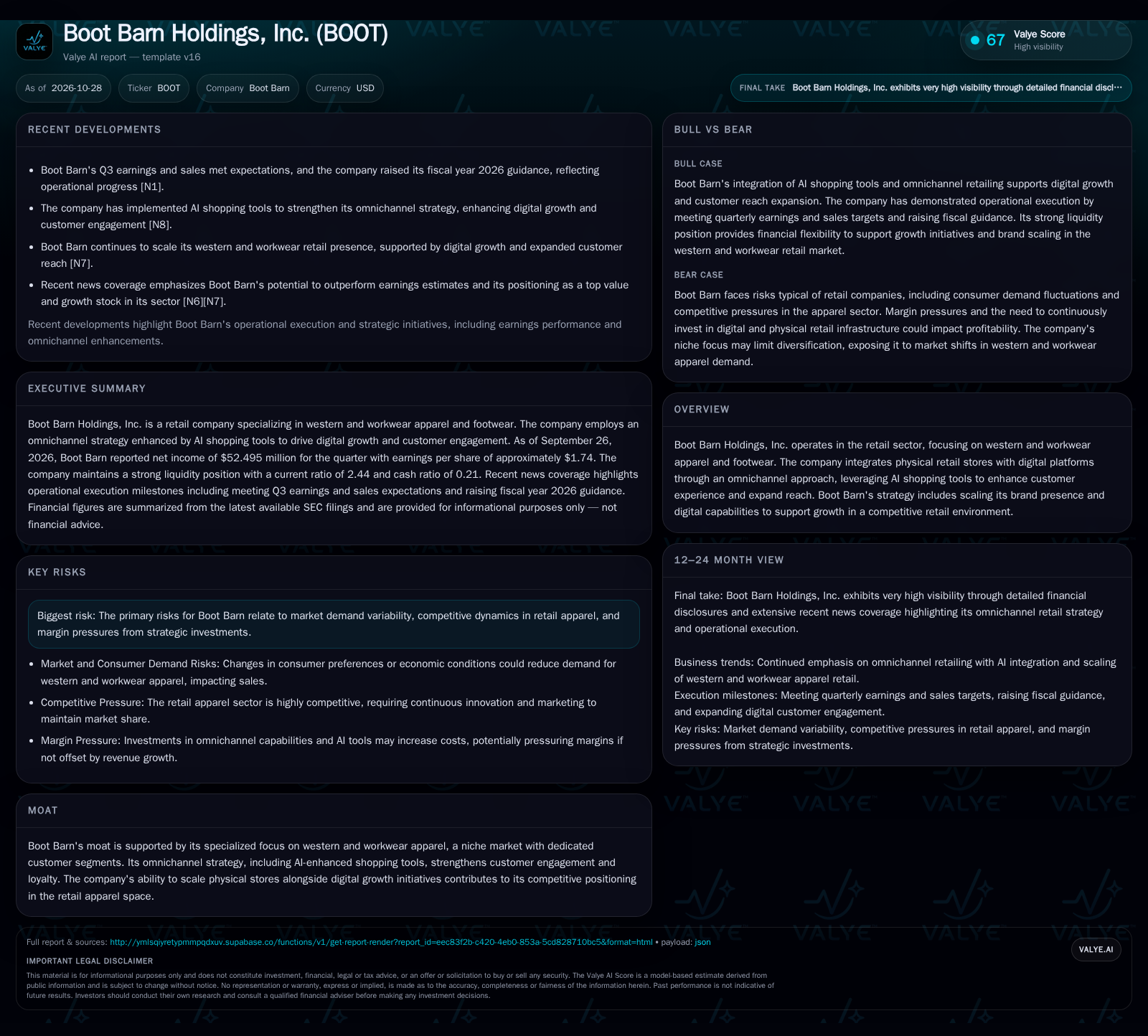
Boot Barn reported $52.5 million in net income for the September 2026 quarter, supported by a 2.44 current ratio and cash above $97 million. The company’s investment in AI shopping tools and a robust omnichannel platform aims to expand its reach in the western and workwear apparel segment. Success will depend on translating digital engagement into store and online sales while managing margin pressures and sector competition. Key variables include consumer demand, tech ROI, and the durability of Boot Barn’s niche focus. [S2] [N8]
Boot Barn Holdings, Inc. has emerged as a notable player in specialty retail by doubling down on western and workwear apparel and footwear—navigating the evolving landscape with a blend of physical stores, digital platforms, and recent AI-powered shopping tools. In the September 2026 quarter, Boot Barn delivered strong profitability and maintained a reported liquidity position. Yet, as the company invests in technology and omnichannel expansion, the real test will be whether this strategy can drive sustained growth, defend margins, and outmaneuver both traditional competitors and digital-native threats. The next year will reveal whether Boot Barn’s blend of tech and niche retailing is a formula for durable advantage or leaves it exposed to the sector’s structural risks.
Strong Quarter, Digital Push, and Financial Cushion Define Today’s Boot Barn
Boot Barn reported net income of $52.495 million for the quarter ended September 26, 2026, translating to basic EPS of $1.74. This performance underscores ongoing profitability amid continued investment in technology and omnichannel retailing. The company ended the quarter with $97.416 million in cash and cash equivalents, current assets of $1.124 billion, and current liabilities of $460.717 million, resulting in a current ratio of 2.44. The recent rollout of AI shopping tools is a headline development, with Boot Barn aiming to enhance digital engagement and customer experience as part of its omnichannel strategy. [S2] [N8]
How Boot Barn’s Omnichannel Model Could Drive Profitable Scale
Boot Barn’s economics rely on the interplay between physical retail volume, digital sales growth, and product mix in a niche category. The company’s core revenue comes from selling western and workwear apparel and footwear—categories characterized by moderately higher average transaction values and potential for brand loyalty, but also by exposure to cyclical and regional demand. The omnichannel approach, now enhanced by AI shopping tools, could improve conversion rates and basket sizes online, while also supporting in-store traffic through digital engagement. If AI personalization and cross-channel integration drive up customer lifetime value or reduce acquisition costs, operating leverage may improve as digital investments scale across the store base.
Fixed costs—rent, store labor, technology investment—are significant, but incremental sales from digital channels could expand margins if the company successfully leverages its infrastructure. However, ongoing capital is required for store expansion, technology upgrades, and supply chain adaptation. Margin preservation will depend on Boot Barn’s ability to offset higher technology spend with increased sales and efficiency, as well as on managing inventory and markdown risks endemic to apparel retail.
Specialization Versus Scale: Boot Barn’s Place in a Fragmented Retail Landscape
Boot Barn’s competitive position rests on its deep focus in the western and workwear segment—a specialty that may foster brand loyalty and repeat purchases, especially in underserved regions. This niche focus differentiates Boot Barn from broader apparel retailers and big-box chains, but it also means exposure to category-specific demand risks and less diversification. The company faces competition from national chains, local specialty stores, and increasingly, digital-native brands targeting the same customer base.
Omnichannel and AI investments could help Boot Barn defend share against both brick-and-mortar and e-commerce rivals, especially if they translate into superior customer experience and retention. However, the ease of online apparel discovery and price comparison puts pressure on margins and makes loyalty programs and brand affinity critical. Substitution risk remains: if fashion trends shift away from western/workwear or if larger players invest more heavily in digital, Boot Barn’s moat could erode. The question is whether its category expertise and community connections can sustain differentiation as the digital landscape matures.
If AI and Omnichannel Integration Unlock New Growth Engines
In a favorable scenario, Boot Barn’s investment in AI shopping tools and integrated omnichannel experiences leads to measurable gains in customer acquisition, retention, and average order value. Enhanced personalization increases conversion rates both online and in-store, while data-driven inventory management reduces markdowns and stockouts. These effects, in turn, drive higher sales growth at attractive incremental margins, allowing Boot Barn to scale its store base and digital platform efficiently.
Evidence that would confirm this scenario includes sustained above-peer revenue growth, improving gross and operating margins despite increased tech spend, and public disclosure of higher digital sales penetration or customer retention rates. New store openings that show rapid ramp-up, or data demonstrating improved customer engagement from AI tools, would also support the upside case. [N8]
Blending Incremental Digital Gains with Category Cyclicality
The most plausible trajectory is that Boot Barn continues to see steady but not breakout growth, with omnichannel and AI enhancements delivering incremental improvements in customer engagement and operational efficiency. The company maintains profitability and a reported liquidity position, balancing ongoing investments with disciplined store expansion and cost management.
Boot Barn’s niche positioning supports a core customer base, but growth rates may moderate as digital-native and traditional competitors adapt. The company could face periodic margin pressure from promotional activity or inventory missteps, but these are managed within historical norms. Confirmation of this scenario would include continued positive net income, stable or slightly improving margins, and regular updates on omnichannel progress without dramatic inflection points. [S2] [N6]
Consumer Weakness or Tech ROI Shortfall Could Pressure Margins and Growth
In a more adverse scenario, Boot Barn’s investments in AI and omnichannel do not yield the expected sales lift or cost efficiencies. Consumer demand in the western and workwear segment softens, perhaps due to macroeconomic pressures or shifting fashion trends. Competitive promotions intensify, leading to margin erosion and potentially excess inventory.
If digital investments become a cost drag without offsetting revenue growth, profitability could decline and the company might need to slow store openings or defer further tech upgrades. Evidence for this case would include declining same-store sales, margin compression, growing inventory balances, or management commentary about delayed returns on digital investments. Material drawdowns in cash or a deteriorating current ratio would also be red flags. [S2]
Milestones That Will Reveal the Strength of Boot Barn’s Digital and Category Strategy
Track disclosed digital sales growth rates and penetration as a percentage of total revenue, as these will indicate whether omnichannel and AI investments are translating into tangible results.
Monitor gross and operating margins for signs that technology and store investments are yielding efficiencies, or conversely, increasing cost pressure.
Watch for changes in same-store sales (comparable sales), particularly in the context of broader apparel and specialty retail trends.
Examine inventory levels and turnover rates—rising inventory or slower turns could signal demand softness or misalignment between digital forecasts and actual sales.
If disclosed, follow metrics around customer retention, loyalty program participation, and customer acquisition cost to gauge the impact of AI-driven personalization.
Pay attention to the pace and performance of new store openings, especially in new geographic markets or digital-first formats.
Assess any management commentary or disclosures about the ROI of AI and omnichannel projects, including pilot results or planned rollouts.
Disclaimer: This is research-only, informational analysis and not investment advice. It may include AI-generated interpretation and general industry context. Always verify important details using primary sources.

Comments