
BriaCell Therapeutics: Clinical Progress, Delivery Innovation, and the Realities of Biotech Economics
BriaCell’s pivotal Phase 3 breast cancer program and FDA Fast Track status provide a visible near-term catalyst, but clinical, competitive, and funding uncertainties remain central to the company’s outlook. New biomarker data, delivery partnerships, and a diversified pipeline offer optionality, yet the path to commercial viability hinges on trial outcomes, regulatory milestones, and the ability to sustain operations through further capital raises.
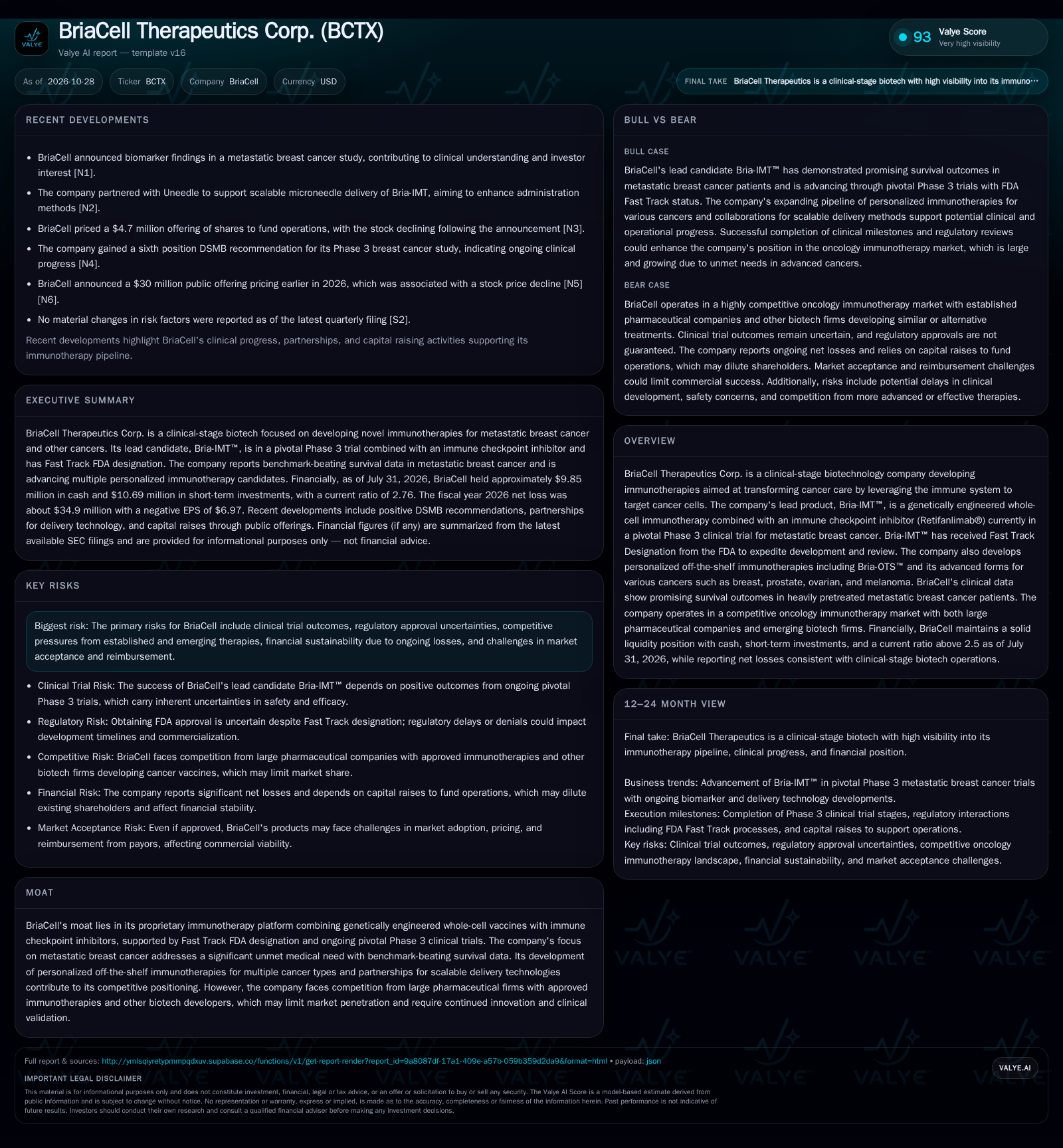
BriaCell Therapeutics’ lead immunotherapy, Bria-IMT™, is in pivotal Phase 3 trials for metastatic breast cancer with FDA Fast Track designation and promising survival data. Recent biomarker findings and partnerships for scalable delivery aim to enhance the clinical and commercial proposition. However, ongoing net losses, reliance on equity raises, and competition from large pharma and other biotechs underscore the high-risk, high-reward dynamics typical of clinical-stage oncology platforms. The next 12-24 months hinge on trial results, regulatory progress, and execution on funding and delivery innovation. [S1] [N1] [N2] [N4]
BriaCell Therapeutics sits at a critical intersection of clinical advancement and financial constraint. Its flagship immunotherapy, Bria-IMT™, has reached the pivotal Phase 3 stage in metastatic breast cancer, bolstered by FDA Fast Track designation and survival data that exceed historical benchmarks. Recent biomarker findings and partnerships for innovative delivery underscore the company’s bid to stand out in a fiercely competitive landscape. Yet, as is typical for clinical-stage biotechs, BriaCell confronts substantial net losses and an ongoing need for external capital, making the outcome of its late-stage trials and regulatory interactions the defining variables for future value.
Pivotal Trial Progress, Funding Events, and Clinical Differentiators in Focus
BriaCell Therapeutics’ lead asset, Bria-IMT™, is undergoing a pivotal Phase 3 trial in metastatic breast cancer, with FDA Fast Track designation providing regulatory visibility and potential for expedited review. Median overall survival in treated patients has reached 13.3 months, notably exceeding benchmarks from prior studies and literature, which could position Bria-IMT™ as a differentiated option if these results are replicated in the full trial population. [S1]
These offerings raised funds but were met with stock price declines, illustrating market wariness around dilution and funding risk. [S1] [N3] [N5] [N6]
Recent operational highlights include new biomarker findings in metastatic breast cancer, a partnership with Uneedle to develop scalable microneedle delivery for Bria-IMT™, and a sixth DSMB recommendation for ongoing clinical progress in the pivotal study. [N1] [N2] [N4]
Biotech Cost Structures, Commercial Leverage, and Funding Dependencies
BriaCell’s economic model is defined by the high fixed costs of clinical development, regulatory engagement, and pipeline advancement, with minimal near-term revenue and heavy reliance on external capital. The company’s net loss of approximately $34.9 million for the fiscal year ending July 31, 2026, is typical for clinical-stage biotechs, reflecting R&D intensity and the absence of commercial sales. [S1]
If Bria-IMT™ achieves approval, commercial economics would depend on pricing power in metastatic breast cancer—a large but competitive market. In oncology, high pricing is plausible for therapies that extend survival or address unmet needs, but payer scrutiny and value-based reimbursement models may constrain realized revenues. Volume uptake would be governed by clinical differentiation, provider adoption, and, critically, inclusion in treatment guidelines and payer formularies.
The partnership with Uneedle for microneedle delivery may offer operational leverage if it enables lower-cost, outpatient administration or improves patient adherence, but the commercial impact will depend on successful clinical validation and regulatory acceptance. Pipeline breadth, with additional candidates in early-stage development, provides optionality but also requires continued capital investment, extending the period before meaningful operating leverage could be achieved.
BriaCell’s Place in the Oncology Immunotherapy Arms Race
BriaCell competes in one of the most crowded and capital-intensive segments of biopharma: cancer immunotherapy. Its proprietary platform—combining a genetically engineered whole-cell vaccine with checkpoint inhibition—offers a mechanistic rationale for synergy and potential efficacy in heavily pretreated patients. The FDA Fast Track designation and early survival signals provide some differentiation, but established pharmaceutical companies already market checkpoint inhibitors and cell-based therapies with deep commercial and clinical infrastructure.
Emerging competitors include other biotechs pursuing cancer vaccines, neoantigen-targeted immunotherapies, and alternative cell-based approaches. Switching costs for providers are low in oncology—adoption is driven by data, guidelines, and payer coverage rather than platform loyalty. Therefore, BriaCell’s sustainable advantage will hinge on robust late-stage efficacy, safety, and, if approved, operational execution in manufacturing, distribution, and clinician education.
Personalized off-the-shelf candidates (Bria-OTS™ and derivatives) could be a future differentiator if they demonstrate scalable efficacy across multiple tumor types, but these programs remain at an early stage and face similar competitive headwinds.
If Phase 3 Data Surpasses Benchmarks and Delivery Innovation Drives Uptake
The most favorable scenario for BriaCell would see the pivotal Phase 3 trial of Bria-IMT™ confirming or exceeding the current median overall survival advantage, leading to regulatory approval and rapid inclusion in clinical guidelines. Fast Track status could accelerate the review process, allowing for earlier market entry. If the partnership with Uneedle enables a differentiated, patient-friendly delivery method, BriaCell could carve out a niche in outpatient oncology settings, potentially expanding addressable market share.
Additional upside could be unlocked if biomarker findings allow for effective patient stratification, improving response rates and supporting premium pricing. The progress of Bria-OTS™ and related candidates into later-stage trials would bolster the pipeline and reduce single-asset risk.
Confirmation for this scenario would come from positive top-line Phase 3 data, favorable regulatory milestones, early commercial traction, and clear evidence of payor support and clinician adoption.
Clinical Readouts, Dilution, and the Standard Biotech Slog
The most plausible trajectory is that BriaCell continues its clinical development with Bria-IMT™ showing some degree of benefit but facing the typical challenges of oncology biotechs: regulatory delays, incremental data updates, and ongoing cash burn. The company is likely to require further equity raises to fund operations through regulatory decision points, resulting in continued dilution for existing shareholders.
Commercialization, if achieved, would be gradual; market penetration would depend on head-to-head efficacy against entrenched therapies, payer willingness to reimburse, and the company’s ability to scale manufacturing and distribution. Pipeline assets would advance slowly, with success dependent on both technical milestones and the availability of capital.
This scenario would be confirmed by steady but not transformative clinical progress, a sequence of additional capital raises, and limited near-term revenue. Falsification would require either a major regulatory setback or, conversely, unexpectedly rapid and decisive clinical success.
When Clinical or Regulatory Setbacks Compound Funding Pressure
In a negative scenario, Bria-IMT™ fails to demonstrate sufficient efficacy or safety in Phase 3, leading to regulatory rejection or the need for additional costly trials. With no commercial-stage products, BriaCell would be forced to rely on increasingly dilutive capital raises, potentially at distressed valuations, or seek strategic alternatives such as licensing, asset sales, or M&A under unfavorable terms.
Competition could intensify if rival therapies report superior data or gain guideline inclusion, further eroding BriaCell’s potential market position. Failure to advance pipeline candidates or secure follow-on partnerships would heighten single-asset risk and reduce optionality.
Evidence for this scenario would include negative or inconclusive clinical readouts, FDA clinical holds or rejections, significant delays in trial enrollment, or difficulty in raising capital on acceptable terms.
Milestones That Will Define BriaCell’s Value Creation Potential
Top-line Phase 3 efficacy and safety results for Bria-IMT™ in metastatic breast cancer, as these will determine regulatory and commercial prospects.
Regulatory interactions and timelines, including FDA feedback, acceptance of filings, and progression under Fast Track designation.
Evidence of payer coverage and pathway to reimbursement, as this will drive real-world adoption if approval is achieved.
Uptake and operational viability of the microneedle delivery platform, with a useful metric being the proportion of patients transitioned to this method (if disclosed).
Sequencing and outcomes of further public offerings or alternative financing events, as these affect dilution and runway.
Advancement and clinical data from pipeline assets beyond Bria-IMT™, particularly Bria-OTS™ and its derivatives.
Any strategic partnerships, out-licensing deals, or M&A activity that could provide non-dilutive funding or accelerate commercialization.
Patient stratification and biomarker-driven subgroup analyses, as these could support targeted approvals or pricing strategies.
Disclaimer: This is research-only, informational analysis and not investment advice. It may include AI-generated interpretation and general industry context. Always verify important details using primary sources.

Comments