
Flexsteel Industries: Blending Manufacturing Flexibility with Innovation Ambitions in a Fragmented Furniture Market
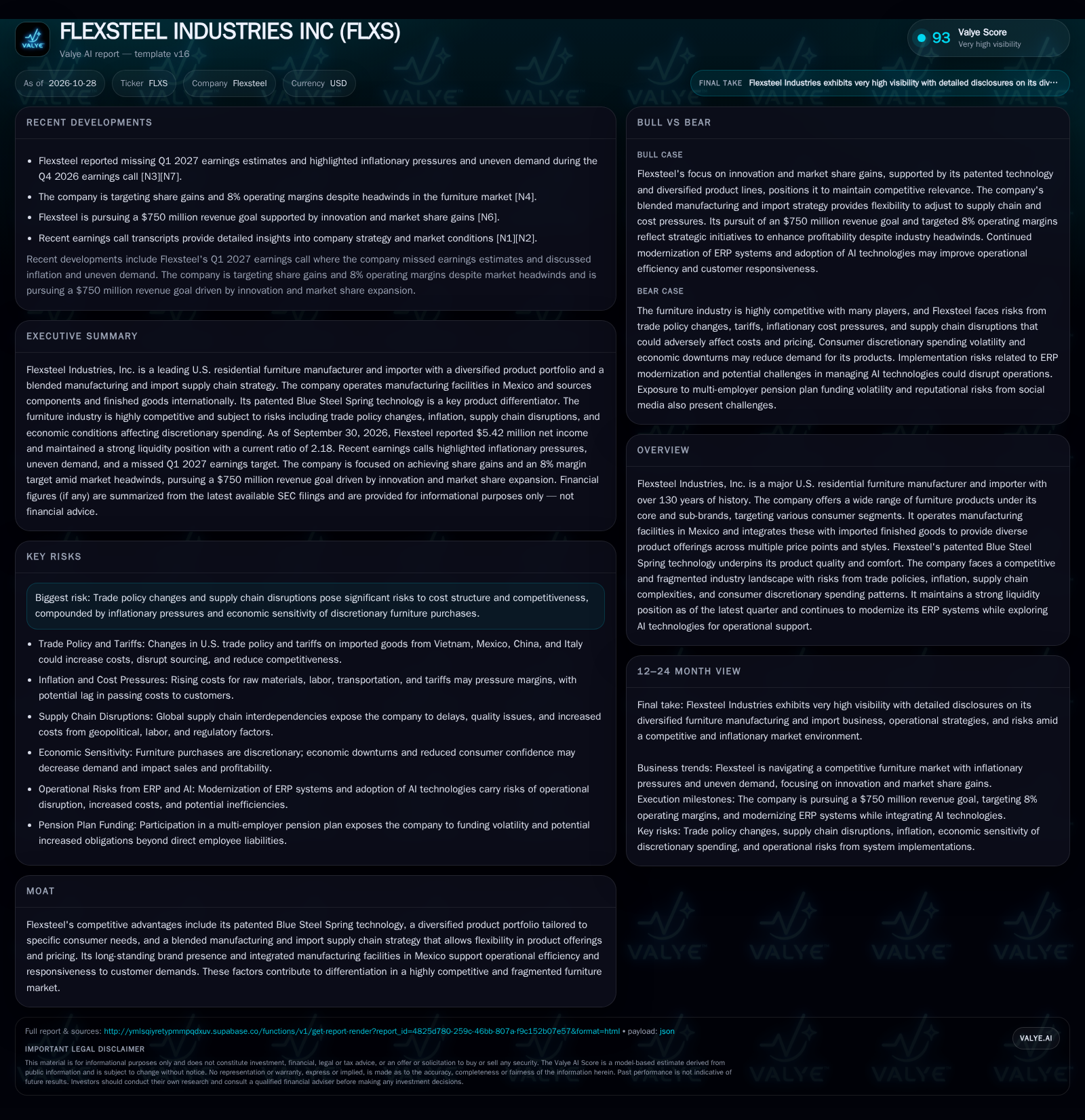
Flexsteel Industries is pursuing an ambitious $750 million revenue target and 8% operating margins in a challenging environment defined by inflation, trade policy risk, and intense competition. Its approach leverages a hybrid manufacturing-import model, patented product technology, and operational modernization—but future performance will hinge on execution, cost discipline, and consumer demand resilience.
Flexsteel Industries is targeting market share gains and improved margins despite a tough furniture retail landscape. The company’s mix of Mexican manufacturing, global sourcing, and patented Blue Steel Spring technology underpins its value proposition. However, risks around trade policy, supply chains, and discretionary spending could challenge its $750 million revenue goal and profitability ambitions. Monitoring execution on innovation, ERP modernization, and cost structure will be critical for investors evaluating its long-term competitiveness. [S1] [S2] [N4] [N6]
Flexsteel Industries stands at an inflection point in the U.S. residential furniture market, seeking to leverage its hybrid manufacturing and import model, brand equity, and patented product features to gain share and improve profitability. The company’s $750 million revenue ambition and 8% margin target contrast with the backdrop of inflation, trade volatility, and erratic consumer demand. With ongoing investments in ERP modernization and AI evaluation, Flexsteel’s near-term performance—and its ability to realize its strategic goals—will depend on operational execution and the resilience of consumer spending.
Flexsteel’s Strategic Priorities and Financial Position in Late 2026
As of September 30, 2026, Flexsteel reported net income of $5.42 million for the quarter, with basic EPS at $1.32 and diluted EPS at $1.24. The company’s balance sheet showed cash and equivalents of $4.41 million, current assets of $148.45 million, and current liabilities of $67.96 million, resulting in a current ratio of 2.18. [S2] Flexsteel is actively targeting share gains and an 8% operating margin, while pursuing a $750 million revenue goal through innovation and market share expansion. [N4] [N6] These ambitions are set against a backdrop of persistent inflation, supply chain complexity, and discretionary spending headwinds in the furniture sector. The company’s operational strategy is further shaped by its ongoing ERP modernization and its evaluation of AI technologies for business functions. [S1]
How Flexsteel’s Hybrid Supply Chain and Product Differentiation Shape Its Profit Model
Flexsteel’s business model blends in-house manufacturing—primarily in Mexico—with the importation of finished goods and components from Asia and other regions. This hybrid approach allows Flexsteel to offer a wide range of furniture products across various price points and styles, providing flexibility to shift sourcing in response to cost, trade, or demand changes. [S1] The company’s patented Blue Steel Spring technology is a product-level differentiator that may support premium pricing and longer product life cycles, potentially reducing warranty costs and customer churn.
In terms of cost structure, key variables include raw material and labor costs (both subject to inflation and trade policy risks), freight and logistics expenses, and the relative mix of higher-margin proprietary products versus lower-margin imported goods. A shift toward higher-value, differentiated offerings could strengthen margins if Flexsteel can maintain sufficient volume and avoid excessive discounting. Operating leverage may be achievable if revenue growth outpaces increases in fixed costs (manufacturing, SG&A), particularly as ERP and AI investments are amortized over a larger revenue base.
The company reported cash and liquidity metrics for the period; these figures do not by themselves establish operating runway, investment capacity, financial flexibility, or financing capacity. [S2] Participation in a multi-employer pension plan introduces potential funding volatility, which could affect future cash needs. [S1]
Navigating a Fragmented Market: Differentiation and Persistent Industry Pressures
Flexsteel operates in a highly fragmented U.S. residential furniture market, facing competition from both large national brands and numerous regional and foreign manufacturers and distributors. [S1] Key competitive dimensions include product style, quality, comfort, price, delivery reliability, customer service, and durability. The company’s Blue Steel Spring is a unique product attribute, but the durability and comfort claims must continually resonate with consumers to justify pricing power or brand loyalty.
The hybrid supply chain offers some agility relative to competitors who are either fully domestic manufacturers (with higher fixed costs) or pure importers (with greater exposure to shipping risk and tariffs). However, this flexibility is double-edged: it provides options but also exposes the company to cross-border logistics complexity and global cost shocks. Brand equity built over 130 years supports Flexsteel’s positioning, but in a market where style cycles are fast and consumer preferences shift, maintaining relevance requires ongoing innovation and marketing investment.
Category peers include other U.S.-based furniture makers with hybrid or global supply chains, as well as private-label importers serving big-box retailers and e-commerce furniture specialists. The absence of material seasonality in Flexsteel’s business reduces inventory risk compared to peers exposed to cyclical homebuying or promotional events. [S1]
Margin Expansion and Share Gains Through Innovation and Operational Discipline
The most favorable scenario for Flexsteel involves a sustained recovery in U.S. home-related spending, allowing the company to execute on its $750 million revenue ambition while achieving or exceeding its 8% operating margin target. [N4] [N6] This outcome would likely require the successful launch of new or refreshed product lines that leverage the Blue Steel Spring differentiation, effective marketing to drive consumer preference, and further penetration into higher-margin channels.
Operationally, a smooth ERP system rollout and the targeted use of AI to improve demand forecasting, inventory management, or customer service could yield cost savings and support margin expansion. The blended supply chain could allow Flexsteel to quickly adapt to input cost changes or trade shocks, maintaining service levels while competitors stumble.
Evidence confirming this scenario would include sequential revenue growth significantly above industry averages, margin uplift despite inflationary trends, positive commentary from channel partners or major retailers, and clear disclosure of cost savings or efficiency gains from ERP/AI initiatives. If the company demonstrates a sustained ability to pass through cost increases without sacrificing volume, or if it secures new large-scale contracts, the upside thesis strengthens.
Balancing Growth Ambitions Against Sector Headwinds and Execution Risks
The most plausible scenario is one where Flexsteel manages modest revenue growth and incremental margin improvement, but progress toward its $750 million revenue and 8% margin goals is gradual. The company continues to face a volatile demand environment, with consumer discretionary spending recovering unevenly and competitors aggressively discounting to maintain share.
Incremental benefits from ERP modernization and AI adoption are realized, but may be offset by ongoing inflation in input and logistics costs. Flexsteel’s hybrid supply chain allows for some cost mitigation, but not enough to fully insulate margins. Occasional supply chain or trade disruptions cause periodic gross margin volatility. The brand retains relevance, but market share gains are limited by the fragmented landscape and the pace of consumer style shifts.
Indicators supporting this scenario would include revenue growth roughly in line with industry averages, operating margins improving but remaining below the 8% target, and neutral to cautious management commentary on the pace of innovation payback or market share capture. Any ERP or AI implementation hiccups could delay the realization of cost or efficiency benefits.
Cost Shocks, Demand Weakness, and Operational Disruption Undermine Progress
In a negative scenario, Flexsteel faces a convergence of adverse factors: a downturn in consumer discretionary spending, a spike in input costs (raw materials, labor, freight), and significant supply chain disruptions—potentially related to changes in U.S. trade policy or geopolitical events. These pressures erode gross margins and force discounting to maintain sales volumes.
If the ERP modernization encounters significant implementation challenges, or if AI adoption introduces inefficiencies or unforeseen costs, operational disruptions could further compress profitability and strain working capital. [S2] [S1]
Confirmation of this scenario may come via declining or flat revenues, margin compression, negative free cash flow, unexpected write-downs or inventory adjustments, and management guidance cuts. External signals could include deteriorating industry demand metrics, rising trade barriers, or reports of customer/channel attrition due to service or delivery problems.
What Will Determine Flexsteel’s Progress Toward Its Margin and Growth Goals?
Quarterly gross and operating margin trends, especially relative to the 8% target, will indicate whether Flexsteel’s cost and innovation initiatives are gaining traction.
Progress toward the $750 million revenue goal, including year-over-year revenue growth rates and any commentary on market share changes. [N6]
Updates on ERP modernization milestones and any quantified cost savings or operational improvements attributed to the new system.
Evidence of successful AI adoption, such as measurable improvements in supply chain efficiency, customer satisfaction, or SG&A leverage.
Shifts in the product mix toward higher-margin, differentiated offerings, or new product launches leveraging the Blue Steel Spring technology.
Management commentary or external data on consumer demand for residential furniture, particularly in relation to inflation and macroeconomic conditions.
Incidence and impact of supply chain disruptions, trade policy changes, or freight/logistics cost spikes on product availability and gross margin.
Disclaimer: This is research-only, informational analysis and not investment advice. It may include AI-generated interpretation and general industry context. Always verify important details using primary sources.

Comments